
Clarifion Air Ionizer: Models Compared by Filtration

For a filterless Clarifion air ionizer, the Clarifion three-pack is the closest fit because it uses negative ions without replacement filters. Choose the DSTx instead if you want a Clarifion model that also includes a HEPA filter; generic plug-in ionizers are alternatives rather than Clarifion models.
Plug-in ionizers are compact devices that release charged ions into room air, while HEPA filters physically capture particles. Neither type should replace source control or ventilation when those are needed.
We earn a commission if you buy through links on this page. As an Amazon Associate I earn from qualifying purchases. Products are compared on manufacturer specifications, not hands-on testing.
- Best overall: Clarifion Home Air Ionizers, 3-Pack – This Clarifion three-pack uses negative ions and does not require replacement air filters.
- Best for HEPA filtration: Clarifion DSTx Portable Air Purifier – The Clarifion DSTx combines negative-ion technology with a HEPA filter.
- Best for a compact single unit: Ion Pure Plug-In Air Purifier – Ion Pure is a single, filterless plug-in ionizer intended for several room types.
| Product | Best for | Filtration | Pack size | Form | Shop |
|---|---|---|---|---|---|
| Clarifion Home Air Ionizers, 3-Pack | Filterless ionizing | Negative ions; no filter | 3 units | Plug-in ionizer | Check Price on Amazon |
| Clarifion DSTx Portable Air Purifier | Ionizer plus HEPA | Negative ions and HEPA | 1 unit | Plug-in purifier | Check Price on Amazon |
| Plug-In Air Ionizers, 4-Pack | Four-room placement | Negative ions; no filter | 4 units | Plug-in ionizer | Check Price on Amazon |
| Air Ionizers, 4-Pack | Multi-room ionizing | Negative ions; no filter | 4 units | Plug-in ionizer | Check Price on Amazon |
| Ion Pure Plug-In Air Purifier | Single-room ionizing | Negative ions; no filter | 1 unit | Plug-in ionizer | Check Price on Amazon |
Clarifion Air Ionizers and Alternatives
Compare the Clarifion models with related plug-in ionizers by filtration method and pack configuration.
Clarifion Home Air Ionizers, 3-Pack

The Clarifion three-pack is the filterless Clarifion option here, with negative-ion technology and no replacement air filter. The manufacturer recommends placing at least one unit in each room where it is used, including bedrooms, bathrooms, kitchens and living rooms. Its compact plug-in format suits buyers who want multiple small units rather than a large purifier. The tradeoff is that this model has no HEPA filter, so it is a less suitable choice for shoppers specifically seeking a device that physically captures airborne particles.
Bottom line: Choose this if you want a multi-room Clarifion ionizer without replacement filters.
Clarifion DSTx Portable Air Purifier
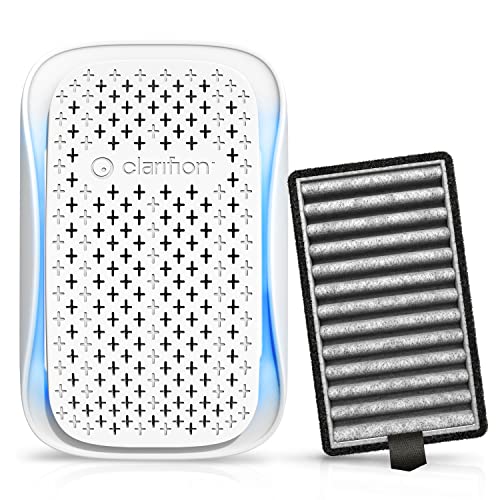
The Clarifion DSTx differs from the filterless model by pairing negative ions with a HEPA filter. Its product features say it may help with airborne dust, smoke, pet dander and odors, and the manufacturer recommends placing it near windows and doors. The main limitation is its single-unit configuration, which may not suit someone planning to place a device in several rooms at once.
Bottom line: Pick this if you want a Clarifion unit that adds a HEPA filter.
Plug-In Air Ionizers, 4-Pack

This generic four-pack offers one more unit than the Clarifion three-pack and is described as a filterless negative-ion device for rooms such as bedrooms, offices and garages. Its features emphasize quiet operation and portability, making it a related alternative for buyers who want several outlet-powered units. Choose another type if physical particle filtration is the deciding requirement.
Bottom line: Choose this alternative when four plug-in units matter more than a Clarifion name.
Air Ionizers, 4-Pack

This four-pack is another generic ionizer option, with features specifically describing negative ions that attach to smoke, dust, pollen and odors. Its multi-unit format is aimed at refreshing several spaces, including bedrooms, kitchens and home offices, and it is described as low-noise. The product features also mention an energy-efficient internal chip, but provide no power figure to compare. Like other ionizer-only options, it is not the right match for someone whose priority is a HEPA filter that captures particles.
Bottom line: Pick this for a four-unit setup with low-noise operation as a priority.
Ion Pure Plug-In Air Purifier

Ion Pure is a single compact plug-in ionizer rather than a Clarifion model, and its features describe filterless negative-ion technology for rooms including kitchens, bedrooms and bathrooms. That one-unit setup may fit a buyer who wants to try an ionizer in a particular room before choosing a multi-pack. The tradeoff is that the product features do not describe a HEPA filter or multiple units. It is therefore a weaker fit for shoppers who need mechanical particle filtration or a ready-made multi-room set.
Bottom line: Choose this if you want one compact ionizer for a particular room.
How to choose a plug-in air ionizer
Start by deciding whether you want ions alone or a device that also filters particles. An ionizer releases charged particles; a HEPA filter physically captures particles as air passes through its media. The familiar HEPA benchmark is 99.97% capture of particles at 0.3 microns under specified test conditions, but that figure applies to the filter, not to an ionizer by itself. For a bedroom or other occupied room, do not treat a small plug-in unit as a substitute for ventilation or a properly sized purifier. A practical rule is to choose a model with HEPA filtration when particle capture is the priority; choose filterless ionizing only when that distinction is acceptable.
How many plug-in units should you use
Room count is a more useful starting point than pack size alone: a multi-pack makes sense only if each unit can be placed in a room where it has open space around the outlet. Air cleaners are ordinarily sized by clean air delivery rate (CADR) relative to room area; a common sizing benchmark is CADR at least two-thirds of the room’s square footage for an 8-foot ceiling. Plug-in ionizers without a CADR cannot be compared against that sizing rule. Keep units away from blocked outlets, curtains and furniture, and do not assume that one small device covers an entire home.
Ionizers and ozone safety
Ozone is a lung irritant, and the EPA advises against using ozone generators in occupied spaces; some ionizing air cleaners can produce ozone as a byproduct. A manufacturer’s statement about ozone emissions or certification is not the same as proof that a unit removes particles effectively. If ozone emissions are a concern, confirm the exact model’s certification status with the relevant California Air Resources Board certified air-cleaning device directory before purchase. Avoid operating an ozone-generating device around people or pets, and favor filtration and ventilation for routine indoor air management.
What ionizers do with airborne particles
Ionizers charge particles so they may clump together or settle on room surfaces, rather than trapping them in a disposable filter. That means dust can remain on furniture and may be stirred back into the air during cleaning. A HEPA-equipped device adds a physical capture step, but its effectiveness in a room depends on airflow and sizing, not simply the presence of a filter. For smoke or fine dust, prioritize a purifier with a suitable CADR and a clearly described particle filter; avoid choosing on claims about odor alone.
Frequently Asked Questions
Do plug-in ionizers remove dust from a room?
Ionizers can charge airborne dust so it settles onto surfaces, but that does not capture it in a filter. Dust may become airborne again during movement or cleaning, so a HEPA purifier is a better fit when particle capture is the goal.
Can an air ionizer produce ozone indoors?
Some ionizing air cleaners can produce ozone as a byproduct, and ozone can irritate lungs. Check the exact model’s emissions certification before using it in an occupied room.
What does a HEPA filter capture?
A HEPA filter is generally benchmarked to capture 99.97% of 0.3-micron particles under specified test conditions. Room-level performance also depends on purifier airflow and whether its capacity suits the room.
Where should a plug-in ionizer sit in a room?
Place a plug-in unit in an open outlet location rather than behind furniture or curtains, where airflow can be blocked. Keep it clear of fabrics and follow the product’s electrical safety instructions.
Should an ionizer replace opening windows?
No; an ionizer does not replace ventilation or removing the source of smoke, odor or dust. When outdoor air is suitable, ventilation can dilute indoor pollutants while filtration handles particles circulating indoors.