
Coconut Oil Trader Joe’s: 3 Options Compared

Trader Joe’s Organic Virgin Coconut Oil, 16 oz is the closest match for shoppers seeking Trader Joe’s coconut oil because it is a 16-ounce organic virgin oil marked cold-pressed and unrefined.
We earn a commission if you buy through links on this page. As an Amazon Associate I earn from qualifying purchases. Products are compared on manufacturer specifications, not hands-on testing.
- Best overall: Trader Joe’s Organic Virgin Coconut Oil, 16 oz – A 16-ounce organic virgin coconut oil marked cold-pressed and unrefined.
- Best for multiple jars: Trader Joe’s Coconut Oil, 3 Jars – The pack contains three 15.99-ounce jars.
- Best for gram sizing: Trader Joe’s Organic Virgin Coconut Oil, 473 g – The package size is given as 473 grams.
| Product | Best for | Type | Package size | Shop |
|---|---|---|---|---|
| Trader Joe’s Organic Virgin Coconut Oil, 16 oz | Virgin oil choice | Virgin coconut oil | 16 fl oz | Check Price on Amazon |
| Trader Joe’s Coconut Oil, 3 Jars | Three-jar supply | Coconut oil | 15.99 fl oz per jar | Check Price on Amazon |
| Trader Joe’s Organic Virgin Coconut Oil, 473 g | Metric package size | Organic virgin coconut oil | 473 g | Check Price on Amazon |
Trader Joe’s Coconut Oil Options
Compare the edible coconut oils by processing claims and package quantity before choosing a jar or multi-pack.
Trader Joe’s Organic Virgin Coconut Oil, 16 oz
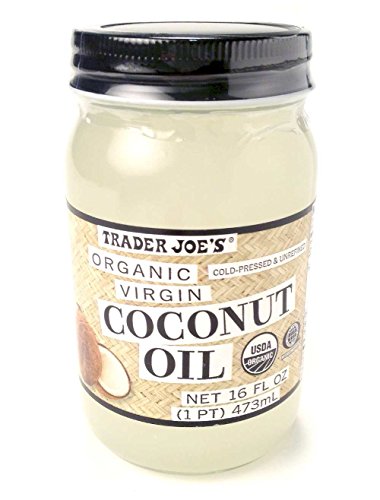
Trader Joe’s Organic Virgin Coconut Oil, 16 oz is the only option here whose product name and features identify organic virgin coconut oil and explicitly call it cold-pressed and unrefined. The single jar contains 16 fluid ounces, and the features also identify it as kosher. It suits shoppers who want those processing attributes in a one-jar size. The limitation is quantity: buyers looking to stock several jars at once may prefer the three-jar pack instead.
Bottom line: Pick this if organic virgin oil and the cold-pressed, unrefined claims are your priorities.
Trader Joe’s Coconut Oil, 3 Jars

Trader Joe’s Coconut Oil, 3 Jars stands apart by bundling three jars, each with a size of 15.99 fluid ounces. That makes the package a straightforward choice when you want multiple containers rather than a single jar. Consider storage space and how quickly you expect to use three jars.
Bottom line: Choose this when a three-jar pack matters more than a specific processing claim.
Trader Joe’s Organic Virgin Coconut Oil, 473 g

Trader Joe’s Organic Virgin Coconut Oil, 473 g is the metric-sized Trader Joe’s organic virgin coconut oil option, with a package quantity of 473 grams. Its features also mention cooking use as a butter alternative, while its name identifies it as a parallel-import product. That makes it relevant to shoppers seeking the Trader Joe’s product in a gram-denominated package.
Bottom line: Pick this if the 473-gram package and organic virgin type are the fit you want.
How to Choose Coconut Oil for Cooking
For cooking, choose virgin coconut oil when you want coconut flavor, and refined coconut oil when a more neutral flavor is the goal. Virgin coconut oil typically has a smoke point near 350°F, while refined coconut oil is commonly around 400°F; exact smoke points vary with processing. A practical rule is to use virgin oil for low-to-medium-heat cooking and choose refined oil for hotter cooking when its label confirms the processing type. These options identify virgin oil for Trader Joe’s Organic Virgin Coconut Oil, 16 oz and Trader Joe’s Organic Virgin Coconut Oil, 473 g, while Trader Joe’s Coconut Oil, 3 Jars does not give a processing type. Coconut oil is solid in a cool room and melts as it warms, so account for the change in texture when measuring it into recipes.
Virgin and Refined Coconut Oil Differences
Virgin and refined coconut oils differ chiefly in flavor and processing, not just package size. Virgin oil retains more coconut aroma and taste, making it a natural fit when that flavor suits the dish; refined oil is processed for a more neutral taste. Virgin oil’s typical smoke point is about 350°F, compared with roughly 400°F for refined oil, though processing can shift those figures. Use this comparison to match the oil to the recipe rather than assuming all coconut oil behaves identically.
The table summarizes the practical choice by intended use.
| Type | Typical flavor | Typical smoke point | Good fit |
|---|---|---|---|
| Virgin | Coconut-forward | About 350°F | Low-to-medium heat, coconut flavor wanted |
| Refined | More neutral | About 400°F | Higher heat or less coconut flavor |
How to Measure and Store Coconut Oil
Coconut oil can be solid or liquid depending on room temperature, so measure it in the form your recipe specifies. Its melting point is around 76°F; a cooler kitchen may leave it solid, while a warmer room can make it pourable. For baking, melt solid oil gently and let it cool before combining it with cold ingredients, which can cause it to firm up again. Store coconut oil in a tightly closed container in a cool, dark, dry cupboard, and use a clean, dry utensil to limit moisture and food particles entering the jar. Check the package for its best-by guidance, since storage conditions affect quality.
Frequently Asked Questions
At what temperature does coconut oil melt?
Coconut oil melts at about 76°F, so it is often solid in a cool room and liquid in a warm kitchen. Warm it gently if a recipe needs it melted.
Can virgin coconut oil be used for frying?
Virgin coconut oil can work for lower-heat cooking, but its typical smoke point is around 350°F. For higher-heat frying, refined coconut oil is usually the more suitable type because its typical smoke point is roughly 400°F.
How should an opened jar of coconut oil be stored?
Keep coconut oil tightly closed in a cool, dark, dry cupboard and use a clean, dry utensil. Avoid water or food crumbs in the jar, which can affect the remaining oil.
Can coconut oil replace butter in baking?
Coconut oil can replace butter in some recipes, but it contains no water and behaves differently as it cools. Start with a recipe written for coconut oil or account for the change in moisture and texture.