
Collapsible Walking Sticks for Hiking: 4 Compared

Trekology Trek-Z Cork Grip is the best match for most hikers who want a pair of collapsible walking sticks, with cork grips and a 130-centimeter size. Choose A ALAFEN 7075 Aluminum Pole instead if you need a single pole that folds to 13.4 inches, or Premium Foldable Poles, 100–120 cm if a height-specific adjustable range is a better fit.
Hiking poles are adjustable supports that can help with balance and rhythm on uneven trails; correct length and secure locks matter more than compactness alone.
We earn a commission if you buy through links on this page. As an Amazon Associate I earn from qualifying purchases. Products are compared on manufacturer specifications, not hands-on testing.
- Best overall: Trekology Trek-Z Cork Grip – It is a pair with cork grips and a 130-centimeter size.
- Best for compact packing: A ALAFEN 7075 Aluminum Pole – The single pole folds to 13.4 inches.
- Best for broad adjustment: TrailBuddy 7075 Aluminum Poles – Its length adjusts up to 54 inches and it uses lever locks.
- Best for shorter hikers: Premium Foldable Poles, 100–120 cm – Its 100–120-centimeter range is designated for users 5 feet 9 inches and shorter.
| Product | Best for | Length range | Folded length | Grip and lock | Shop |
|---|---|---|---|---|---|
| Trekology Trek-Z Cork Grip | Pair with cork grips | 51.2 in; range not given | — | Cork; EVA lower grip | Check Price on Amazon |
| A ALAFEN 7075 Aluminum Pole | Compact single pole | 43.3–49.2 in | 13.4 in | EVA foam; quick lock | Check Price on Amazon |
| TrailBuddy 7075 Aluminum Poles | Wide length adjustment | Up to 54 in; range not given | 24.5 in | —; lever locks | Check Price on Amazon |
| Premium Foldable Poles, 100–120 cm | Shorter height range | 39.4–47.2 in | 15 in | Cork and EVA; metal locks | Check Price on Amazon |
Collapsible Walking Sticks for Hiking
Compare pole length, pack size and grip style to find a set that fits your height and trail needs.
Trekology Trek-Z Cork Grip
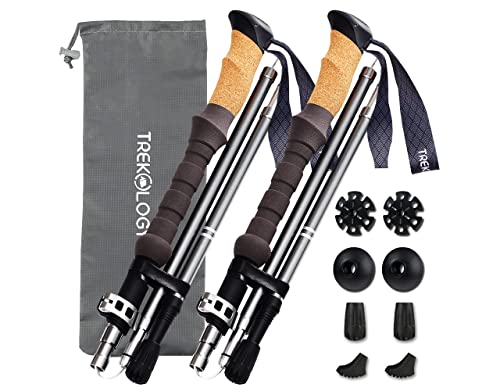
Trekology Trek-Z Cork Grip stands out as a two-pole set with natural cork handles and EVA foam lower grips. Each pole is made with aluminum shafts, and the 130-centimeter size converts to about 51.2 inches. The set includes a carry bag, which suits hikers who want a matched pair for trail balance and travel. Cork can flex slightly in rotation, an ergonomic feature the maker notes; hikers who prefer a rigid-feeling handle may favor foam instead. The maker says the shafts use aircraft-grade aluminum and added metal caps at the joints for rugged terrain.
Bottom line: Choose this pair if cork handles and two matching poles are your priorities.
A ALAFEN 7075 Aluminum Pole

A ALAFEN 7075 Aluminum Pole is the compact single-pole option, folding to 13.4 inches and adjusting from 43.3 to 49.2 inches. Its maker gives a recommended user-height range of 5 feet 3 inches to 6 feet 2 inches. A quick-lock mechanism and measuring scale help set the pole length, while the EVA foam handle has a wrist strap. The shaft is 7075 aluminum; a tungsten-steel rod tip sits under the rubber footing. Because this is one pole rather than a pair, it suits hikers who want one support, not those seeking matching left-and-right poles.
Bottom line: Pick this if you need one pole that packs very short.
TrailBuddy 7075 Aluminum Poles

TrailBuddy 7075 Aluminum Poles differs with a 54-inch maximum length and one-handed lever locks, making quick length adjustments a notable feature. Each pole weighs 9.7 ounces according to the maker and collapses to 24.5 inches. The shafts use 7075 aluminum, and the product is described for hiking, snowshoeing and use by adults or children. That broad maximum length may suit taller users or situations where extra reach is useful, but hikers prioritizing the smallest folded size should consider a shorter-collapsing option. The input calls these trekking poles but does not specify the grip material, so choose based on the confirmed length and lock style.
Bottom line: Choose these for lever locks and a 54-inch maximum reach.
Premium Foldable Poles, 100–120 cm

Premium Foldable Poles, 100–120 cm is the height-specific option for users 5 feet 9 inches and shorter, with an adjustable 100-to-120-centimeter range, or about 39.4 to 47.2 inches. It folds to 15 inches and combines cork and EVA grips with metal locks. The short-version weight is 9.95 ounces, and the shafts are aircraft aluminum. This range is the shortest among the adjustable choices here, which can make fitting easier for shorter hikers; taller hikers should look at the separate 115-to-135-centimeter version instead. The product’s height cutoff is a useful starting point, but actual pole fit still depends on arm length and terrain.
Bottom line: Select this version if its 100–120-centimeter range fits your height.
How to Choose Collapsible Hiking Poles
Start with a pole length that lets your elbow bend about 90 degrees while standing on level ground. On a steep climb, shorten poles by roughly 2 to 4 inches; on a descent, lengthen them by a similar amount if the adjustment range allows. A measured range matters more than a maximum length alone because a pole that cannot shorten enough is awkward on climbs. Choose a pair for balanced support on both sides, or a single pole only if you specifically want one-sided support. Folding size matters most when poles must fit inside a pack; check that the collapsed length fits your bag rather than assuming every folding design is cabin-compatible.
How Pole Length and Fit Work
For an initial fit, stand upright in hiking shoes and set the handle so your elbow sits near a right angle with the tip on level ground. Arm length, footwear, and whether you prefer a higher or lower hand position can shift that setting by an inch or two. Many adjustable trekking poles use telescoping sections, while folding poles rely on joined segments; both should lock firmly before carrying weight. A practical rule is to leave at least 2 inches of adjustment room above and below your usual setting, so you can adapt to climbs and descents. Do not use a pole beyond its marked range or continue if a joint slips under a firm hand check.
Grip, Locks, and Trail Conditions
Grip materials change comfort in different ways: cork can feel less slick with damp hands, while foam is soft and light; neither replaces a secure wrist strap or a properly fitted handle. Lever locks open and close quickly, while twist locks need rotation and can be harder to adjust with cold hands. Before each hike, extend each section and press down firmly on a flat surface to make sure the locks hold. On rock, mud, or snow, choose the tip and basket setup for the surface; small rubber feet are useful on hard ground, while baskets help limit sinking into soft surfaces. Keep pole tips pointed away from other hikers and stow sharp tips when moving through crowded areas.
Frequently Asked Questions
How should hiking poles fit on level ground?
Set the handle so your elbow bends about 90 degrees while you stand upright in your hiking shoes. Adjust by an inch or two for arm length or preference, then confirm that the lock holds under pressure.
Should hiking poles be shorter uphill?
Yes, many hikers shorten poles by about 2 to 4 inches for steep climbs to keep the hands in a comfortable position. Lengthen them by a similar amount for descents when the adjustment range allows.
Are trekking poles allowed in carry-on luggage?
Rules can vary by carrier and airport, so verify before travel rather than assuming folding poles qualify as carry-on items. Trekology Trek-Z Cork Grip’s maker specifically says to check that pair as luggage, not carry it on.
How often should I check hiking pole locks?
Check every lock before each hike and again if a section slips or the pole takes a hard impact. Extend the pole, secure the lock, then press down firmly on a flat surface before relying on it.
Do hiking poles need baskets for every trail?
No; baskets are most useful on soft ground or snow, where they help keep the tip from sinking deeply. On firm trails, smaller tips or rubber feet are generally more practical.