
Convert Car Lighter to Outlet: 3 Inverters Compared

For converting a car lighter socket to a household-style AC outlet, FOVAL 150W Car Power Inverter suits modest electronics with its 150W continuous output and single AC outlet.
We earn a commission if you buy through links on this page. As an Amazon Associate I earn from qualifying purchases. Products are compared on manufacturer specifications, not hands-on testing.
- Best overall: FOVAL 150W Car Power Inverter – Its 150W continuous output and AC outlet handle modest plug-in electronics.
- Best for fault cutoff: 150W Vehicle Power Inverter – Its built-in protection is designed to shut off output when the inverter detects a fault.
- Best for more AC outlets: BESTEK 300W Car Power Inverter – It provides 300W continuous output, two AC outlets and dual USB ports.
| Product | Best for | Continuous AC output | AC outlets | USB output | Shop |
|---|---|---|---|---|---|
| FOVAL 150W Car Power Inverter | Modest electronics | 150W | 1 | 3.1A total | Check Price on Amazon |
| 150W Vehicle Power Inverter | Fault cutoff | 150W | 1 | 3.1A | Check Price on Amazon |
| BESTEK 300W Car Power Inverter | More AC capacity | 300W | 2 | 4.8A | Check Price on Amazon |
Car Lighter to Outlet Inverters
Compare continuous wattage and port configuration, then make sure the vehicle socket can supply the required current.
FOVAL 150W Car Power Inverter
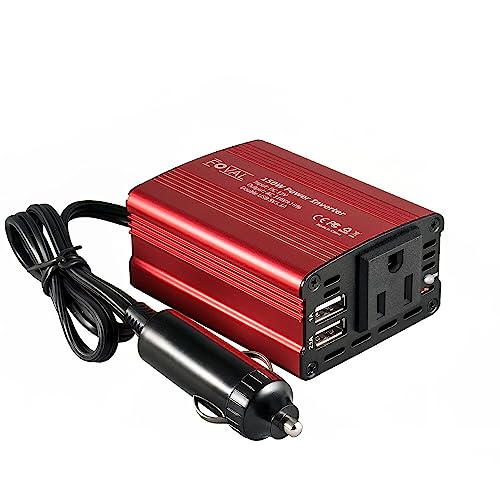
FOVAL 150W Car Power Inverter pairs a 150W continuous AC output with two USB ports, making it a compact option for charging a small mix of plug-in and USB devices. Its dimensions are 3.7 × 2.5 × 1.5 inches, and the maker gives 3.1A as the combined USB output. This suits lower-draw electronics when one AC socket is enough. The 150W ceiling limits what it can power, and a vehicle socket may have a lower practical limit than the inverter itself; check the socket rating against the device load.
Bottom line: Pick this for modest electronics and a compact, single-outlet setup.
150W Vehicle Power Inverter

150W Vehicle Power Inverter distinguishes itself with a built-in fuse and smart-chip protection that the maker says shuts off output and lights a red indicator when a fault is detected. It supplies 150W continuous AC power, with 300W peak power, plus dual USB ports rated at 3.1A. The small 3.4 × 2.5 × 1.5-inch body suits drivers who want basic AC and USB charging with a fault response. Peak wattage is not continuous capacity, so choose devices by their running draw rather than their startup or peak demand.
Bottom line: Choose this if the fault cutoff is a priority and 150W is sufficient.
BESTEK 300W Car Power Inverter
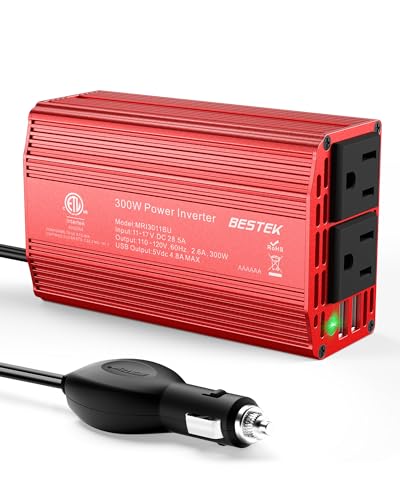
BESTEK 300W Car Power Inverter offers twice the continuous AC output of the 150W options and has two AC outlets, which can suit a larger combined load if the vehicle power source supports it. It also has two USB ports with 4.8A output and an aluminum body measuring 4.8 × 3.1 × 1.9 inches. The maker says it accepts 11–17V input. Its 300W rating does not mean every lighter socket can supply 300W; confirm the vehicle socket’s fuse and current limit before connecting higher-draw devices.
Bottom line: Pick this when you need two AC outlets and your vehicle can support the load.
How to choose a car lighter to outlet inverter
Choose an inverter by continuous wattage, not its peak figure, and leave headroom above the device’s running draw. A 150W inverter is intended for smaller loads than a 300W model, but the vehicle socket can impose a lower ceiling than either inverter. Many 12V accessory sockets use 10A or 15A fuses; at 12V, those ratings represent 120W or 180W before conversion losses. Add the wattage of devices running at the same time, and account for startup surges from motors. If the combined load is close to the socket’s fuse limit, choose a lower-draw setup rather than relying on the inverter’s maximum rating.
Check socket capacity and device fit
A car lighter socket supplies nominal 12V DC, while an inverter turns that input into household-style AC; the inverter’s output rating does not upgrade the socket or vehicle wiring. A 300W load at 12V would require 25A even before conversion losses, beyond many accessory sockets. Read the vehicle manual or socket marking for its fuse/current rating and compare it with the expected draw. The 150W options are a better match for modest loads, while higher-output use may require a purpose-built battery connection; confirm the vehicle and inverter instructions permit that connection. Never substitute a household appliance’s plug fit for an electrical load check.
Understand AC wattage, USB ports and peak power
AC outlets are for devices designed for household AC input, while USB ports power USB-compatible devices directly and avoid using an AC adapter. Check each device’s input label and add simultaneous wattage; the combined load must stay within both the inverter’s continuous output and the vehicle circuit’s capacity. Peak wattage is a short-duration ceiling, not a safe running target: 150W Vehicle Power Inverter lists 300W peak alongside 150W continuous output. Motors, compressors and some power supplies can draw more during startup than while running. If a device’s startup draw is unknown, avoid using it near the inverter’s limit.
Use a car inverter safely
Use an inverter only with the voltage and load it is designed for, and keep its ventilation openings clear; conversion losses generate heat. A vehicle battery can discharge while the engine is off, so limit use with the engine stopped and avoid leaving an inverter running unattended. High-draw heating appliances are poor candidates for accessory sockets because they can exceed common socket-current limits quickly. Stop using the equipment if a plug, socket or inverter becomes unusually hot, or if a fuse repeatedly blows; do not fit a higher-rated fuse to defeat the vehicle circuit’s protection.
Frequently Asked Questions
Can a 150W inverter run a laptop?
A laptop may fit within 150W, but check the wattage on its power adapter and leave room for other connected loads. The combined demand must remain below both the inverter’s 150W continuous output and the vehicle socket limit.
Can I use a 300W inverter in a cigarette lighter socket?
Only if the socket and vehicle circuit are rated for the required current. At 12V, 300W requires 25A before conversion losses, more than many 10A or 15A accessory sockets can provide.
Will a car inverter drain the battery?
Yes, an inverter draws energy from the vehicle battery whenever it is operating, even if the engine is off. Use a small load for a limited time with the engine stopped, since battery capacity and load determine how quickly charge falls.
Can an inverter power a CPAP machine in a car?
Check the CPAP’s input label and any humidifier or heater wattage before choosing an inverter. The total running load and startup demand must stay within the inverter’s continuous rating and the vehicle socket’s current limit.
What is the difference between peak and continuous watts?
Continuous watts are the output an inverter is designed to supply during ongoing operation; peak watts describe a brief higher output. Choose by the device’s running draw and startup demand, not by peak wattage alone.