
Glue for Arrow Fletching: 4 Adhesives Compared

Bohning Fletch Fuse, 1/2 oz is the strongest starting point for most fletching jobs because its 30-second clamp time and 2-hour cure time are clearly defined, and it is made for vanes, feathers and nocks on all shaft types. Choose AAE MAX Adhesion Kit instead if you want a primer pen and wipes with the glue, or Fletching Glue, 100 g if package quantity is your priority.
Fletching glue bonds an arrow’s vanes or feathers to its shaft; the right choice depends on application control, prep needs and how long you can leave a repair undisturbed.
We earn a commission if you buy through links on this page. As an Amazon Associate I earn from qualifying purchases. Products are compared on manufacturer specifications, not hands-on testing.
- Best overall: Bohning Fletch Fuse, 1/2 oz – Defined 30-second clamp and 2-hour cure times, with compatibility across shaft types.
- Best for surface prep: AAE MAX Adhesion Kit – The 20-gram glue kit includes a primer pen and a package of cleaning wipes.
- Best for larger quantity: Fletching Glue, 100 g – The 100-gram package is the largest amount among these choices.
- Best for precise application: TAC Vanes TAC Glue, 1/2 fl oz – A precision applicator tip is designed for controlled, cleaner glue placement.
| Product | Best for | Package size (oz) | Set or cure time | Application or extras | Shop |
|---|---|---|---|---|---|
| Bohning Fletch Fuse, 1/2 oz | Defined cure timing | 0.5 oz | 30-sec clamp; 2-hr cure | Vanes, feathers, nocks | Check Price on Amazon |
| Fletching Glue, 100 g | Larger package | 3.5 oz | 10–45 sec bond (maker claim) | 6 precision tips | Check Price on Amazon |
| TAC Vanes TAC Glue, 1/2 fl oz | Controlled application | 0.5 oz | Fast-setting; no time given | Precision tip | Check Price on Amazon |
| AAE MAX Adhesion Kit | Prep included | 0.7 oz glue | — | Primer pen; wipes | Check Price on Amazon |
Glue for Arrow Fletching Compared
Compare the package sizes, timing and application features to match an adhesive to your fletching routine.
Bohning Fletch Fuse, 1/2 oz

Bohning Fletch Fuse, 1/2 oz stands out for giving both a clamp time and a full cure time, so it is easier to plan when an arrow can return to use. Bohning says the adhesive is designed for vanes, feathers and nocks and works on all shaft types. The 1/2-ounce bottle is a straightforward option when you need adhesive rather than a prep kit or a larger package. Its limitation is the two-hour cure: archers who need the maker’s full cure before use must allow that time rather than relying on the shorter clamp period.
Bottom line: Pick this if you want defined clamp and cure timing across shaft types.
Fletching Glue, 100 g

Fletching Glue, 100 g differs from the smaller bottles with a 100-gram package and six precision tips. The maker says its clear adhesive bonds in 10–45 seconds and is intended for carbon, aluminum, wood and fiberglass shafts, as well as vanes, feathers and inserts. That broad stated use makes it relevant for an archer working across several arrow materials or attachment jobs. The fast-bond claim does not provide a separate full-cure time, so choose another option if you need a cure schedule before putting arrows back into use.
Bottom line: Choose this when a larger package and multiple precision tips matter most.
TAC Vanes TAC Glue, 1/2 fl oz
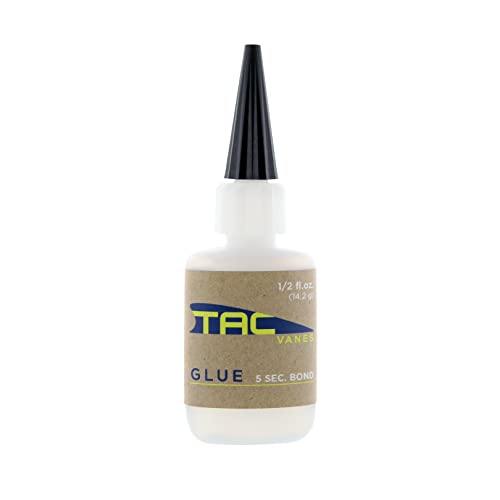
TAC Vanes TAC Glue, 1/2 fl oz is the focused choice for controlled vane application: its precision tip is intended to place glue neatly with minimal mess. TAC says the adhesive bonds vanes to carbon, aluminum and wooden shafts, and is compatible with virtually all fletching materials and arrow types. Its 1/2-fluid-ounce size is comparable to the Bohning bottle by volume, though the use emphasizes vanes. The maker calls it fast-setting but gives no numeric set or cure time, so it is less suitable when scheduling depends on a specific wait period.
Bottom line: Pick this for a precision tip and a vane-focused adhesive.
AAE MAX Adhesion Kit

AAE MAX Adhesion Kit is the only choice here that bundles surface-prep tools with the adhesive: the kit contains 20 grams of Max Bond Glue, a MAXweld Primer Pen and a package of Max Clean Wipes. That combination suits archers who want glue and prep supplies together for attaching vanes or fletching. If a repair must be ready on a schedule, the missing timing could affect your choice; otherwise, the included prep items are its defining distinction.
Bottom line: Choose this when a primer pen and cleaning wipes are useful additions.
How to choose glue for arrow fletching
Choose fletching glue by matching the set schedule and applicator to your workflow. A 30-second clamp is not the same as a complete cure: Bohning Fletch Fuse, 1/2 oz gives both, while the maker of Fletching Glue, 100 g gives a 10–45-second bond claim without a separate full-cure time. Precision tips help place a narrow bead along a vane foot, while a primer pen and wipes add surface-prep steps. For a same-session repair, favor a product with a clear timing claim; if a repair can sit, a prep kit or larger package may matter more. Dry-fit the vane in its clamp before applying glue so alignment does not depend on rushing after adhesive is spread.
| Need | What to prioritize |
|---|---|
| Defined return-to-use timing | Separate clamp and cure times |
| Clean, narrow placement | Precision applicator tip |
| Surface-prep supplies | Primer pen and wipes |
Prepare the shaft and vane before gluing
Clean, dry bonding surfaces matter because dust, oil and release residue can interfere with adhesion. Remove an old vane and scrape off remaining glue without cutting into or deeply scoring the shaft; carbon shafts can be damaged by aggressive scraping. Wipe the bonding area and let it dry fully before applying adhesive. Follow the adhesive maker’s primer direction when a primer is part of the process, since primers are not interchangeable by assumption. Keep the vane seated squarely in its clamp and use a consistent, narrow bead rather than flooding the foot, which can squeeze onto the shaft or into the clamp.
Set time, full cure and safe handling
Clamp time describes how long a part is held in place; full cure is the longer period needed for the bond to reach its intended readiness. For Bohning Fletch Fuse, 1/2 oz, the 30-second clamp and 2-hour cure are distinct, so do not treat the clamp time as permission to shoot immediately. Fast-setting adhesives may bond skin rapidly, and cyanoacrylate-type fumes can irritate eyes and airways. Work with ventilation, avoid eye and skin contact, and keep adhesive away from children. If glue contacts skin or eyes, follow the product label’s first-aid directions rather than pulling bonded skin apart.
Frequently Asked Questions
How long should fletching glue cure before shooting?
Use the adhesive’s full cure time, not merely its clamp time. Bohning Fletch Fuse, 1/2 oz gives a 2-hour cure after a 30-second clamp, so allow the longer interval before shooting with that adhesive.
Can fletching glue be used on carbon arrow shafts?
Some fletching adhesives are made for carbon shafts; Fletching Glue, 100 g and TAC Vanes TAC Glue, 1/2 fl oz both state carbon compatibility. Clean and dry the bonding area first, and avoid gouging carbon while removing old glue.
Should arrow vanes be cleaned before gluing?
Yes, bond only to clean, dry surfaces because dust and oil can weaken contact. Let any cleaning residue evaporate fully before applying adhesive or primer.
What is the difference between clamp time and cure time?
Clamp time is the period a joint is held in position; cure time is the longer period before the adhesive reaches its intended readiness. When both are given, use the cure time to decide when to shoot.
How much glue should go on an arrow vane?
Apply a narrow, continuous bead along the vane foot rather than filling the whole surface. Excess glue can squeeze out and make a mess, so test the placement in the clamp before applying adhesive.