
Corner Lazy Susan Cabinets: 3 Types Compared

For a hinged-door corner base cabinet, Rev-A-Shelf 24-Inch Kidney-Shaped 2-Tier is the better fit when its 24-inch width and 26-to-31-inch adjustable post match your cabinet. Choose Rev-A-Shelf 28-Inch Pie-Cut 2-Tier instead for a 28-inch pie-cut shelf and a compatible door; Right-Opening Blind-Corner Pullout is a different, right-opening pullout for a blind-corner cabinet.
We earn a commission if you buy through links on this page. As an Amazon Associate I earn from qualifying purchases. Products are compared on manufacturer specifications, not hands-on testing.
- Best overall: Rev-A-Shelf 24-Inch Kidney-Shaped 2-Tier – The kidney-shaped, two-tier unit fits corner base cabinets with 26 to 31 inches of interior height.
- Best for pie-cut shelves: Rev-A-Shelf 28-Inch Pie-Cut 2-Tier – Its 28-inch pie-cut trays suit a corner cabinet with a compatible door.
- Best for blind corners: Right-Opening Blind-Corner Pullout – The right-opening pullout swings out to access a blind-corner shelf.
| Product | Best for | Shelf layout | Size | Access | Shop |
|---|---|---|---|---|---|
| Rev-A-Shelf 24-Inch Kidney-Shaped 2-Tier | Hinged-door cabinets | Kidney-shaped, 2 tiers | 24 W × 14.31 D × 26 H in | Corner base; hinged door | Check Price on Amazon |
| Rev-A-Shelf 28-Inch Pie-Cut 2-Tier | Pie-cut shelves | Pie-cut, 2 tiers | 28 W × 18.25 D × 26 H in | Corner base; compatible door | Check Price on Amazon |
| Right-Opening Blind-Corner Pullout | Blind-corner access | 2 trays | 36-in size; 34.25 L × 17.32 W in | Right-opening; 270° swing | Check Price on Amazon |
Corner Lazy Susan Cabinet Options
Compare the shelf shape, cabinet fit and access style before choosing a corner organizer.
Rev-A-Shelf 24-Inch Kidney-Shaped 2-Tier

Unlike a pie-cut model, this kidney-shaped unit is designed for a corner base cabinet with a hinged door. The two polymer shelves measure 24 inches wide by 14.31 inches deep, and the adjustable post accommodates an interior height of 26 to 31 inches. Mounting plates secure at the cabinet top and bottom, with the included hardware.
Choose it if those measurements fit your cabinet and you want a fixed-post, two-tier organizer. The post’s height range and the required 2-inch wall clearance leave little room for a cabinet outside those dimensions, so measure the interior before selecting it.
Bottom line: Pick this if your hinged-door cabinet meets the post-height and clearance requirements.
Rev-A-Shelf 28-Inch Pie-Cut 2-Tier

The 28-inch pie-cut trays distinguish this model from the kidney-shaped option, and the existing cabinet door must be compatible with the pie-cut shelves. Its two polymer tiers measure 28 inches wide by 18.25 inches deep by 26 inches high. Installation takes place inside the cabinet: brackets, cam base, shafts and trays are assembled, then the trays attach to the door.
Choose it when a larger pie-cut format matches your cabinet and door. The 2-inch wall clearance and inside-cabinet assembly are important constraints; a cabinet that cannot provide both may not suit this setup.
Bottom line: Choose this for a compatible door and a cabinet that accommodates its larger pie-cut trays.
Right-Opening Blind-Corner Pullout
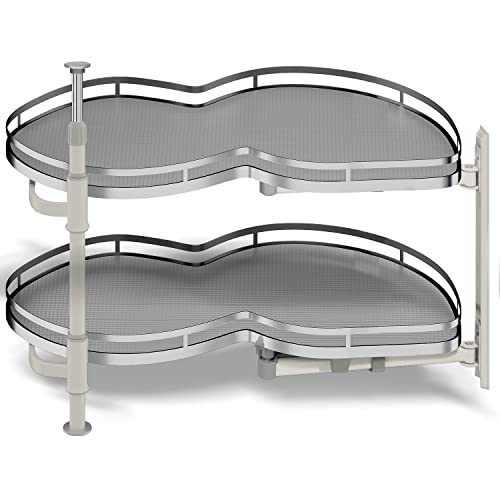
Unlike the fixed-post turntables, this organizer is a right-opening pullout for a blind-corner shelf. Its two trays swing independently through 270 degrees, and the maker says each basket can hold up to 33 pounds. The unit is identified as a 36-inch size and measures about 34.25 inches long by 17.32 inches wide.
Choose it when the cabinet has a blind-corner and right-side access suits the layout. It is not a replacement for a kidney-shaped or pie-cut lazy Susan, and the cabinet dimensions need close checking because a substantial size mismatch can waste usable space.
Bottom line: Pick this for a right-opening blind-corner rather than a hinged-door turntable.
How to choose a corner lazy Susan
Choose by door style and shelf shape first, then confirm the cabinet’s interior dimensions. Kidney-shaped and pie-cut units are both two-tier corner-base organizers here, but their shelf shapes and door requirements differ: the kidney-shaped model is for a hinged door, while the pie-cut unit needs a compatible door. A blind-corner pullout is a different mechanism, designed to swing trays out from a blind shelf rather than rotate on a center post.
Measure usable interior width, depth and height, not just the cabinet’s outside face. For the fixed-post option, allow 2 inches between the unit and cabinet wall and make sure the interior height falls between 26 and 31 inches. If either measurement fails, do not assume the shelves will clear the cabinet.
| Cabinet setup | Type to consider | Key check |
|---|---|---|
| Corner base, hinged door | Kidney-shaped | Interior height and 2-inch clearance |
| Corner base, compatible door | Pie-cut | Door compatibility and assembly room |
| Blind-corner | Swing-out pullout | Opening direction and cabinet dimensions |
Measure cabinet fit before installation
Measure the cabinet’s inside opening and height before choosing a corner organizer; outside cabinet width alone does not establish fit. The 24-inch kidney-shaped unit needs 26 to 31 inches of interior height, while the 28-inch pie-cut model requires 2 inches of clearance from the cabinet wall and enough room to assemble inside the cabinet.
For a pullout, check that the opening direction matches the cabinet layout. The right-opening model’s 36-inch size and roughly 34.25-inch length are useful starting points, but compare those dimensions with the cabinet’s usable interior and the route trays need to swing. Leave room for doors and hinges to move without striking the shelves. Confirm the lift range before ordering if the cabinet height is outside a fixed-post model’s range.
Kidney-shaped, pie-cut and blind-corner systems
Kidney-shaped shelves, pie-cut shelves and blind-corner pullouts solve different access problems. Kidney and pie-cut turntables rotate inside a corner base cabinet, while a blind-corner system swings trays out from the hidden part of the cabinet. Door construction matters: a hinged-door cabinet is the specified fit for the kidney-shaped unit, and pie-cut shelves require a compatible door.
The distinction is useful when an old organizer is being replaced. Match the existing cabinet hardware and opening style rather than choosing by shelf count alone; all three options have two tiers, but their access mechanisms are not interchangeable. Use a swing-out pullout only when its opening direction and clearance fit the blind-corner layout.
Installation and safe loading
Install a fixed-post lazy Susan with its top and bottom mounting plates secured to the cabinet, then assemble the post and shelves in place. The pie-cut installation also involves attaching trays to the compatible door, so door alignment and inside-cabinet working room matter. Pre-drilling and centering the hardware help avoid misaligned rotation or door interference.
Do not infer a load rating from shelf material or appearance. The blind-corner pullout’s maker gives a limit of 33 pounds per basket; no comparable capacity is provided for the two turntables, so avoid applying that figure to them. For any rotating organizer, distribute items rather than concentrating heavy containers at one edge, and stop using it if fasteners loosen or trays bind.
Frequently Asked Questions
How much clearance does a corner lazy Susan need?
The two turntable models call for 2 inches of clearance from the cabinet wall. Measure that gap around the unit, because a shelf that rubs the wall can obstruct rotation.
What cabinet height fits an adjustable-post lazy Susan?
The kidney-shaped model’s post adjusts for 26 to 31 inches of interior cabinet height. Measure from the cabinet floor to its inside top; a height outside that range is a reason to choose another setup.
Can pie-cut shelves use any cabinet door?
No; pie-cut trays need a compatible existing door. Check the door and tray attachment arrangement before installation, since door fit is part of how this style operates.
What is the difference between a blind-corner pullout and a lazy Susan?
A lazy Susan rotates shelves around a center post, while a blind-corner pullout swings trays out from a hidden cabinet area. Choose based on the cabinet’s access style and opening direction, not just the two-tier shelf count.