
Double Battery Box for RVs: 5 Models Compared

For most RV owners with two GC2 or two Group 24/24M batteries, Camco 55375 Double Battery Box is the clearest fit because it names both battery configurations and gives interior dimensions to check. Choose a metal enclosure instead if a lockable cover or cable ports matter more, and confirm your batteries fit within its interior measurements.
We earn a commission if you buy through links on this page. As an Amazon Associate I earn from qualifying purchases. Products are compared on manufacturer specifications, not hands-on testing.
- Best overall: Camco 55375 Double Battery Box – Fits two 6V GC2 or two 12V Group 24/24M batteries, with interior dimensions provided.
- Best for included mounting: Camco 55374 End-to-End Double Box – Includes two straps and four strap clamps with screws.
- Best for cable routing: YeeJinHong Lockable Steel Dual Box – Has a lockable cover and cable ports with rubber grommets.
| Product | Best for | Interior length | Material | Included mounting | Shop |
|---|---|---|---|---|---|
| Camco 55375 Double Battery Box | Common dual setups | 21-9/16 in | Heavy-duty polymer | — | Check Price on Amazon |
| Camco 55374 End-to-End Double Box | Mounting hardware | — | Polypropylene | Two straps, four clamps | Check Price on Amazon |
| Stainless Steel Dual Battery Box | Metal enclosure | 21.7 in | Stainless steel | — | Check Price on Amazon |
| YeeJinHong Lockable Steel Dual Box | Cable routing | 21.56 in | Coated steel | — | Check Price on Amazon |
| Peastorm Steel Double Battery Box | Larger stated fit | 22 in | Coated steel | Bottom screws | Check Price on Amazon |
Double Battery Boxes for RVs
Compare battery capacity, enclosure construction and fit dimensions before choosing a box for your RV setup.
Camco 55375 Double Battery Box

Camco 55375 Double Battery Box is a polymer enclosure sized for two 6V Group GC2 batteries or two 12V Group 24/24M batteries, making it a straightforward match for those common dual battery arrangements. Its inside dimensions are 21-1/2 by 7-3/8 by 11-3/16 inches, while the maximum battery fit is 21-9/16 by 7-7/16 by 11-9/16 inches; use the maximum-fit figures when checking your battery labels and measurements. Built-in handles aid carrying. Camco says the box meets U.S. Coast Guard CFR 183.420 and ABYC E-10.7. The limitation is the narrower 7-7/16-inch maximum width, which rules it out for wider batteries.
Bottom line: Choose this if your batteries match one of its two named group configurations and fit within its maximum dimensions.
Camco 55374 End-to-End Double Box
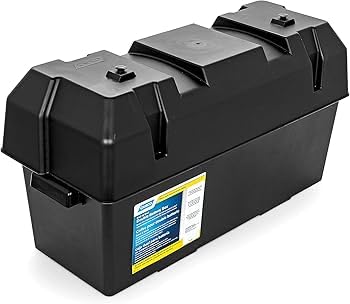
Camco 55374 End-to-End Double Box stands out by including installation hardware: two straps, four strap clamps and screws. It holds two 6V GC2 batteries or two 12V Group 24/24M batteries, the same configurations as Camco 55375 Double Battery Box, but the maker does not give an interior measurement to compare against an unusually tight compartment. The polypropylene construction is corrosion-resistant, and its design is vented. Camco says it meets U.S. Coast Guard CFR 183.420 and ABYC E-10.7 when used with two 6V GC2 batteries. That conditional standard claim matters if compliance is part of your setup; confirm the exact battery fit before buying.
Bottom line: Pick this when the included straps and clamps suit your installation and the battery fit is confirmed.
Stainless Steel Dual Battery Box
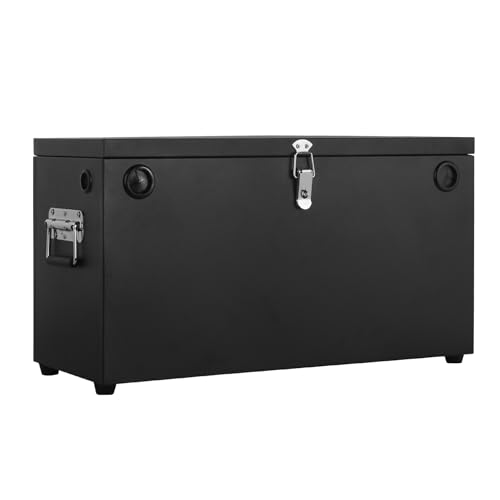
Stainless Steel Dual Battery Box is the stainless steel choice, with an interior measuring 21.7 by 8 by 11 inches and an exterior measuring 22.6 by 9 by 12.2 inches. Its compatible setup is two 12V Group 24/27 batteries; it excludes oversized batteries wider than 8 inches and high-cover batteries taller than 11 inches. The manufacturer describes the enclosure as waterproof and sunproof, with a lockable cover. Check the measured battery width and height against those limits, including any terminal covers that add height. The steel construction adds a different fit and handling consideration than the polymer boxes, and this option is unsuitable if either battery exceeds its dimensions.
Bottom line: Choose this if you want a lockable stainless steel enclosure and both batteries fit the limits.
YeeJinHong Lockable Steel Dual Box

YeeJinHong Lockable Steel Dual Box distinguishes itself with cable ports fitted with rubber grommets, plus a lockable top cover. Its interior measures 21.56 by 8.33 by 11.77 inches, providing a precise reference for checking two 12V batteries before installation. A black protective coating covers the steel enclosure, which is intended for RV, trailer and marine setups. Measure the battery bodies and account for the room needed to route cables through the ports; a battery pair that fits the interior can still be awkward if cables bend sharply. The dimensions make this more useful for fit planning than models without interior measurements, but no straps or clamps are identified as included.
Bottom line: Choose this when cable routing and a lockable steel cover are priorities.
Peastorm Steel Double Battery Box

Peastorm Steel Double Battery Box gives a maximum battery capacity of 22 by 8.5 by 11.5 inches, the broadest width among these options. Its exterior measures 22.25 by 8.7 by 11.75 inches, so check both battery fit and available compartment space rather than relying on the capacity measurement alone. The steel box has handles on both sides, a lockable lid, rubber-ringed openings and bottom fixing holes with screws included. The manufacturer describes its coating as waterproof, sunproof and fireproof; those are maker claims, not a substitute for correct battery installation. This model suits buyers needing those enclosure features, but confirm clearance around its external dimensions before selecting it.
Bottom line: Pick this if your batteries fit its maximum and the compartment accommodates its exterior size.
How to choose a double battery box for an RV
Start with the battery pair and the box’s interior dimensions, not the exterior footprint. Measure each battery at its widest and tallest points, including terminal covers, then compare the pair’s arrangement with the box’s capacity; a box sized for two GC2 batteries does not automatically fit every two-battery combination. Leave room for cable bends and access to terminals rather than treating a close dimensional match as a comfortable installation. For a compartment with less than 1 inch of spare width, do not assume the interior will provide useful cable clearance; measure the cable route separately. Also compare the box’s external dimensions with the RV compartment opening, since a box can fit inside the bay but fail to pass through its access door.
Battery box fit and clearance
Interior length, width and height determine whether the batteries fit, while the exterior measurements determine whether the enclosure can be installed in its intended spot. Compare the box’s maximum battery dimensions with your own measurements in the same orientation; rotate batteries only if the manufacturer permits the intended layout and the cables still reach safely. The 22-by-8.5-by-11.5-inch maximum on Peastorm Steel Double Battery Box is a capacity size, not its exterior size. Include lid clearance above the batteries and enough space for cable connections. Measure the narrowest part of the RV bay opening as well as the compartment itself. If a battery or terminal cover is even slightly larger than the box’s maximum fit in one direction, select a larger compatible enclosure rather than forcing the lid closed.
Ventilation and battery safety
Lead-acid batteries can release hydrogen while charging, so battery enclosures must not trap charging gases in an occupied or sealed space. Use a box designed for the battery type and installation, and keep ventilation paths clear; do not block vents with cables or stored gear. Hydrogen is flammable, so keep sparks, flames and smoking materials away from batteries, especially during charging. Battery terminals can also short against tools or metal: disconnect power as directed for the RV system and protect exposed terminals during service. A lockable or weather-resistant enclosure does not replace proper ventilation or secure mounting. Before choosing an enclosure, confirm the battery chemistry and charging setup, then ensure the box and compartment work with those requirements.
Polymer and steel battery boxes compared
Polymer boxes provide a nonmetal enclosure, while steel models offer a rigid metal housing and may add locking covers or cable-routing features. Material alone does not establish a box’s compatibility: capacity, ventilation, interior dimensions and mounting method still decide fit. Use this comparison to narrow the enclosure style, then verify the battery measurements and installation needs against the specific model.
| Need | Suitable feature | Fit check |
|---|---|---|
| Two GC2 or Group 24/24M batteries | Named capacity in polymer boxes | Compare maximum battery dimensions |
| Strapped installation | Included straps and clamps | Confirm box dimensions and mounting surface |
| Locked cover and cable routing | Metal box with cover and cable ports | Check interior size and cable path |
| Largest width here | 22-inch maximum capacity length; 8.5-inch width | Compare battery and compartment measurements |
Frequently Asked Questions
How much clearance should a double battery box have?
The battery must fit within the box’s maximum interior dimensions, and the enclosure must fit through the RV compartment opening. Measure terminal covers and cable bends too; a near-zero side gap can leave no practical room to connect or route cables.
Do RV battery boxes need ventilation?
Lead-acid batteries can release flammable hydrogen while charging, so their enclosure must allow gases to disperse. Keep ventilation openings unobstructed and keep ignition sources away during charging.
Can two different battery group sizes share one box?
Only if the batteries fit the box’s interior and the layout supports the intended cables and terminals. A capacity for two GC2 batteries or two Group 24 batteries does not guarantee room for a mixed pair.
Should I measure the box interior or exterior?
Measure both: interior dimensions check battery fit, while exterior dimensions check the RV compartment and access opening. Include lid height and terminal covers in the fit check.
Are metal battery boxes suitable for RV use?
A metal enclosure can be used only when its dimensions, mounting and ventilation suit the batteries and RV installation. Steel construction or a lockable lid does not replace safe venting for charging batteries.