
Dyna-Glo Heaters: 5 Models Compared by Heat Type

For a garage with an electrical supply, Dyna-Glo Dual Power Electric Garage Heater stands out for its two power settings and 24 heat settings; choose another model if you need fuel-based backup or heat for a different space. Dyna-Glo heaters use different heating methods, so fuel access, ventilation, and the area to heat should decide the fit.
We earn a commission if you buy through links on this page. As an Amazon Associate I earn from qualifying purchases. Products are compared on manufacturer specifications, not hands-on testing.
- Best overall: Dyna-Glo Dual Power Electric Garage Heater – Two power settings and 24 heat settings make it adaptable for an electric garage setup.
- Best for portable propane heat: Dyna-Glo 60K Vertical Radiant LP Heater – The radiant heater offers two output levels and wheels for transporting a 20-pound propane tank.
- Best for dual-fuel wall heat: Dyna-Glo 30,000 BTU Blue Flame Wall Heater – It can run on either liquid propane or natural gas and has a thermostat control.
| Product | Best for | Heat output | Fuel | Coverage | Shop |
|---|---|---|---|---|---|
| Dyna-Glo Dual Power Electric Garage Heater | Electric garages | 38,556–51,180 BTU/hr | Electric | — | Check Price on Amazon |
| Dyna-Glo WK95C8 Kerosene Convection Heater | Kerosene backup | 23,000 BTU/hr | Kerosene | 1,000 sq. ft. | Check Price on Amazon |
| Dyna-Glo 60K Vertical Radiant LP Heater | Portable propane heat | 30,000–60,000 BTU/hr | Propane | 750–1,350 sq. ft. | Check Price on Amazon |
| Dyna-Glo 30,000 BTU Blue Flame Wall Heater | Dual-fuel wall heat | 30,000 BTU/hr | Natural gas or propane | 1,000 sq. ft. | Check Price on Amazon |
| Dyna-Glo IR30NMDG-1 Natural Gas Infrared Heater | Natural gas radiant heat | 30,000 BTU/hr | Natural gas | 1,000 sq. ft. | Check Price on Amazon |
Dyna-Glo heaters compared
Compare the heating method, output, and coverage to narrow the choices to your space and available fuel.
Dyna-Glo Dual Power Electric Garage Heater
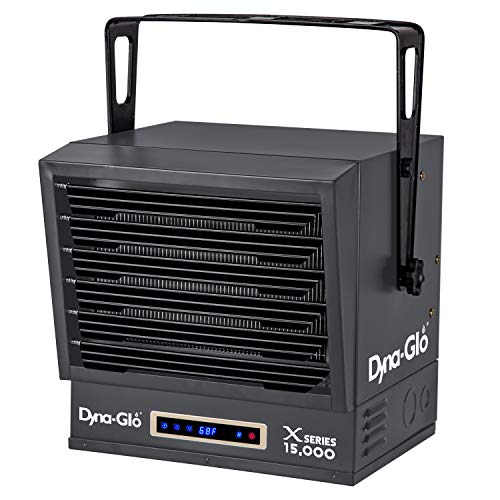
Dyna-Glo Dual Power Electric Garage Heater is the electric choice in this group, with 11,300- and 15,000-watt settings and 24 heat settings from 50°F to 95°F. It can also run as a fan without heat, and its angle adjusts for horizontal or vertical airflow. This setup suits garages where electricity is available and the owner wants adjustable airflow. The main limitation is its reliance on electrical power, so it is not a fuel-based backup option during an outage.
Bottom line: Choose this for adjustable electric heat and fan-only operation in a garage.
Dyna-Glo WK95C8 Kerosene Convection Heater

Dyna-Glo WK95C8 Kerosene Convection Heater is the kerosene convection option, rated at 23,000 BTU per hour for spaces up to 1,000 square feet, and it does not need electricity. That makes it relevant where power access is limited and kerosene is available. Convection heaters warm air that circulates through a space, unlike radiant heaters that primarily warm objects and people in their path. Fuel-burning heaters require careful attention to ventilation and carbon monoxide safety; this model’s indoor designation is not a reason to skip those precautions.
Bottom line: Choose this when you need kerosene heat without electrical power.
Dyna-Glo 60K Vertical Radiant LP Heater

Dyna-Glo 60K Vertical Radiant LP Heater provides radiant heat at two levels: 30,000 BTU per hour for up to 750 square feet or 60,000 BTU per hour for up to 1,350 square feet. Its wheels are designed to carry a 20-pound propane tank, and a regulator and hose assembly are included; the tank itself is not. The radiant design directs warmth toward people and objects rather than relying only on heating all the surrounding air. This is a portable propane option, but the tank is an additional requirement and fuel-burning safety precautions remain essential.
Bottom line: Choose this for portable, two-level radiant heat when you have a propane tank.
Dyna-Glo 30,000 BTU Blue Flame Wall Heater

Dyna-Glo 30,000 BTU Blue Flame Wall Heater is a wall-mounted blue flame heater rated at 30,000 BTU per hour for up to 1,000 square feet. Its dual-fuel design accepts either natural gas or liquid propane, and a thermostat knob is intended to maintain a selected room heat level. Blue flame heating warms air by convection, which can suit a room where circulating warm air is the goal. The wall-mounted format is less portable than the wheeled propane option, and fuel connection and installation suitability need to match the home.
Bottom line: Choose this for wall-mounted heat when natural gas or propane flexibility matters.
Dyna-Glo IR30NMDG-1 Natural Gas Infrared Heater

Dyna-Glo IR30NMDG-1 Natural Gas Infrared Heater uses infrared heating to warm nearby objects first, with a 30,000-BTU-per-hour output rated for spaces up to 1,000 square feet. Its control offers low, medium, and high settings, and the heater is designed for natural gas only; fuel conversion is not permitted. Optional fan and base legs are separate accessories. The infrared approach differs from the blue flame convection wall heater, making this a fit for buyers who prefer directed radiant warmth. Its single-fuel design is a limitation if natural gas is unavailable.
Bottom line: Choose this for natural gas infrared heat with low, medium, and high control.
How to choose a Dyna-Glo heater
Start with the space, fuel supply, and whether electricity is available. Electric resistance heat converts roughly 3.4 BTU per hour for each watt, while fuel-burning heaters need a suitable fuel connection and safe operating conditions. Match the heater’s rated coverage to the space, but treat square-foot ratings as guidance rather than a guarantee: insulation, ceiling height, drafts, and outdoor temperatures change heating needs. As a practical rule, if the area is larger than the model’s coverage, compare a higher-capacity option rather than assuming a smaller unit will keep up. Also distinguish radiant heat, which warms objects in its path, from convection heat, which warms circulating air.
Fuel and installation fit
Fuel compatibility is a hard fit requirement: natural gas-only units cannot be converted to propane, while dual-fuel models are built for either natural gas or liquid propane. Confirm the available fuel and the intended mounting location before choosing a wall heater. Portable propane equipment also depends on having the correct tank; the 60,000-BTU radiant model’s 20-pound tank is not included. Never treat a heater’s fuel flexibility as permission to improvise a connection or installation. For gas wall units, verify that the model and installation are permitted for the particular room and local requirements, especially for unvented equipment.
Heater types and where they fit
Radiant and convection heaters distribute warmth differently, while electric heaters avoid burning fuel at the point of use. The following comparison helps match the method to a need rather than treating output alone as the deciding factor.
| Type | How warmth is delivered | Consider when |
|---|---|---|
| Electric | Heats air electrically | Electrical power is available |
| Radiant | Warms nearby objects and people | Directed warmth is useful |
| Convection | Warms circulating air | Room air heating is preferred |
Portable designs trade fixed installation for repositioning, while wall-mounted heaters are intended to stay in one place. Pick the form factor that suits the room and do not use rated square footage as a substitute for checking clearances.
Fuel-heater safety and ventilation
Fuel-burning heaters can produce carbon monoxide, an odorless gas that can be fatal; use working carbon monoxide alarms and follow the heater’s installation and operating requirements. Unvented or vent-free equipment is not permitted in every location, so confirm local rules before installation. Keep combustible materials away from the heater and preserve the required clearances; do not block air openings. A portable radiant heater with a tip-over shutoff adds a safety feature, but it does not replace stable placement, supervision, or safe fuel handling. Never run a fuel-burning heater in an enclosed space unless it is specifically approved for that use and the installation meets applicable requirements.
Frequently Asked Questions
How much area can a Dyna-Glo heater warm?
The models here are rated from 750 to 1,350 square feet where a coverage figure is provided. Actual comfort depends on insulation, drafts, ceiling height, and outdoor temperature, so match the rating to the room rather than relying on output alone.
Can a natural gas Dyna-Glo heater use propane?
Only a model designed for both fuels can use natural gas or liquid propane. The infrared model here is natural gas-only, and its fuel conversion is not permitted.
Do kerosene and propane heaters need electricity?
The kerosene convection heater and propane radiant heater described here do not require electricity. Fuel-burning models still require safe placement, appropriate ventilation, and carbon monoxide alarms.
What is the difference between radiant and blue flame heat?
Radiant heat warms objects and people directly, while blue flame convection warms air that circulates through a room. Choose based on whether directed warmth or warming room air better suits the space.
Can a vent-free heater be installed in any room?
No; vent-free heater use is restricted in some locations and room types. Check local requirements and the unit’s approved installation conditions before mounting or operating one.