
EVO-X Marksman Elite Scope: Models Compared

The TenPoint EVO-X Marksman Elite 3.0 in Vektra TenPoint EVO-X Marksman Elite 3.0, Vektra suits crossbows rated from 380 to 550 FPS, while the Veil Alpine version TenPoint EVO-X Marksman Elite 3.0, Veil Alpine extends the range down to 300 FPS. Choose between them by your crossbow’s rated speed and the reticle layout you prefer.
The Rangemaster 100 TenPoint Rangemaster 100 and Garmin Xero X1i Garmin Xero X1i are alternatives rather than EVO-X Marksman Elite models; they differ in speed-range or ranging features.
We earn a commission if you buy through links on this page. As an Amazon Associate I earn from qualifying purchases. Products are compared on manufacturer specifications, not hands-on testing.
- Best overall: TenPoint EVO-X Marksman Elite 3.0, Vektra – Its 380–550 FPS range and aiming marks extending to 100 yards make it the broad-use EVO-X option here.
- Best for lower-speed crossbows: TenPoint EVO-X Marksman Elite 3.0, Veil Alpine – Its 300–550 FPS range includes slower crossbows than the Vektra version.
- Best for variable magnification: TenPoint Rangemaster 100 – The Rangemaster 100 has 2–7× magnification and covers 380–505 FPS.
- Best for automatic ranging: Garmin Xero X1i – The Xero X1i measures target distance and provides an adjusted illuminated aim point.
| Product | Best for | Crossbow speed range | Aiming or ranging distance | Shop |
|---|---|---|---|---|
| TenPoint EVO-X Marksman Elite 3.0, Vektra | Broad speed range | 380–550 FPS | Aiming marks to 100 yd | Check Price on Amazon |
| TenPoint EVO-X Marksman Elite 3.0, Veil Alpine | Lower-speed fit | 300–550 FPS | Aiming marks to 100 yd | Check Price on Amazon |
| TenPoint Rangemaster 100 | Variable magnification | 380–505 FPS | Aiming marks to 100 yd | Check Price on Amazon |
| Garmin Xero X1i | Automatic ranging | — | 250 yd game; 500 yd reflective | Check Price on Amazon |
EVO-X Marksman Elite Scope and Alternatives
Compare the two EVO-X versions by speed compatibility, then consider the related scopes for distinct aiming needs.
TenPoint EVO-X Marksman Elite 3.0, Vektra

The Vektra EVO-X Marksman Elite 3.0 is the direct match for the search and covers crossbows rated from 380 to 550 FPS. Its reticle places illuminated dots at 20, 30, and 40 yards, illuminated crosshairs at 50, 60, and 70 yards, and non-illuminated chevrons at 80, 90, and 100 yards. External micro-adjustable turrets provide windage and elevation adjustment. TenPoint describes it as a 100-yard scope with variable speed and arrow drop compensation. Its lower speed limit makes it a poor fit for crossbows below 380 FPS; consider the Veil Alpine version for those setups.
Bottom line: Choose this version if your crossbow is rated at least 380 FPS and no more than 550 FPS.
TenPoint EVO-X Marksman Elite 3.0, Veil Alpine
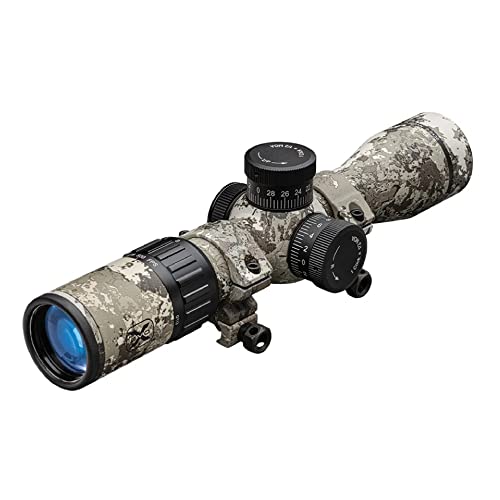
The Veil Alpine EVO-X Marksman Elite 3.0 reaches down to 300 FPS, making it the more suitable EVO-X version for a lower-speed crossbow. Its reticle uses illuminated duplex crosshairs at 20, 40, and 60 yards, illuminated dots at 30 and 50 yards, and non-illuminated chevrons from 70 through 100 yards. The 30 mm aluminum tube has an etched-glass reticle, and external micro-adjustable turrets adjust windage and elevation. TenPoint says the scope’s variable speed and drop compensation accommodate 300–550 FPS. Its reticle layout differs from the Vektra version, so choose based on the marks you want to use.
Bottom line: Pick this if your crossbow’s rated speed falls between 300 and 379 FPS, or if its reticle layout suits you better.
TenPoint Rangemaster 100

The Rangemaster 100 is a related TenPoint crossbow scope, not an EVO-X Marksman Elite; its distinguishing feature is 2–7× magnification. It accommodates crossbows shooting 380–505 FPS, with magnification tied to speed. The etched-glass reticle has illuminated dots at 20, 30, and 40 yards, crosshairs at 50, 60, and 70 yards, and chevrons at 80, 90, and 100 yards. Scope rings and flip-up caps are included. TenPoint says its upgraded glass improves image clarity and brightness, and the scope is water- and fog-proof. Its upper speed limit is lower than either EVO-X option.
Bottom line: Choose this if variable 2–7× magnification matters more than the wider speed range of the EVO-X options.
Garmin Xero X1i

The Garmin Xero X1i takes a different approach from the TenPoint scopes: it automatically measures distance and supplies an illuminated aim point adjusted for the shot. It has 3.5× magnification and can range game to 250 yards, reflective targets to 500 yards, and black targets to 125 yards. A wired trigger or the device’s range button activates ranging with minimal movement, and aim-point brightness adjusts to outside light. The Target Lock feature and custom bolt profiles are also part of its feature set. No crossbow FPS range is provided in the specifications, so confirm compatibility with your crossbow before choosing this alternative.
Bottom line: Choose this if automatic ranging and adjusted aim points are the priority, after confirming crossbow compatibility.
How to Choose an EVO-X Marksman Elite Scope
Match the scope’s FPS range to your crossbow’s rated speed before comparing reticles. The Vektra model covers 380–550 FPS, while the Veil Alpine model covers 300–550 FPS; the lower limit is the key difference for slower setups. Then compare the yard marks and whether you prefer dots, crosshairs, or chevrons at a given distance. A reticle’s yard labels depend on the scope’s speed and drop-compensation setup, so do not assume marks will align with a different crossbow or bolt configuration. As a practical rule, if your crossbow is rated below 380 FPS, select the Veil Alpine option from these EVO-X choices rather than the Vektra.
How Crossbow Scope Reticles Work
A crossbow reticle uses separate aim points to account for the bolt’s drop at different distances. The EVO-X versions provide marks from 20 through 100 yards, but their mark types and intervals differ. Speed settings matter because a faster or slower bolt follows a different trajectory; bolt weight and setup can also change where an aim point lands. Start by sighting in at 20 yards, then verify each farther mark at a measured distance on a safe range before relying on it. Make adjustments in small increments and record the crossbow speed setting that matches the setup. Never assume a 100-yard mark is a safe or appropriate shot distance.
This table highlights the practical differences by range and reticle approach.
| Scope | Speed fit | Reticle or ranging approach |
|---|---|---|
| TenPoint EVO-X Marksman Elite 3.0, Vektra | 380–550 FPS | Dots, crosshairs, then chevrons |
| TenPoint EVO-X Marksman Elite 3.0, Veil Alpine | 300–550 FPS | Crosshairs, dots, then chevrons |
| TenPoint Rangemaster 100 | 380–505 FPS | 2–7× variable magnification |
| Garmin Xero X1i | — | Automatic ranging and adjusted aim point |
Sighting In and Verifying Aim Points
Sight in at a measured 20 yards, then confirm the remaining aim points at their marked distances. TenPoint’s Rangemaster calibration guidance also starts at 20 yards, and a consistent starting zero helps expose a mismatched speed setting or bolt setup early. Use a stable rest, a clear backstop, and a target rated for crossbow bolts; keep the bow pointed downrange and never dry-fire it. Change only one setting at a time, then shoot a group to distinguish a real adjustment from a single errant bolt. If the farther marks do not align after speed and setup checks, stop relying on them until the scope is correctly calibrated.
Common Crossbow Scope Fit Mistakes
The most common fit error is choosing by a scope’s maximum distance while overlooking its FPS range. A 100-yard reticle does not establish that every crossbow will match its marks through 100 yards, and a maximum mark is not a guarantee of a usable shot. Check the crossbow’s rated speed against the scope range, then verify the reticle with the exact bolt setup. A second mistake is treating every yard mark as the same kind of aiming point: the EVO-X layouts mix dots, crosshairs, and chevrons, with different distances assigned to each. Keep the crossbow unloaded while mounting or adjusting the optic, and follow the crossbow maker’s mounting and safety procedures.
Frequently Asked Questions
What FPS range does the EVO-X Marksman Elite cover?
The Veil Alpine version covers 300–550 FPS, while the Vektra version covers 380–550 FPS. Match the lower and upper limits to your crossbow’s rated speed.
How far out are the EVO-X reticle marks calibrated?
Both EVO-X versions have aiming marks extending to 100 yards. Verify the marks at measured distances with your own crossbow setup before relying on them.
Do the two EVO-X versions use the same reticle layout?
No. The Vektra version uses dots at 20, 30, and 40 yards, while the Veil Alpine version uses crosshairs at 20, 40, and 60 yards. Their other illuminated and non-illuminated marks also fall at different distances.
Why does crossbow speed affect a scope’s aim points?
Bolt speed changes how much the bolt drops over distance, so a reticle calibrated for one speed may not align on another setup. Use the scope’s speed setting and verify its marks with the crossbow and bolts you intend to shoot.
What distance should I use to sight in a crossbow scope?
A 20-yard zero is a practical starting point, and TenPoint’s Rangemaster calibration guidance also starts at 20 yards. Confirm farther reticle marks at their measured distances on a safe range.
Is a scope’s 100-yard mark a safe shooting distance?
No; a 100-yard reticle mark only identifies an aiming reference, not a safe or appropriate shot. Consider range conditions, a secure backstop, and your demonstrated accuracy before taking any shot.