
French Bread Baking Tray: 5 Baguette Pans Compared

For most home bakers, Chicago Metallic Commercial II 3-Loaf Pan is the strongest fit because its 16-by-9-inch aluminum pan holds three loaves without taking up as much width as the four-loaf trays. Choose a different pan if you bake four baguettes at once, want two loaf channels, or need a carbon-steel option.
A French bread baking tray supports baguette-shaped dough in curved channels, while perforations let hot air reach more of the crust. Measure your oven rack before choosing a wider tray.
We earn a commission if you buy through links on this page. As an Amazon Associate I earn from qualifying purchases. Products are compared on manufacturer specifications, not hands-on testing.
- Best overall: Chicago Metallic Commercial II 3-Loaf Pan – Its three loaf channels fit a compact 16-by-9-inch aluminum pan.
- Best for four loaves: Pavsrmy 4-Wave Baguette Pan – The 15-by-13-inch pan has four channels for larger batches.
- Best for a two-pan set: Tiawudi 2-Pack 4-Wave Baguette Pans – The set includes two perforated four-channel pans made from carbon steel.
- Best for two loaves: KITESSENSU 2-Loaf Baguette Pan – Its 15-by-6.3-inch pan keeps the footprint narrow for smaller batches.
| Product | Best for | Pan size | Loaf capacity | Material | Shop |
|---|---|---|---|---|---|
| Chicago Metallic Commercial II 3-Loaf Pan | Compact three-loaf batches | 16 × 9 in. | 3 loaves | Aluminum | Check Price on Amazon |
| Pavsrmy 4-Wave Baguette Pan | Four-loaf batches | 15 × 13 in. | 4 loaves | — | Check Price on Amazon |
| Tiawudi 2-Pack 4-Wave Baguette Pans | Two-pan batches | 15 × 13 in. | 4 loaves each | Carbon steel | Check Price on Amazon |
| 15 × 11-Inch 3-Loaf Carbon-Steel Pan | Carbon-steel three-loaf | 15 × 11 in. | 3 loaves | Carbon steel | Check Price on Amazon |
| KITESSENSU 2-Loaf Baguette Pan | Narrow two-loaf batches | 15 × 6.3 in. | 2 loaves | — | Check Price on Amazon |
French bread baking trays compared
Compare channel count, pan footprint and material to find a tray that fits your oven and batch size.
Chicago Metallic Commercial II 3-Loaf Pan
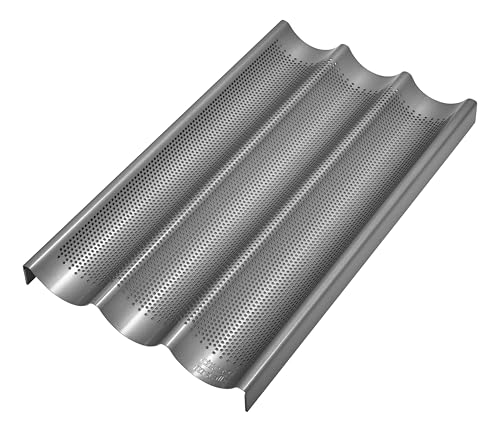
For three baguettes in a relatively narrow pan, this Chicago Metallic tray measures 16 by 9 inches and is made from heavy-weight aluminum. Its perforated, three-channel design lets air circulate around the dough, and the dual nonstick coating is intended to ease release. The maker recommends a light coat of oil or parchment for best release. This is a practical fit when width matters more than maximizing batch size; the channels are not a fit for a baker who needs four loaves at once.
Bottom line: Choose this for three loaves when a narrower pan footprint matters.
Pavsrmy 4-Wave Baguette Pan

The Pavsrmy pan offers four loaf channels in a 15-by-13-inch footprint, giving it the highest single-pan capacity among the options here. Its perforated surface and nonstick coating are designed for baguette baking, and the maker recommends lifting with both hands when the pan holds four loaves. That wider layout suits large batches, but it needs more side-to-side oven space than the narrower three-channel pan. Confirm your rack has room for the full 13-inch width before choosing it.
Bottom line: Choose this when four baguettes in one batch matter more than a narrow footprint.
Tiawudi 2-Pack 4-Wave Baguette Pans

This set stands apart by providing two four-channel pans, each measuring 15 by 13 inches, for baking multiple batches or using both pans when oven space allows. The pans are carbon steel with a food-safe nonstick coating and perforations. The maker gives an oven-safe rating of 450°F. The two-pan format suits bakers who want spare capacity, but the wide footprint can limit fit in smaller ovens; check rack width and clearance before planning to use both at once.
Bottom line: Choose the set if you want two four-channel carbon-steel pans.
15 × 11-Inch 3-Loaf Carbon-Steel Pan

For three loaves in carbon steel, this 15-by-11-inch pan has a wider footprint than the three-channel aluminum option. Its 0.8 mm thickened carbon steel is intended to conduct heat evenly, and the pan has strengthened edges. The maker gives a maximum temperature of 446°F and describes the coating as food-grade silicone. This choice suits bakers who prefer the carbon-steel construction; its 11-inch width may be less convenient than a narrower tray in a tight oven.
Bottom line: Choose this for three baguettes if carbon steel is your priority.
KITESSENSU 2-Loaf Baguette Pan
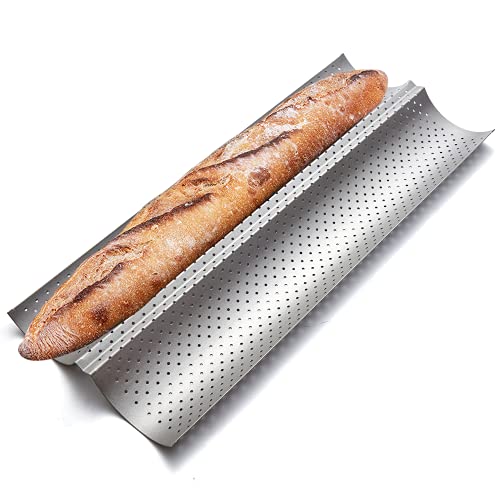
The KITESSENSU tray is the narrowest option here at 6.3 inches wide, with two curved channels for 15-inch baguettes. Its perforations are intended to let air circulate, and the nonstick surface helps release shaped loaves. The maker also presents the curved grooves as a way to support dough during fermentation and baking. This format suits small batches and limited rack width, but it cannot match the three- or four-loaf capacity of the wider trays.
Bottom line: Choose this when a narrow, two-loaf tray fits your baking routine.
How to choose a French bread baking tray
Choose a tray by oven fit first, then by how many loaves you bake at once. These options range from 6.3 to 13 inches wide and hold two to four loaves per pan; a wider channel count is useful only if the rack can accommodate the full pan. Measure the rack’s usable width and depth, allowing room to slide the pan in without scraping the oven walls. Perforations are common on baguette trays because they expose more of the dough surface to oven air, while curved channels support the loaf shape. Coating and metal are separate considerations: aluminum and carbon steel are both represented here, and the product-specific temperature limits differ. If you regularly bake near a pan’s maximum temperature, compare that limit with your recipe’s oven setting.
How many baguette channels do you need
Two channels suit small batches, three balance batch size with a narrower footprint, and four maximize the number of loaves per pan. The four-channel trays here are 13 inches wide, while the two-channel option is 6.3 inches wide; channel count alone does not determine overall fit. For a simple decision rule, choose a four-channel tray only if your rack has at least 13 inches of usable width plus room to handle the pan safely. Dough size also affects results: oversized pieces can crowd neighboring channels and bake into joined loaves, while undersized pieces may not fill the curved troughs. Divide dough evenly by weight when uniform loaf sizing matters.
| Batch need | Tray style | Fit consideration |
|---|---|---|
| Two baguettes | Two channels | Narrowest footprint |
| Three baguettes | Three channels | Compare 9- and 11-inch widths |
| Four baguettes | Four channels | 13-inch-wide pan |
Perforated trays versus solid baking sheets
Perforated baguette trays allow more airflow around the underside of dough than a solid sheet, which can help form a drier, crisper crust. A solid baking sheet is more versatile for loaves and rolls, but it does not cradle baguette dough in separate curved channels. The channel shape helps preserve a long, narrow profile as dough expands; it does not replace proper shaping or proofing. Parchment can simplify cleanup, but it may cover some perforations and reduce direct airflow at the base. For a crust-focused baguette, use only the parchment approach allowed by the pan maker and avoid letting paper extend beyond the tray near oven elements.
Safe use and care for baguette pans
Check the tray’s temperature limit before baking; the carbon-steel options here have different stated ceilings of 450°F and 446°F. Use oven mitts and support a loaded wide tray with both hands, since dough weight and uneven lifting can make a flexible pan slide. Nonstick coatings are best protected from sharp tools and abrasive scouring pads; use utensils that will not cut the surface and wash according to the pan’s care guidance. One option specifically recommends hand washing, while another says it is dishwasher safe, so care method depends on the tray. Let a hot pan cool before washing to avoid thermal shock and reduce the chance of burns from water or steam.
Frequently Asked Questions
Should baguette dough go on a cold or hot tray?
Place shaped dough on the tray before it goes into the oven, unless your recipe gives another method. A hot tray can make transfer difficult and increases burn risk; proof the dough in its channels only when the tray’s coating and recipe method support that step.
Do perforated baguette pans need parchment paper?
No, parchment is optional on a nonstick perforated tray, though one maker recommends it as a release aid. Covering the holes can reduce direct airflow under the loaf, so use a light coating of oil instead when you want the perforations exposed and the pan maker permits it.
What oven temperature can a baguette pan handle?
The two carbon-steel pans with limits are rated to 446°F and 450°F, respectively. Set the oven no higher than the specific pan’s limit, and account for broiler use separately rather than assuming the tray is broiler-safe.
How do you keep baguettes from sticking to a pan?
Use a thin coat of oil or a permitted parchment liner, and avoid cutting or scraping the nonstick surface with metal tools. Dough that is very wet or has overflowed the channels may be harder to release, so portion it evenly and leave space between loaves.
Can a four-loaf baguette tray fit in a small oven?
The four-channel trays here are 13 inches wide, so measure usable rack width before buying. Allow extra space to grip and center the tray; the narrow two-loaf option is 6.3 inches wide if rack width is the main constraint.