
Fuel Line Non-Return Valves: 5 Types Compared

For a fuel line with 6AN male-threaded connections, EVIL ENERGY 6AN Piston Check Valve is the clearest match, with a 3 PSI opening pressure and a 150 PSI maximum pressure. Choose a hose-barb valve instead when your line is sized by inside diameter; confirm the hose and fitting dimensions before ordering.
We earn a commission if you buy through links on this page. As an Amazon Associate I earn from qualifying purchases. Products are compared on manufacturer specifications, not hands-on testing.
- Best overall: EVIL ENERGY 6AN Piston Check Valve – The 6AN threaded connection and 150 PSI maximum pressure suit systems built around that fitting.
- Best for 10 mm hose: mxuteuk 10 mm Check Valves, Set of 2 – The set includes two 10 mm valves and adjustable clamps for 6–12 mm hoses.
- Best for multiple hose sizes: EVIL ENERGY 6AN Diaphragm Check Valve – The four-valve set covers 6, 8, 10 and 12 mm line sizes.
| Product | Best for | Connection or line size | Valve style | Pressure range | Shop |
|---|---|---|---|---|---|
| EVIL ENERGY 6AN Piston Check Valve | 6AN threaded systems | 6AN male, 9/16-18 UNF | Piston | 3–150 PSI | Check Price on Amazon |
| EVIL ENERGY 6AN Diaphragm Check Valve | 6AN diaphragm style | 6AN male, 9/16-18 UNF | Diaphragm | 3–150 PSI | Check Price on Amazon |
| mxuteuk 10 mm Check Valves, Set of 2 | 10 mm hose lines | 10 mm hose; clamps 6–12 mm | Inline | 2.9–87 PSI | Check Price on Amazon |
| Four-Size Aluminum Check Valve Set | Several hose diameters | 6, 8, 10 and 12 mm | Inline | 2.9–87 PSI | Check Price on Amazon |
| 4 mm Aluminum Check Valves, Set of 2 | Small 4 mm lines | 4 mm OD (5/32 in.) | Inline | 2.9–87 PSI | Check Price on Amazon |
Fuel Line Non-Return Valves
Match the valve connection and pressure rating to the fuel line and system before choosing a style.
EVIL ENERGY 6AN Piston Check Valve
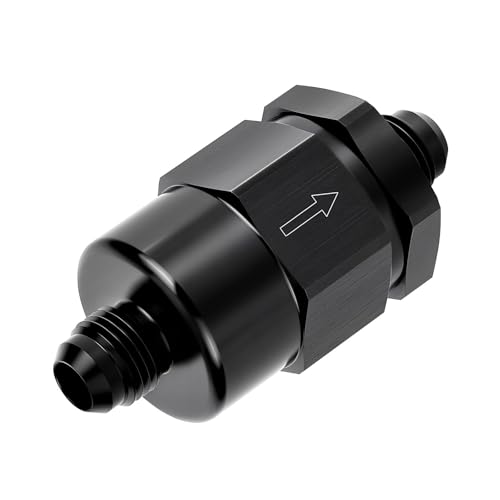
For a 6AN threaded system, this piston-style valve is the pick with a 150 PSI maximum pressure. Its body is 6061-T6 aluminum with a black anodized finish, and it has a stainless steel spring. The manufacturer gives a 3 PSI opening pressure and says the valve supports one-way flow for fuels and other fluids, including gasoline, diesel, methanol and E85. Choose it when the system uses matching 6AN male connections; it is not a hose-barb valve, so a hose-only setup needs compatible adapters.
Bottom line: Choose this if your fuel system uses 6AN connections and needs the higher stated maximum pressure.
EVIL ENERGY 6AN Diaphragm Check Valve

The diaphragm mechanism distinguishes this 6AN option from the piston-style 6AN valve. It has a 6061-T6 aluminum body, black anodized finish and stainless steel spring; the manufacturer specifies a 3 PSI opening pressure and 150 PSI maximum pressure. The maker says it is suitable for fuel, oil, coolant, air, diesel, methanol, ethanol and E85. This option suits a setup that calls for a diaphragm design while retaining 6AN threaded connections. Its threaded ends still require compatible fittings, so it will not attach directly to bare hose.
Bottom line: Pick this when you specifically want a diaphragm-style valve for a 6AN system.
mxuteuk 10 mm Check Valves, Set of 2

For a 10 mm hose line, this two-valve set includes four adjustable stainless steel clamps sized for hoses from 6 to 12 mm. The aluminum valves are described as resistant to gasoline, diesel and aging. The manufacturer gives a 2.9–87 PSI working range, a 2.9 PSI opening pressure and a temperature range of -30°C to 130°C. That range differs substantially from the 6AN options, so match it to the system rather than relying on the valve’s general fuel-line purpose. The hose size is the deciding fit; it is not a threaded 6AN fitting.
Bottom line: Choose this for a 10 mm hose installation that benefits from included clamps.
Four-Size Aluminum Check Valve Set

The four different line sizes are the distinguishing feature: this set includes valves for 6, 8, 10 and 12 mm hoses. Each valve is aluminum alloy with an anodized surface. The manufacturer gives a working pressure range of 2.9–87 PSI and an operating temperature range of -30°C to 130°C. It can be useful when maintaining equipment with more than one hose diameter, but the set does not replace checking each connection: select the valve that matches the particular line, not merely the size in the box. It is a hose-size option, not a 6AN threaded fitting.
Bottom line: Pick this set when you need to match different hose diameters across several lines.
4 mm Aluminum Check Valves, Set of 2

For a small fuel line, this pair is sized for 4 mm (5/32-inch) outside-diameter tubing. Each valve uses an aluminum alloy body, 304 stainless steel spring and NBR rubber seals. The manufacturer gives a 2.9–87 PSI operating range and says the valves are intended for diesel, gasoline, water or oil. The narrow 4 mm fit makes this a different choice from the 6–12 mm options; verify the tubing’s outside diameter before selecting it. The product is intended for low-pressure systems, so confirm the system pressure falls within its range.
Bottom line: Choose this pair for a compatible 4 mm line in a low-pressure system.
How to choose a fuel line non-return valve
Choose by connection first, then check the valve’s pressure range and opening pressure. A 6AN fitting uses a 9/16-18 UNF thread, while hose-size valves are selected by line diameter; these are different connection systems and are not interchangeable without suitable adapters. A check valve allows flow one way, and its opening pressure is the pressure needed to begin that flow. Compare the system’s operating pressure with the valve’s specified working or maximum pressure, not just the opening pressure. The 6AN models here specify 3 PSI opening and 150 PSI maximum; the hose-style options give working ranges topping out at 87 PSI. Select only a valve whose rating meets the system requirement.
Fuel hose sizing and connection fit
Measure hose outside diameter when the valve is sized for a hose, and confirm the manufacturer’s fit convention before installation. The 4 mm product explicitly gives outside diameter; the other hose products name 10 mm or a range of line sizes. AN fittings, by contrast, are threaded connections, so match the thread and fitting type rather than treating the AN number as a hose measurement. A useful decision rule is to choose a hose-size valve only when its size matches the measured hose dimension; do not force a near-size fit with a clamp. Inspect the hose for cracks or hardening and use fuel-compatible hose and clamps. A loose or damaged fuel connection can leak, creating a fire hazard.
Piston and diaphragm check valve styles
Piston and diaphragm describe different internal mechanisms, not different connection sizes. Both 6AN examples here specify the same opening and maximum pressures, but one uses a piston style and the other a diaphragm style; their connection and pressure figures therefore do not distinguish them. The hose-size valves are also inline choices, but their specifications do not identify an internal mechanism. For selection, prioritize the connection and pressure requirements before choosing a particular mechanism. Install any directional valve with its flow direction aligned to the intended fuel path. Reversing the flow direction can block the line rather than prevent return flow, so confirm the arrow or flow marking on the part itself before fitting it.
Fuel line check valve pressure and safety
Depressurize the fuel system before opening a line, keep sparks and flames away, and work with good ventilation because gasoline vapor can ignite readily. The valve’s maximum rating is not a target operating pressure: the system must stay within its own limits and the valve’s rating. The options here span opening pressures of 2.9–3 PSI and stated upper working or maximum pressures of 87–150 PSI, so they are not universally interchangeable. After installation, check every joint for leaks before operating the vehicle or equipment. Use fuel-rated components and compatible seals; a valve advertised for several fluids should still be matched to the exact fuel, hose and operating conditions in the application.
Frequently Asked Questions
What does a fuel line non-return valve do?
A non-return valve permits flow in one direction and resists reverse flow. Its opening pressure, such as the 2.9–3 PSI figures on these options, is the pressure needed to start forward flow.
How do I identify a 6AN fuel fitting?
A 6AN fitting uses a 9/16-18 UNF thread, as specified for the two 6AN valves here. Confirm that both mating parts use the matching thread and fitting form; hose diameter alone does not establish a 6AN match.
Can I use an 87 PSI valve on a 150 PSI system?
No: a valve with an 87 PSI upper working pressure is not rated for a 150 PSI system. Match the valve’s allowed pressure to the system’s maximum operating conditions, and do not treat opening pressure as the upper limit.
Which way should an inline check valve face?
The valve’s flow direction must point toward the intended forward fuel flow. Check the arrow or marking on the actual valve before installation, since reversing it can obstruct the supply path.
Should I clamp a smaller fuel hose onto a larger valve?
No; choose a valve sized for the hose rather than forcing a mismatch with a clamp. For example, a 4 mm outside-diameter valve is for tubing of that outside diameter, and an oversized or undersized connection can leak.