
Lawn Mower Gasoline Shutoff Valves Compared by Fit

For most lawn mowers with a 1/4-inch inner-diameter fuel line, Laranvi 1/4-Inch Inline Shutoff Valve, 4-Pack is the closest match because it is a straight shutoff valve supplied with clamps. Choose 90-Degree 1/4-Inch Shutoff Valve instead if a 90-degree turn better fits the hose route; confirm the line size and connection space before ordering.
A fuel shutoff valve interrupts gasoline flow between the tank and engine, which can help isolate the fuel system during storage or service.
We earn a commission if you buy through links on this page. As an Amazon Associate I earn from qualifying purchases. Products are compared on manufacturer specifications, not hands-on testing.
- Best overall: Laranvi 1/4-Inch Inline Shutoff Valve, 4-Pack – It is designed for small engines with 1/4-inch inner-diameter fuel line and includes clamps.
- Best for angled routing: 90-Degree 1/4-Inch Shutoff Valve – Its 90-degree shape is intended for 1/4-inch fuel lines and it includes two clamps.
- Best for a two-valve set: Two-Piece Plastic Inline Petcock Tap – The package has two plastic inline taps for 1/4-inch fuel-tap engines, though its motorcycle-oriented design merits a fit check.
| Product | Best for | Fuel connection | Valve shape | Included quantity | Shop |
|---|---|---|---|---|---|
| Laranvi 1/4-Inch Inline Shutoff Valve, 4-Pack | Small-engine lines | 1/4-inch ID line | Straight inline | 4 valves | Check Price on Amazon |
| 90-Degree 1/4-Inch Shutoff Valve | Angled hose routes | 1/4-inch ID line | 90-degree | 1 valve, 2 clamps | Check Price on Amazon |
| Two-Piece Plastic Inline Petcock Tap | Two-valve set | 1/4-inch tap engines | Inline | 2 valves | Check Price on Amazon |
Lawn mower gasoline shutoff valves
Compare the hose size, valve shape, and package contents before choosing a replacement.
Laranvi 1/4-Inch Inline Shutoff Valve, 4-Pack

For a straight replacement on a small engine, this four-pack is specified for 1/4-inch inner-diameter fuel line. The maker names lawn mowers, riding mowers, garden tractors, pressure washers, and other small engines among its applications, and includes several replacement part numbers. The package gives you four valves for multiple repairs or spares. It suits a mower whose existing line and routing match a straight inline valve. Its limitation is the straight layout: where the hose must turn sharply or clearance is tight, compare the angled option and measure the available space first.
Bottom line: Pick this for a mower with a straight 1/4-inch fuel-line route and a need for several valves.
90-Degree 1/4-Inch Shutoff Valve

A 90-degree body distinguishes this valve from the straight inline options, helping when the hose needs to change direction near the shutoff. It is described for 1/4-inch inner-diameter lines on snow blowers and lawn mowers, and the package contains one valve and two clamps. This is a fit for a mower where a straight valve would make the hose route awkward, provided the existing line diameter matches. The package has only one valve, unlike the multi-valve packs, and the compact measurements supplied do not establish the installed clearance, so compare the shape with the space around the existing connection.
Bottom line: Choose this when the hose route calls for a 90-degree valve and the line measures 1/4 inch.
Two-Piece Plastic Inline Petcock Tap
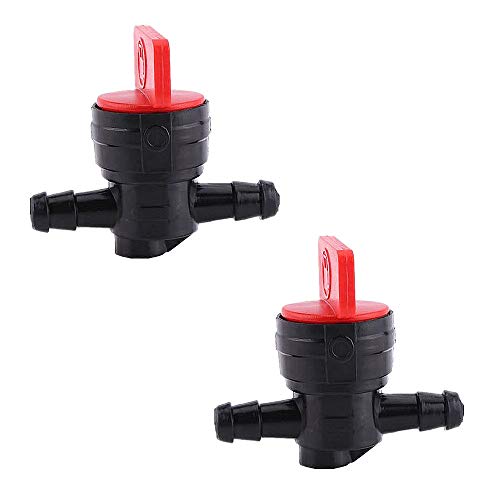
This pair is an inline plastic petcock set rather than a mower-specific replacement kit; its design is for motorcycle fuel systems, while its fit claim covers engines using a 1/4-inch fuel tap. The black-and-red taps are supplied two to a package and are described as easy to install. It may suit a lawn tractor or other engine only when the existing connection and fuel-line arrangement match the tap. The limitation is its less mower-focused fit guidance compared with the small-engine valves; verify the connection style and hose compatibility before selecting it.
Bottom line: Consider this only when the existing engine connection matches its 1/4-inch inline tap design.
How to choose a lawn mower fuel shutoff valve
Match the valve to the fuel-line inner diameter and the available hose route, not just the mower category. A 1/4-inch line means the hose’s inside diameter is 1/4 inch; measuring the hose opening is more useful than measuring its outside. Then compare a straight inline valve with a 90-degree body: use a straight valve when the hose can run without kinking, and an angled valve when a turn is needed and there is room for it. Record the existing valve’s connection style and clamp arrangement before removing it. A practical rule is to avoid any routing that bends the hose sharply or presses it against hot engine parts; if the connection differs from the original, confirm fit before installation.
Fuel-line sizing and valve fit
Small engines commonly use flexible fuel hose, and these options target a 1/4-inch inner diameter, but the mower’s actual hose size decides compatibility. Measure the inside opening of the existing hose or check the engine documentation; do not assume every lawn mower uses the same diameter. A replacement also needs compatible ends: inline valves join two hose ends, while tank-mounted petcocks use threaded tank openings. Those are different connection types, even when both control gasoline flow. Compare the old valve’s orientation and the space around it, since a valve body that fits the hose can still interfere with nearby parts. Avoid forcing a hose onto a mismatched barb, which can damage the hose or leave a leak path.
Installing and using a gasoline shutoff valve
Work only with a cool engine outdoors, away from cigarettes, flames, sparks, and other ignition sources; gasoline vapor can ignite. Close the existing shutoff if present, then prevent fuel from flowing through the line before disconnecting it, using a suitable fuel-line clamp rather than pinching or cutting the hose. Place an inline valve in the route between the tank and carburetor, secure the hose ends with compatible clamps, and make sure the valve handle remains reachable. After installation, open the valve and check for leaks before starting the engine. Close the valve for service or storage when appropriate, but never treat the valve as a substitute for safe fuel handling or a proper repair.
Common fuel shutoff replacement mistakes
Choosing by a mower’s brand alone is a common mismatch: line diameter, connection type, and valve shape matter more. A second mistake is installing a straight valve where the hose must bend tightly; a kink can restrict fuel flow, while a strained hose connection can leak. Keep the hose clear of hot exhaust and moving engine parts, and route it without tension. Check the valve and hose connections for wetness or gasoline odor after fitting and again before each use. If fuel continues to seep, stop using the mower, move it away from ignition sources, and repair the leak before restarting. Replace damaged, hardened, or cracked hose rather than relying on a new valve to correct a worn line.
Frequently Asked Questions
How do I measure a lawn mower fuel line?
Measure the inside diameter of the hose opening, not its outside width. A 1/4-inch inner-diameter line is the size these inline options are intended to fit.
Where does a mower fuel shutoff valve go?
An inline shutoff generally fits in the fuel hose between the tank and carburetor. Keep it accessible and route the hose away from hot or moving engine parts.
Should I close the fuel valve during storage?
Closing a shutoff can isolate fuel flow during storage or service, but it does not replace safe fuel storage practices. Keep gasoline in an approved container and away from heat or ignition sources.
Can I use a straight valve in a tight space?
Use a straight valve only if the hose can reach both ends without a sharp bend or strain. If the route needs a turn, a 90-degree valve may fit better, provided there is clearance for its body.
What should I do if a new valve leaks?
Stop the engine and keep the mower away from sparks, flames, and cigarettes. Do not restart it until the hose connection or valve has been repaired and the area is dry.