
Hole Punches for Leather: 4 Types Compared

For most leather projects that need a range of hole sizes, UNCO Hollow Punch Set, 1–10 mm is the most flexible choice because its 10 hollow punches span 1 to 10 mm. Choose a rotary plier instead for quick, repeated holes in the narrower 2 to 4.5 mm range.
Hollow punches suit larger or less common hole sizes, while pliers are convenient for small belt and strap holes.
We earn a commission if you buy through links on this page. As an Amazon Associate I earn from qualifying purchases. Products are compared on manufacturer specifications, not hands-on testing.
- Best overall: UNCO Hollow Punch Set, 1–10 mm – Ten hollow punches cover 1 to 10 mm, including sizes beyond the rotary sets’ 4.5 mm maximum.
- Best for easier squeezing: Diyife Double-Lever Rotary Punch – The double-lever design is intended to reduce the effort needed to squeeze the pliers.
- Best for compact handling: General Tools Model 72 Leather Punch – The 8.5-inch revolving plier has a self-opening design and rubber grip.
| Product | Best for | Style | Hole sizes | Punches | Shop |
|---|---|---|---|---|---|
| UNCO Hollow Punch Set, 1–10 mm | Wide size range | Hollow punches | 1–10 mm | 10 pieces | Check Price on Amazon |
| Diyife Double-Lever Rotary Punch | Reduced squeeze effort | Rotary pliers | 2–4.5 mm | 6 sizes | Check Price on Amazon |
| XOOL Revolving Punch Plier Kit | General craft use | Rotary pliers | 2–4.5 mm | 6 sizes | Check Price on Amazon |
| General Tools Model 72 Leather Punch | Rubber-grip pliers | Revolving pliers | 6 sizes; range unavailable | 6 punches | Check Price on Amazon |
Hole Punches for Leather
Match the punch style to the hole diameter and the way you plan to make each hole.
UNCO Hollow Punch Set, 1–10 mm
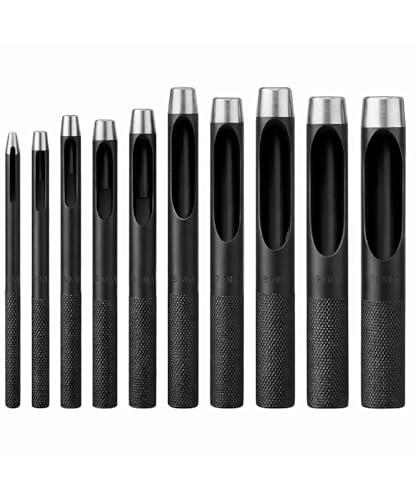
The UNCO set stands apart with 10 individual hollow punches covering 1 to 10 mm, rather than the six smaller diameters on the rotary pliers. Its carbon-steel punches are intended for leather, vinyl and fabric, and the set is suited to projects that call for varied hole sizes. A hollow punch requires a separate striking tool and a firm, sacrificial surface, so it is less convenient than pliers when making repeated belt holes. The set is a practical fit when diameter range matters more than one-handed operation.
Bottom line: Choose this set when your leather projects need holes larger than 4.5 mm or several different diameters.
Diyife Double-Lever Rotary Punch

The Diyife rotary punch has a double-lever mechanism, distinguishing it from the other plier-style options for buyers who want leverage while squeezing. Its six rotating sizes run from 2 to 4.5 mm, and it can punch leather, belts, plastic, rubber, canvas, fabric and cardboard. The blue tool includes two extra punch plates. Its size range is limited to small holes, so it is not the right fit when a project requires a hole larger than 4.5 mm or a very small 1 mm opening.
Bottom line: Pick this when the 2–4.5 mm range fits and reduced squeeze effort is a priority.
XOOL Revolving Punch Plier Kit

The XOOL kit pairs a revolving plier with six hole sizes from 2 to 4.5 mm, making it a match for small leather, belt and strap holes. The plated-steel tool is also intended for plastic, rubber, canvas, fabric, cardboard, saddles and shoes. Its brass pad and six punch heads are part of the kit. The narrow diameter range is the main constraint: projects calling for holes below 2 mm or above 4.5 mm need a different tool. This is a useful option for a household craft kit used across materials.
Bottom line: Choose this for small leather holes and occasional projects across several material types.
General Tools Model 72 Leather Punch

The General Tools Model 72 is the shortest plier-style tool here at 8.5 inches, with a self-opening design and rubber grip. It has six hollow hardened-steel punches and is intended for leather, canvas, denim, cloth and cardboard. That makes the Model 72 less straightforward to match by measurement than the other rotary pliers, but its grip and compact length may suit buyers who prefer those handling features.
Bottom line: Pick this if its six punch sizes match your project and you prefer an 8.5-inch rubber-grip tool.
Choosing a leather hole punch by diameter
Choose the punch by measuring the hole you need, not the width of the strap. Leathercraft holes commonly fall around 1 to 10 mm; small belt and strap holes are often in the 2 to 5 mm range, while hardware may call for larger openings. A 2 to 4.5 mm rotary wheel covers many small repairs, whereas individual hollow punches provide more diameter choices. For a hole larger than 4.5 mm, choose a punch set that reaches the required measurement instead of forcing a rotary tool beyond its range. Match the hole to the hardware stem with just enough clearance for a clean fit; an oversized hole can loosen a buckle or rivet.
Rotary pliers and hollow punches compared
Rotary pliers make small holes by squeezing a selected rotating punch against an anvil, while a hollow punch is struck to cut a circle from the leather. Plier-style tools are convenient for small, repeat holes and need no separate striking tool. Hollow punches offer broader size choices and can handle locations where plier jaws cannot reach, but each hole requires controlled strikes. Use a cutting board or other sacrificial surface beneath a hollow punch; a hard workbench can damage the cutting edge. A rawhide or plastic mallet is generally preferable to a steel hammer, which can deform the punch head.
| Need | Suitable style | Why |
|---|---|---|
| Repeated small holes | Rotary pliers | Rotating sizes and squeeze action |
| More diameter choices | Hollow punch set | Individual punches span broader ranges |
| Holes beyond 4.5 mm | Check the marked range | Some rotary sets stop at 4.5 mm |
Making clean holes in leather
Mark the center of each hole before punching and support the leather on a stable cutting surface. For a belt, measure from the existing holes and keep the new hole centered across the strap; spacing around 1 inch is common for standard belt holes, though the existing pattern is the best guide. A rotary punch should sit squarely against the leather so the cut is round rather than angled. With a hollow punch, use firm, controlled strikes and check that the cut has gone through before removing the tool. Keep fingers clear of the cutting edge, and do not punch directly over a finished table or hard floor.
Keeping leather punches sharp and aligned
Remove leather plugs from hollow punches after each cut, since packed scraps can interfere with clean cutting. Wipe steel tools dry before storage to reduce corrosion, and keep cutting edges covered or separated from other tools. Rotary punches need the selected head aligned over the anvil; if the wheel is between positions, the punch can land crooked and make a ragged hole. Test a new size on a scrap of comparable leather before working on the finished piece. Thick or layered leather may require more effort or a different punch style, so avoid twisting a punch or increasing force while it is misaligned.
Frequently Asked Questions
What size hole punch do I need for a leather belt?
Many belt holes are about 4 to 5 mm, but measure an existing hole or the buckle prong before punching. Choose a punch that leaves only modest clearance around the prong so the belt does not shift excessively.
Can rotary hole punches cut thick leather?
Rotary pliers can cut many common belt and strap materials, but thicker leather takes more force and can be harder to punch cleanly. For leather that will not sit squarely between the jaws, a correctly sized hollow punch and mallet may be easier to control.
How do I use a hollow punch without damaging a table?
Place the leather on a sacrificial cutting board or end-grain block before striking the punch. A rawhide or plastic mallet helps avoid deforming the punch head, and fingers should stay clear of the sharp cutting edge.
How far apart should new belt holes be?
About 1 inch between belt holes is common, but match the spacing of the existing holes when extending a belt. Mark each center on the same line and check the buckle position before cutting.
How can I keep a leather punch from making ragged holes?
Keep the punch perpendicular to the leather and use a sharp cutting edge on a stable surface. Clear leather scraps from hollow punches and confirm rotary heads are fully aligned before each cut.