
Housewise Tabletop Fire Pit: 4 Alternatives Compared

The Housewise tabletop fire pit is not represented here; among these alternatives, AmazStove 9.7 x 7.1-Inch Tabletop Fire Pit suits buyers who want a larger wood-or-pellet burner, with maker-claimed capacity up to 2.5 pounds. Choose HGD 5.5-Inch Tabletop Fire Pit instead for a smaller unit, or Ciays 28-Inch Propane Tabletop Fire Pit if you want propane and a 28-inch-wide fire pit.
We earn a commission if you buy through links on this page. As an Amazon Associate I earn from qualifying purchases. Products are compared on manufacturer specifications, not hands-on testing.
- Best overall: AmazStove 9.7 x 7.1-Inch Tabletop Fire Pit – Maker says it holds up to 2.5 pounds of fuel and burns for 50 to 60 minutes.
- Best for compact spaces: HGD 5.5-Inch Tabletop Fire Pit – Its tabletop body measures 5.5 inches across and weighs 1.7 pounds.
- Best for propane: Ciays 28-Inch Propane Tabletop Fire Pit – This 28-inch model uses propane and includes a glass wind guard and glass beads.
| Product | Best for | Dimensions | Fuel | Weight | Shop |
|---|---|---|---|---|---|
| HGD 5.5-Inch Tabletop Fire Pit | Compact wood fires | 8 x 5.5 x 5.5 in | Wood or pellets | 1.7 lb | Check Price on Amazon |
| BALI OUTDOORS 6.5-Inch Tabletop Fire Pit | Woven flame effect | 8.6 x 6.5 x 6.5 in | Dual fuel | 2.98 lb | Check Price on Amazon |
| Ciays 28-Inch Propane Tabletop Fire Pit | Propane centerpiece | 28.27 x 8.27 x 7.28 in | Propane | 20.05 lb | Check Price on Amazon |
| AmazStove 9.7 x 7.1-Inch Tabletop Fire Pit | Longer burn sessions | 9 x 7.5 x 7.5 in | Wood or pellets | 2.8 lb | Check Price on Amazon |
Tabletop Fire Pits Compared
Compare burner size and fuel type against the space and setup you have in mind.
HGD 5.5-Inch Tabletop Fire Pit

At 5.5 inches across, this is the most compact listed option with a carry bag, making it a fit for buyers who want a small wood-or-pellet fire pit for outdoor outings. Its stainless-steel construction and double-wall design with vent holes are intended to support airflow. The maker says the design reduces smoke; smoke can still occur, especially with damp fuel or poor airflow. The small footprint also means less room for a fire than a 28-inch tabletop model, so choose it for compact fires rather than a broad centerpiece.
Bottom line: Choose this when portability and a small footprint matter more than a wide flame area.
BALI OUTDOORS 6.5-Inch Tabletop Fire Pit
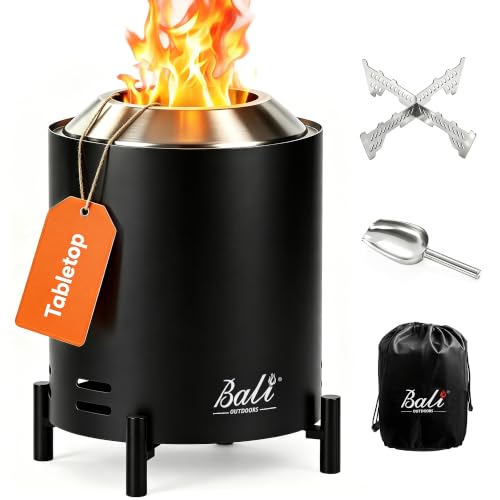
The BALI OUTDOORS model is distinguished by its secondary-combustion design, which the maker says creates a woven, tornado-like flame. Its 6.5-inch diameter is larger than the 5.5-inch unit, while the weight is 2.98 pounds. The maker also describes it as smokeless and dual-fuel, but the fuel information does not identify the options, so confirm compatibility before choosing fuel. This is a compact outdoor fire feature, not a substitute for a large fire pit when you need broad heat coverage.
Bottom line: Pick this for the secondary-combustion flame effect in a compact outdoor burner.
Ciays 28-Inch Propane Tabletop Fire Pit

Unlike the compact wood-burning models, this 28-inch tabletop fire pit is propane-powered and includes glass beads and a glass wind guard. The maker claims a heat output of up to 50,000 BTU, and the shield is intended to help protect the flame from breezes. Its size and 20.05-pound weight make it better suited to a stable patio table than to backpacking or casual carry. Confirm that your table can support the unit and that the propane setup matches the maker’s requirements before use.
Bottom line: Choose this for a larger propane flame display on a sturdy outdoor table.
AmazStove 9.7 x 7.1-Inch Tabletop Fire Pit

The AmazStove offers the clearest fuel-capacity figure among these compact wood-or-pellet burners: the maker says it accommodates up to 2.5 pounds of particles and burns for 50 to 60 minutes. It is made from 304 stainless steel and includes a transport bag, with a weight of 2.8 pounds. The maker also offers three years of service. Its dimensions are larger than the 5.5-inch HGD unit, so measure your table space; its claimed burn time is still finite, not an all-evening fire.
Bottom line: Pick this when a longer maker-claimed burn and a carry bag are priorities.
How to Choose a Tabletop Fire Pit
Choose first by fuel and footprint: a wood-or-pellet burner needs solid fuel and ash cleanup, while a propane model needs a compatible gas setup. Secondary-combustion designs route air back toward the flame through a double wall or vents; airflow and dry fuel affect how much smoke remains. A BTU figure describes heat output, not how much warmth reaches each person, because wind and distance change the result. Measure the table’s usable surface before selecting a burner, and leave room around the fire pit for safe handling. For these choices, a 28-inch body needs substantially more table space than a 5.5-inch unit. If your table cannot hold the unit’s footprint plus a clear area around it, choose a smaller model.
Wood, Pellet and Propane Fuel Differences
Wood and pellets burn as solid fuel and leave ash; propane burns without ash from the fuel itself but requires a compatible burner and gas connection. Small wood burners often use a double wall and vent holes to feed combustion air, so blocking vents or using damp fuel can increase smoke. Pellets are uniform in shape, while wood pieces vary; either fuel must fit the burner’s actual fire chamber. Propane models are not interchangeable with wood-burning tabletop pits: use only the fuel and connection arrangement intended for that appliance. The options here range from small solid-fuel units to a 28-inch propane fire pit. For portable trips where carrying bulk matters, favor a compact footprint and bag; for a stationary patio table, size may be less restrictive.
Tabletop Fire Pit Safety and Placement
Use a tabletop fire pit outdoors on a stable, noncombustible surface, and keep it away from overhead branches, awnings and other combustibles. A common fire-safety guideline is to keep outdoor fires at least 10 feet from buildings and combustible materials; follow any larger clearance required by the appliance maker or local fire rules. Never use a wood-burning fire pit indoors, in a tent or in an enclosed area, because burning fuel can produce carbon monoxide. Keep children and pets at a distance, and do not move a lit or hot unit. A glass wind guard can reduce direct wind exposure, but it does not remove the need for clearance. Check that the table is level and can support the unit before lighting.
Cleaning and Fuel Setup
Let a fire pit cool completely before removing ash or handling accessories; hot ash can retain heat after the flame is out. Empty ash into a metal container and keep it outdoors away from combustible materials until fully cold. For wood or pellet burners, keep vents clear and use dry fuel sized for the chamber; oversized pieces can obstruct airflow. Propane models need the correct connection and leak checks before ignition, following the appliance maker’s process. Store fuel and the fire pit separately from active flames, and protect stainless steel from prolonged moisture to reduce staining or corrosion. A carrying bag is for transport, not for storing a hot appliance.
Frequently Asked Questions
Can a tabletop fire pit be used indoors?
No; use a fuel-burning tabletop fire pit outdoors in open air. Wood and propane combustion can produce carbon monoxide, which can build up in enclosed or partly enclosed spaces.
How much clearance does an outdoor fire pit need?
A common outdoor fire-safety guideline is at least 10 feet from buildings and combustible materials. Increase that distance if the appliance maker or local fire rules require more, and avoid overhead branches or awnings.
Can I burn wood pellets in any tabletop fire pit?
No; use only fuel types intended for the specific burner. Pellet and wood size affect airflow, so keep vents open and avoid fuel that blocks the fire chamber.
How should I dispose of fire pit ash?
Wait until the unit is completely cool, then place ash in a metal container. Keep the container outdoors away from combustible materials until the ash is fully cold.
Can I move a tabletop fire pit while it is burning?
No; do not move a lit or hot fire pit. Let the burner and any glass accessories cool fully before handling or packing them.