
Matte Black Wheel Paint: Spray and Touch-Up Options

For painting a whole wheel, Rust-Oleum High Performance Wheel Spray Paint is the closest fit because it is an 11-ounce aerosol made for wheels and hubcaps; touch-up pens suit small scratches instead. Choose a pen or kit if you are repairing a few chips or scuffs rather than coating the full wheel.
We earn a commission if you buy through links on this page. As an Amazon Associate I earn from qualifying purchases. Products are compared on manufacturer specifications, not hands-on testing.
- Best overall: Rust-Oleum High Performance Wheel Spray Paint – The 11-ounce aerosol is intended for aluminum and steel wheels and plastic hubcaps, with coverage up to 8 square feet per can.
- Best for quick touch-ups: SMAPHY Matte Black Rim Touch-Up Pen – The 0.5-fluid-ounce pen is aimed at small wheel scratches and allows additional coats after drying.
- Best for repair prep: Matte Black Wheel Scratch Repair Kit – The boxed kit combines prep tools with a paint pen for detailed DIY touch-ups.
| Product | Best for | Application | Size | Drying or coverage | Shop |
|---|---|---|---|---|---|
| Rust-Oleum High Performance Wheel Spray Paint | Full wheel coating | Aerosol spray | 11 oz | Up to 8 sq ft; touch-dry in 10 min | Check Price on Amazon |
| SMAPHY Matte Black Rim Touch-Up Pen | Small scratches | Paint pen | 0.5 fl oz | About 10 min to dry at room temperature | Check Price on Amazon |
| Matte Black Wheel Scratch Repair Kit | Prepared touch-ups | Paint pen and prep tools | — | — | Check Price on Amazon |
Matte Black Wheel Paint Options
Match the application to the size of the repair: aerosol for broader coverage, or a pen and kit for small defects.
Rust-Oleum High Performance Wheel Spray Paint

For broader wheel coverage, this aerosol is made for aluminum and steel wheels as well as plastic hubcaps, unlike the touch-up-focused pens. The can holds 11 ounces, covers up to 8 square feet, and provides a matte, flat finish. Rust-Oleum says it dries to the touch in 10 minutes and offers dent and scratch resistance. It suits someone coating a wheel rather than dabbing isolated damage. Its aerosol format is less targeted than a pen, so small chips call for careful masking and controlled passes.
Bottom line: Choose this for a matte black coating across a wheel or hubcap.
SMAPHY Matte Black Rim Touch-Up Pen
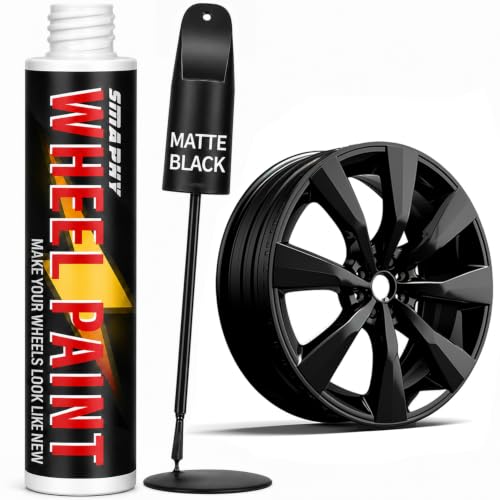
For isolated curb scrapes, this 0.5-fluid-ounce pen offers more targeted application than an aerosol can. The maker describes it as quick-drying automotive enamel for alloy and metal rims, with a flat or satin finish. Its instructions call for cleaning the bare area, shaking the pen for about a minute, and letting the first coat dry for 10 minutes at room temperature before adding coats if needed. It is a touch-up product, not a practical choice for coating an entire wheel, and the finish wording leaves some uncertainty about the exact sheen.
Bottom line: Choose this for small scuffs when a pen-style applicator suits the repair.
Matte Black Wheel Scratch Repair Kit

This boxed kit distinguishes itself by pairing a paint pen with prep tools for a more involved small repair. It is intended for minor curb rash, scratches, chips, scuffs, and small exposed spots on black-painted wheels, including alloy wheels. The maker describes the finish as OEM-style matte black and says the kit is designed to give a finer repair than a pen alone. It is best suited to localized damage; the specifications give no basis for estimating coverage or dry time, so it is not the right pick when those measurements are essential.
Bottom line: Choose this for small wheel defects when prep tools are useful.
How to Choose Matte Black Wheel Paint
Choose by repair area first: an aerosol is suited to broader coating, while a pen or repair kit targets small defects. A wheel face has contours and recessed areas, so masking and careful application matter more than simply matching the color name. Matte, flat, and satin are not interchangeable in appearance: flat and matte generally reflect little light, while satin has a more noticeable sheen. If matching an existing wheel, compare the paint on an inconspicuous area before committing to a visible repair. A touch-up pen is not a substitute for a full-wheel coating, and aerosol overspray can reach nearby tires, brakes, and bodywork unless those areas are protected.
Preparing a Wheel for Paint
Clean the wheel and let it dry fully before applying paint; dirt, brake dust, and moisture can interfere with adhesion. Remove loose paint and corrosion from the repair area, then mask the tire, valve stem, and brake components before spraying. Do not paint the tire or friction surfaces of the brake rotor or pads. For aerosol work, use light, even passes rather than trying to cover the wheel in one heavy pass; heavy wet coats are more prone to runs. Work outdoors or with strong ventilation, away from flames and sparks, and use the product label’s protective equipment guidance. If damage includes a bend, crack, or air leak, paint cannot repair the wheel’s structure or seal.
Spray Paint Versus Touch-Up Pens
Aerosols cover broad surfaces more naturally, while paint pens put material on a small chip without coating as much surrounding area. The table helps match the applicator to the repair scale; it does not guarantee a color match to every factory wheel finish.
| Repair need | Useful format | What to consider |
|---|---|---|
| Broad wheel coverage | Aerosol spray | Mask adjacent areas against overspray |
| Isolated scratch | Touch-up pen | Keep application within the damaged spot |
| Small defect needing prep | Repair kit with pen | Use prep tools before painting |
With a defect confined to a few small spots, a pen or kit avoids spraying across the whole wheel. If most of the visible face needs color, an aerosol is a more fitting format.
Common Wheel-Painting Mistakes
The most common mistake is painting over contamination or loose coating, which can leave a rough or poorly bonded repair. Another is failing to mask the tire and brake hardware: wheel paint belongs on the wheel surface, not on the tire tread or brake friction surfaces. Matte black also may not match a factory wheel simply because both are called matte; gloss level and the underlying finish affect how the repair looks in daylight. Keep the coating away from lug-seat contact surfaces and threads, where paint can interfere with proper wheel clamping. Follow the can or pen label for recoat and handling instructions, because touch-dry time does not establish when a painted wheel is ready for driving or washing.
Frequently Asked Questions
Can wheel paint be used on plastic hubcaps?
Some wheel paints are made for plastic hubcaps as well as metal wheels; the Rust-Oleum spray is described for both. Confirm that the chosen paint is intended for the specific substrate before applying it.
Should I use a pen or spray for curb rash?
A pen is suited to a few localized scratches, while spray is more appropriate when a broader wheel surface needs coating. If the rim is bent or cracked, paint is only cosmetic and does not repair the damage.
How many coats should I apply to wheel paint?
The SMAPHY pen instructions allow a second and third layer after the first has dried for about 10 minutes at room temperature. For any paint, use the label’s recoat directions rather than assuming touch-dry means ready for another coat.
Can I paint a wheel without removing it?
A touch-up kit is described for minor damage without removing the wheel, but the tire and brake components still need protection. Mask the tire, valve stem, and brake friction surfaces, and keep paint off lug seats and threads.
Why does matte black touch-up paint look different?
Matte, flat, and satin finishes reflect different amounts of light, so a product labeled matte black may not visually match every factory wheel. Test a small inconspicuous area first and compare it in daylight.