
Nordica Rear Entry Ski Boots: HF Models Compared

Nordica HF 120 Men’s 26.5 is the right starting point for skiers who want the stiffest flex in this group and a roomy 102 mm last. Choose another model if you need a medium flex or a women’s model; boot flex and gender-specific fit are the key differences here.
Rear-entry ski boots use an opening shell and rear closure to make getting in and out easier than on many traditional overlap boots.
We earn a commission if you buy through links on this page. As an Amazon Associate I earn from qualifying purchases. Products are compared on manufacturer specifications, not hands-on testing.
- Best overall: Nordica HF 120 Men’s 26.5 – It pairs the group’s stiff flex with a 102 mm last and rear-entry closure.
- Best for medium flex: Nordica HF 100 Men’s 25.5 – Its medium flex and 25.5 size distinguish this men’s model.
- Best for women: Nordica HF 75 Women’s 26.5 – It is the women’s model and has a medium flex with a 102 mm last.
| Product | Best for | Flex | Size | Shop |
|---|---|---|---|---|
| Nordica HF 120 Men’s 26.5 | Stiffer flex | Stiff | 26.5 | Check Price on Amazon |
| Nordica HF 100 Men’s 25.5 | Medium flex | Medium | 25.5 | Check Price on Amazon |
| Nordica HF 75 Women’s 26.5 | Women’s fit | Medium | 26.5 | Check Price on Amazon |
Nordica Rear Entry Ski Boots
Compare these HF models by flex, intended fit and size before choosing a shell that matches your foot and skiing style.
Nordica HF 120 Men’s 26.5

Nordica HF 120 Men’s 26.5 is the stiff-flex option among these three, while retaining the same 102 mm last as the other HF models. The men’s boot pairs a rear-entry design with a shell that opens 40 degrees, a hands-free back buckle, and a heat-moldable shell and cork liner. GripWalk soles are part of this model, so check binding compatibility before skiing. The 26.5 size and high-volume fit make it a candidate for skiers who need room but still want a firmer flex. Its stiff feel may be less forgiving for lighter or less aggressive skiers seeking easier ankle movement.
Bottom line: Choose this option if you want a firmer flex and the roomy 102 mm last.
Nordica HF 100 Men’s 25.5

Nordica HF 100 Men’s 25.5 gives you a medium-flex men’s option in size 25.5, rather than the stiff flex of the HF 120. Nordica’s HF shell opens 40 degrees, and the rear monolock buckle is designed to close by pressing it down with a foot. The 102 mm last and high-volume shape favor feet that need more space across the forefoot. A medium flex can suit recreational skiers who do not want the firmer response of a stiff boot, but flex labels are not standardized across brands; try the boot in a skiing stance to judge how it feels for your weight and ability.
Bottom line: Pick this model if you want a medium-flex men’s boot in size 25.5.
Nordica HF 75 Women’s 26.5
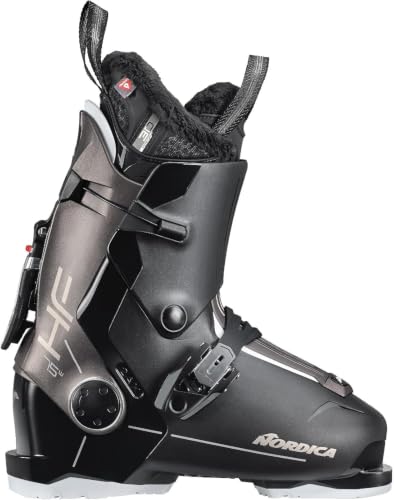
Nordica HF 75 Women’s 26.5 is the women’s HF choice here, with a medium flex and 26.5 size. Its 102 mm last, high-volume construction and rear-entry shell match the other HF models, so gender designation and flex—not width—are the main distinctions in this group. The shell opens 40 degrees, and the back buckle is designed for hands-free operation. That ease of entry may appeal to skiers who find overlap shells awkward to step into. The medium flex is not the firmer choice for aggressive skiing, and the size number alone cannot confirm fit; shell shape and foot length matter too.
Bottom line: Choose this if you want the women’s HF model with a medium flex.
How to choose Nordica rear entry ski boots
Start with shell fit and flex, not the convenience of the rear closure. Ski boot sizes use Mondopoint, which corresponds roughly to foot length in centimeters; measure both feet while standing, since feet can lengthen under load. A 102 mm last is a width reference at a particular shell size, and the perceived width changes as boot size changes. Flex numbers and labels are not standardized between brands, so compare models within this group rather than assuming a number means the same feel elsewhere. As a practical rule, choose the stiffer option only if you can flex it forward in a skiing stance without pain or loss of balance; otherwise favor the medium-flex models. A boot that is too long can reduce control even when the forefoot feels roomy.
Rear-entry boot fit and sizing
A rear-entry shell opens behind the foot so the skier can step in, then closes around the ankle and lower leg. The HF shells in this group open 40 degrees, but that opening angle does not guarantee a match for every instep, heel or calf shape. Try boots with ski socks, standing upright and then flexing forward; toes may brush the front when standing, but should ease back as the knees bend. Check heel movement and pressure at the instep, not just toe room. A boot fitter can assess shell length and width separately, and heat molding should be handled by a qualified fitter when needed. Avoid sizing up just to relieve a single pressure point, since excess length can weaken ski control.
Binding compatibility and boot safety
Boot sole compatibility is a safety requirement: the boot sole and ski binding must be designed to work together, and a binding should be adjusted and release-tested by a qualified ski shop. GripWalk soles require bindings marked as GripWalk compatible; do not assume a binding fits because the boot clicks into it. Sole wear, ice or packed snow can also interfere with the boot-binding interface, so keep the sole clean before stepping in. Verify the binding type and the boot’s sole marking before skiing, especially when replacing boots but keeping existing skis. A comfortable fit cannot compensate for an incompatible or poorly adjusted binding, and release settings should not be guessed at home.
Frequently Asked Questions
What does a 102 mm ski boot last mean?
A 102 mm last is a reference width measured at a specific boot size, not a promise that every foot will feel exactly 102 mm wide inside. The fit also depends on shell shape, liner thickness and the skier’s foot volume.
How should ski boots feel when standing?
Ski boots should feel snug around the heel and midfoot without sharp pain or numbness. Toes may lightly touch the front while standing upright, then draw back as you flex forward; persistent toe pressure or heel lift calls for a fit assessment.
Are rear-entry ski boots easier to put on?
Rear-entry boots open at the back, which can make stepping into them easier for some skiers than entering an overlap shell. Fit still depends on instep height, heel shape and calf volume, so an easy entry does not prove the boot fits securely.
Can I use GripWalk boots with any ski binding?
No; a GripWalk boot needs a binding explicitly compatible with GripWalk soles. Have a qualified ski shop confirm boot-binding compatibility and check the binding adjustment before skiing.
Does ski boot flex mean the same thing across brands?
No; flex labels are not standardized across brands, and the boot’s feel also depends on skier weight, temperature and stance. Compare flex choices within a model family and test forward movement in a skiing stance.