
Orange Ninja Knife Sharpeners: 3 Models Compared

For most kitchen users, Orange Ninja 4-Stage Serrated & Kitchen Sharpener is the Orange Ninja knife sharpener to choose because its four-stage system includes a slot for serrated blades as well as three stages for straight knives. Choose Sharp Pebble 5-Angle Sharpener instead if you want selectable angles for straight-edge blades; for field or garden tools, the dedicated outdoor models are a better match.
We earn a commission if you buy through links on this page. As an Amazon Associate I earn from qualifying purchases. Products are compared on manufacturer specifications, not hands-on testing.
- Best overall: Orange Ninja 4-Stage Serrated & Kitchen Sharpener – Four slots cover coarse repair, medium sharpening, fine polishing, and serrated blades.
- Best for angle selection: Sharp Pebble 5-Angle Sharpener – Offers five selectable angles from 12° to 24° for straight-edge blades.
- Best for field carry: Orange Ninja Pocket Field Sharpener 6-in-1 – Combines diamond plates, guided sharpening, a strop, fire starter, and diamond rod.
| Product | Best for | Sharpening stages | Blade compatibility | Length | Shop |
|---|---|---|---|---|---|
| Orange Ninja 4-Stage Serrated & Kitchen Sharpener | Kitchen knives | 4 slots | Straight and serrated | 8.18 in | Check Price on Amazon |
| Sharp Pebble 5-Angle Sharpener | Angle selection | 3 stages | Straight-edge only | 10 in | Check Price on Amazon |
| Orange Ninja Pocket Field Sharpener 6-in-1 | Outdoor maintenance | 6-in-1 kit | Straight, serrated, gut hooks | 5 in | Check Price on Amazon |
Orange Ninja Knife Sharpeners Compared
Match the sharpener to the blade type and setting before choosing a model.
Orange Ninja 4-Stage Serrated & Kitchen Sharpener

For kitchen drawers that include both straight and serrated knives, this four-slot sharpener is the most versatile dedicated kitchen option here. Its coarse carbide slot repairs and straightens straight blades, diamond rods sharpen, and the fine slot polishes; a separate slot is intended for serrated edges. The handle is designed for left- or right-handed use, and the tool measures 8.18 inches long. It is not the smallest choice for a compact kit, and the serrated slot is not a substitute for angle selection when you need a specific bevel.
Bottom line: Choose this for kitchen drawers with both straight and serrated knives.
Sharp Pebble 5-Angle Sharpener
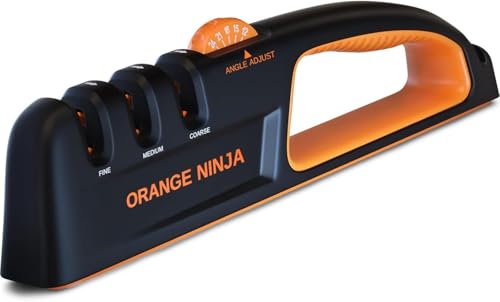
Selectable bevel angles distinguish this manual three-stage sharpener from the fixed-slot designs: choose 12°, 15°, 18°, 21°, or 24° for a straight-edge blade. Its handheld format is intended for kitchen, pocket, and hunting knives, and its 10-inch length makes it longer than the other kitchen-oriented picks. The key limitation is compatibility: the maker specifies straight-edge blades only, so skip it for serrated knives or scissors. It suits buyers who know the angle they want and prefer to set it rather than use a general multi-slot system.
Bottom line: Pick this when a selectable angle matters more than serrated-blade support.
Orange Ninja Pocket Field Sharpener 6-in-1

For field maintenance, this five-inch kit combines more than a pull-through sharpener: it has 220- and 600-grit diamond plates, a guided system, carbide slot, leather strop, fire starter, and diamond rod. The maker says it works on straight edges, serrated knives, and gut hooks, making its blade coverage broader than a kitchen-only sharpener. Its small size suits a pack, tackle box, or EDC kit. The tradeoff is that it is built around outdoor carry and multiple tools, rather than a simple dedicated kitchen sharpening routine.
Bottom line: Choose this for maintaining mixed knife types while camping or hunting.
How to choose an Orange Ninja knife sharpener
Start with blade type, then choose the sharpening format: a serrated edge needs a serrated-capable tool, while a straight edge can use a standard slot or guided system. A pull-through sharpener is quick because the blade passes across preset abrasive surfaces; a guided system helps control the angle during strokes. If you need a defined bevel, the adjustable-angle model offers settings from 12° to 24°. If your knife set has serrated blades, choose a model whose features explicitly include serrated sharpening rather than assuming a straight-blade slot will work.
Match the tool to its main job. Kitchen touch-ups favor a simple station; a field kit adds portability and multiple sharpening elements, while garden sharpeners are intended for tools such as pruners and axes.
Knife sharpener types and blade fit
Pull-through slots and guided systems solve different problems: slots emphasize convenience, while guided sharpening gives more control over the blade angle. Serrated knives need care at the scallops, generally sharpening the beveled side rather than grinding both sides like a straight edge. A pull-through tool should have an explicitly designated serrated slot; the standard coarse, medium, and fine stages are for straight knives unless the maker says otherwise.
Use this fit guide to match the tool format to the intended blade and setting.
| Need | Suitable format | Check before use |
|---|---|---|
| Straight kitchen knife | Coarse, medium, and fine slots | Keep the blade aligned in the slot |
| Serrated knife | Dedicated serrated slot or rod | Work with the serrations, not across them |
| Specific bevel angle | Adjustable-angle or guided sharpener | Match the existing edge angle when possible |
| Garden shears or axes | Garden-tool sharpener | Use only on compatible blade shapes |
Safe knife sharpening technique
Keep the sharpener stable on a nonslip surface and move the blade away from your body; a knife can cut during sharpening even when the edge is dull. Hold the handle securely and use light, controlled strokes rather than forcing the blade through a slot. Pull-through sharpeners remove metal, so repeated heavy passes can shorten a blade’s useful life and create an uneven edge.
Separate knives from scissors and other tools unless the sharpener is expressly designed for them. For field kits with diamond plates or rods, keep fingers clear of the abrasive path and secure the blade before each stroke. After sharpening, wipe away metal filings before returning the knife to food preparation.
When to sharpen and how to avoid mistakes
Sharpen when a straight kitchen knife no longer slices cleanly through a tomato skin or paper with light pressure; honing and sharpening are different, since honing realigns an edge while sharpening removes metal to form a new one. A knife used daily may need honing every few uses, while sharpening frequency depends on steel, cutting board, and workload. Glass, stone, and ceramic boards blunt edges faster than wood or plastic.
A common mistake is using a serrated slot for a straight knife or a straight-blade slot for serrations. Another is changing the bevel angle unnecessarily: if the knife’s original angle is known, select the closest setting instead of repeatedly reshaping the edge.
Frequently Asked Questions
Can an Orange Ninja sharpener sharpen serrated knives?
Some models are designed for serrated blades, including the four-slot kitchen sharpener and the six-in-one field kit. Use a dedicated serrated slot or rod and avoid drawing serrations through a standard straight-edge slot.
What angle should I use to sharpen a kitchen knife?
A 15° to 20° angle per side is common for many Western kitchen knives, while some Japanese knives use narrower angles. When a sharpener offers fixed settings, use the closest angle to the existing bevel rather than changing it without a reason.
How often should kitchen knives be sharpened?
Many home cooks sharpen a frequently used knife every few months, with honing more often to realign the edge. Hard cutting surfaces such as glass or stone can make sharpening necessary sooner than wood or plastic boards.
Can a pull-through sharpener damage a knife?
A pull-through sharpener can remove excess metal if you press hard or make many unnecessary passes. Use controlled strokes and stop once the edge cuts cleanly; a coarse repair slot is for damaged or very dull edges, not routine touch-ups.
Can I sharpen scissors with a knife sharpener?
Only use a sharpener that explicitly supports scissors; a knife slot can damage scissor bevels or misalign the blades. The adjustable-angle model here is specified for straight-edge knives, not scissors.