
Paint Roller Wood Grain Effect: 5 Tools Compared

For a paint roller wood grain effect, 11-Piece Wood Grain Tool Set is the most versatile choice because its 11 pieces include a 7-inch roller, a rocker, four rubber graining tools and five brushes. Choose a different set if you want fewer accessories or smaller rubber tools for narrow areas.
Wood-grain tools texture a wet topcoat to imitate wood figure over a base coat; they are decorative tools, not rollers for applying paint to large surfaces.
We earn a commission if you buy through links on this page. As an Amazon Associate I earn from qualifying purchases. Products are compared on manufacturer specifications, not hands-on testing.
- Best overall: 11-Piece Wood Grain Tool Set – The 11-piece set combines a 7-inch roller, four rubber tools, a rocker and five brushes.
- Best for a 6-piece kit: 6-Piece 7-Inch Wood Graining Set – The set offers six tools with a 7-inch roller and handle.
- Best for varied widths: King Origin 4-Piece Rubber Tool Set – Four rubber tools range from 2.8 to 5.9 inches.
| Product | Best for | Roller or tool widths | Piece count | Included accessories | Shop |
|---|---|---|---|---|---|
| 11-Piece Wood Grain Tool Set | Full accessory kit | 3–7 in | 11 pieces | Roller, rocker, 4 rubber tools, 5 brushes | Check Price on Amazon |
| 6-Piece 7-Inch Wood Graining Set | Handle included | 7 in roller | 6 pieces | Roller, handles and rubber tools | Check Price on Amazon |
| King Origin 4-Piece Rubber Tool Set | Four rubber widths | 2.8–5.9 in tools | 4 pieces | Rubber graining tools | Check Price on Amazon |
| 7-Piece Wood Grain Tool Set | Paint layering steps | — | 7 pieces | Rubber graining tools | Check Price on Amazon |
| LUTQ Wood Grain Tool Pack of 4 | Handheld operation | — | 4 pieces | Rubber graining tools | Check Price on Amazon |
Paint Roller Wood Grain Effect Tools
Compare the working widths and kit contents to match a graining tool to the surface and pattern you want to create.
11-Piece Wood Grain Tool Set

The 11-piece set stands out for combining graining tools with paint brushes, so it covers more steps of a decorative project than a roller-only kit. It includes a 7-inch roller, a 4-inch rocker, rubber tools in 3, 4, 5 and 6 inches, and five brushes from 1 to 2.5 inches. The rubber tools are soft, and the brushes use synthetic filaments with wood handles. This set suits projects that need varied widths and brush application. Its larger assortment may be unnecessary if you only need a single broad graining tool.
Bottom line: Choose this kit if you want brushes and multiple graining widths in one set.
6-Piece 7-Inch Wood Graining Set
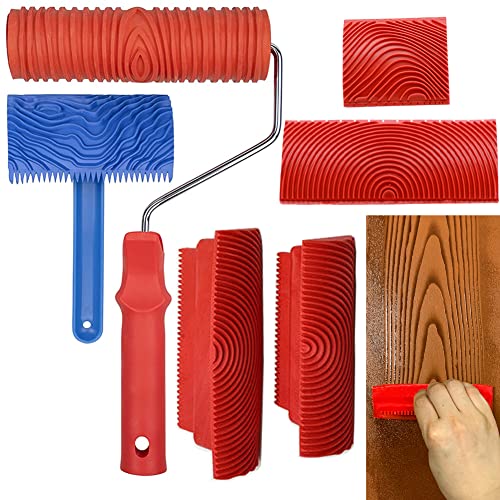
The 6-piece set is the option that specifically emphasizes a handle with its 7-inch wood-grain roller. Its rubber tools are described as elastic and wear-resistant, and the set is intended for decorative work on surfaces such as walls, floors, furniture, fences and decks. The longer handles can help keep hands farther from the painted surface. This kit suits someone looking for a compact set centered on a 7-inch tool. The piece breakdown is limited, so confirm the exact included tool shapes if a particular pattern is essential.
Bottom line: Pick it if a 7-inch roller and handle matter more than a large brush assortment.
King Origin 4-Piece Rubber Tool Set

The King Origin set differs by offering four specified rubber tool widths without a separately identified roller assembly or brushes. The sizes are 2.8, 3.5, 5.1 and 5.9 inches, giving a spread from relatively narrow strokes to broader patterns. Its rubber tools are described as washable, elastic and resistant to deformation. This format suits furniture, doors or other sections where tool width matters more than a handle-and-roller setup. Because the maximum width is 5.9 inches, it may take more passes than a wider roller across broad panels.
Bottom line: Choose this set for a range of rubber tool widths on smaller sections.
7-Piece Wood Grain Tool Set

The 7-piece set is distinct for giving a basic process for layering paint: apply a base color and let it dry, then work the surface color while wet with the graining tool. The set uses soft rubber tools and is presented for textured and water-based paint, with applications including walls, furniture, floors, fences and decks. It suits DIY projects where the user wants to create the grain by drawing tools through a wet coat.
Bottom line: Pick this set if you want rubber graining tools and a wet-topcoat approach.
LUTQ Wood Grain Tool Pack of 4

The LUTQ pack is framed around handheld operation, with an ergonomic handle intended to support grip and controlled movement. It includes four premium-rubber graining tools and is intended for creating decorative wood textures on varied surfaces. The compact package dimensions are 6.5 inches long and 5.8 inches wide, with a weight of 0.45 pounds. This option suits someone prioritizing a small four-piece pack for hand-controlled pattern work.
Bottom line: Choose it for a compact four-piece set designed for controlled handheld work.
How to choose a wood grain roller
Choose by working width and included tool type first: a broad 7-inch roller covers more area per pass than a narrow rubber graining tool. Rubber graining tools create the figure by moving through a wet topcoat, while brushes apply paint and a rocker can vary the pattern with a rolling motion. For a large flat panel, a wider tool can reduce repeated passes; for trim or small furniture sections, a tool under 4 inches is easier to keep within the edge. Match the kit to the steps you need rather than counting pieces alone. A set with brushes helps apply coatings, but brush count does not tell you whether the graining tool fits your panel.
Practice first on a scrap panel with the same base and topcoat. The wet working time controls how long you have to adjust the grain before the surface begins to set.
How paint layering creates a wood grain effect
A faux wood grain finish usually uses a contrasting base coat and a wet topcoat: let the base dry, then draw a graining tool through the wet surface color. The motion displaces the topcoat and reveals the base beneath it, creating a grain-like pattern. The 7-piece set specifically describes this base-dry, topcoat-wet sequence for textured and water-based paint. Work in manageable sections because the topcoat must remain workable while the pattern is formed. If a panel is wider than the tool, keep the passes aligned and avoid stopping mid-section, where a seam can become visible.
Practice pressure and speed on scrap; lighter or firmer contact changes how much of the underlying color shows. Do not assume every coating behaves alike: verify that the paint type can be worked with the tool before starting the finished surface.
Tool width and surface fit
Match tool width to the area: tools below 4 inches are easier to control on trim, while a 7-inch roller is more suited to broad flat spans. A large roller can overrun narrow edges, and a narrow tool can require extra passes on a door or tabletop. The specified kits span 2.8 to 7 inches, but some sets do not give individual tool widths, so check the actual pieces if an exact fit is critical. Keep the tool aligned with the direction you want the grain to run, and complete each section consistently. Wood-grain tools are for decorative patterning; they are not substitutes for a standard paint roller when coating a large area.
Test on a sample before committing to a visible surface. Differences in panel width, corners and raised details affect how easily a pattern can continue across the whole piece.
Common mistakes with faux wood graining
The most common mistake is working after the topcoat has begun to dry; the graining tool needs a wet surface to move paint cleanly. A second is using uneven pressure, which can create inconsistent pattern depth across one panel. Apply the base coat and allow it to dry before adding the wet working coat, as the 7-piece set’s instructions describe. Use a scrap test to find a steady hand speed and pressure before tackling doors or furniture. Keep the tool clean enough to avoid carrying dried paint into the wet layer, and avoid starting a section you cannot finish before the coating loses workability.
For safety, use coatings only as directed on their labels, ventilate the work area, and keep paint away from skin and eyes. Soft rubber tools can prevent surface scratching, but they do not replace ordinary care when working with paint or ladders.
Frequently Asked Questions
Can a wood grain roller create realistic grain on furniture?
A graining tool can create a wood-like decorative pattern by moving through a wet topcoat and revealing a contrasting base color. Test the paint combination and hand motion on a scrap piece before working on furniture.
How wide should a wood graining tool be?
Choose a width that fits the panel: tools under 4 inches are easier to control on narrow trim, while a 7-inch roller covers a broader span per pass. Test the pattern at the edge of a sample first.
Does the base coat need to dry first?
Yes, the described process for the 7-piece set is to apply the base color and let it dry before adding a wet surface color. The wet layer is where the graining tool forms the pattern.
Can wood grain tools be used with water-based paint?
The 7-piece set is described for textured and water-based paint, but coatings differ in how long they stay workable. Check that the paint can be manipulated while wet and test a small sample before coating the finished surface.