
Pool Floats for 2 Year Olds: 4 Options Compared

For a 2-year-old, the car-shaped float with a safety seat and removable UPF 50+ canopy is the closest match when a canopy and defined age range matter. Choose a simpler ring if you want a smaller float, or another seat design if its dimensions better match your child.
Pool floats are buoyant toys, not life-saving devices; stay within arm’s reach and supervise continuously.
We earn a commission if you buy through links on this page. As an Amazon Associate I earn from qualifying purchases. Products are compared on manufacturer specifications, not hands-on testing.
- Best overall: Toddler Car Float with Canopy – Its 1–5 year age range and removable UPF 50+ canopy suit a range of sunny pool settings.
- Best for seat sizing: iGeeKid Car Float with Canopy – It gives seat and leg-hole measurements plus a 0–44 lb load-bearing range.
- Best for compact size: 25.6-Inch Baby Pool Float – Its 25.6-inch square size is smaller than the car-style floats.
| Product | Best for | Age range | Dimensions | Seat or canopy | Shop |
|---|---|---|---|---|---|
| Toddler Car Float with Canopy | Sunny pool days | 1–5 years | 31 × 24 × 10.6 in | Safety seat; UPF 50+ canopy | Check Price on Amazon |
| iGeeKid Car Float with Canopy | Measured seat fit | 18–36 months | 33.5 × 21 × 23 in | 9.8 × 13.9 in seat; canopy | Check Price on Amazon |
| 25.6-Inch Baby Pool Float | Smaller footprint | 6–36 months | 25.6 × 25.6 in | Seat; two air chambers | Check Price on Amazon |
| CICITOYWO Unicorn Float | Unicorn design | 8–48 months | Kids/child-sized | Cushion; handle | Check Price on Amazon |
Pool Floats for 2 Year Olds Compared
Compare the age ranges, overall dimensions, and seat or canopy features before deciding which float fits your child and setting.
Toddler Car Float with Canopy

Compared with the other options, this car-shaped float combines a broad stated age range with a removable UPF 50+ canopy. It measures 31 × 24 × 10.6 inches and includes a safety seat, steering wheel, and horn. The maker says the canopy adjusts or removes for changing conditions. It suits families who want shade built into the float, but the overall dimensions may take more storage space than a simple ring. Treat the canopy as supplemental shade, not a substitute for protective clothing, sunscreen, or close supervision.
Bottom line: Choose this if a removable sun canopy and car-style seat are priorities.
iGeeKid Car Float with Canopy

Unlike the other choices, this car float gives measurements for its inner seat and leg openings, helping caregivers compare the fit with a child’s size. The float measures 33.5 × 21 × 23 inches; its inner seat is about 9.8 × 13.9 inches, and its leg openings are about 5.1 × 4.1 inches. The load-bearing range is 0–44 pounds, and it has a canopy, steering wheel, and horn. Its 18–36-month age range is narrower than the other car float’s, so it is for toddlers rather than older preschoolers.
Bottom line: Pick this when the seat and leg-hole measurements match your child.
25.6-Inch Baby Pool Float

This is the smallest float by overall dimensions among the options with measurements, and it uses a round seat-style design rather than a car shape. The 25.6 × 25.6-inch float has two air chambers and a seat; the maker says the design helps keep a child upright. Its age range is 6–36 months, which includes many 2-year-olds. The seat opening is not dimensioned, so this is less useful when you need to compare a precise leg fit before purchase. Keep a hand close to the child even when the float appears stable.
Bottom line: Choose this if a smaller, seat-style float is the main priority.
CICITOYWO Unicorn Float
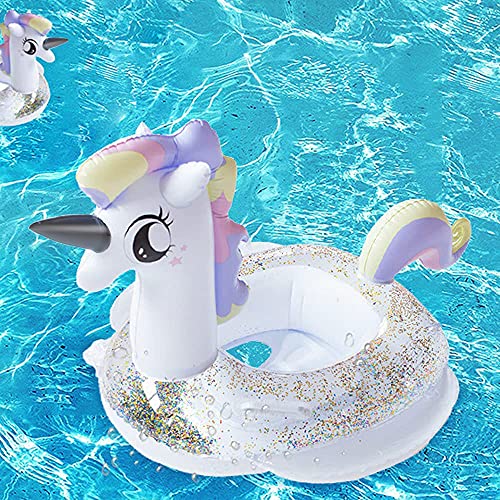
Unlike the seat-and-canopy car floats, this option emphasizes a unicorn design, sequins, a handle, and a cushion. Its age range is 8–48 months, covering age 2, but the size is only identified as kids/child-sized rather than given as measurements. That makes it harder to check fit against a child’s body or compare storage needs. The handle and cushion offer places to hold and sit, but the maker’s wording about safe use does not make any float a safety device. Choose it for the design only when its actual fit can be confirmed.
Bottom line: Pick this if the unicorn styling matters and fit can be confirmed.
How to choose a toddler pool float
Choose by fit, body support, and intended conditions rather than by shape alone. A seat-style float positions a child through leg openings; a ring-style float uses an inner opening and seat straps; car-style floats add a platform and often a canopy. Compare the child’s age and weight with the float’s range, then measure seat and leg openings when those dimensions are available. If a float gives no fit measurements, do not assume that a broad age range guarantees a secure fit. For sunny water play, a canopy can add shade, but it does not replace shade breaks, sun-protective clothing, or sunscreen. No inflatable float replaces adult supervision or a properly fitted life jacket where one is required.
Seat fit and size checks
Seat openings matter more than overall float dimensions when a child sits through leg holes. Measure the child’s seated width and compare it with the inner seat and leg openings; the opening should not allow slipping through or pinch the legs. A load range is a ceiling, not proof that the fit is right. Check for complete inflation, secure air valves, and any damage before each use, and remove a float from use if it loses air or has a tear. Keep the child within arm’s reach in and around water. A pool float is a toy, not a personal flotation device, and should never be used as a substitute for an approved life jacket.
Float styles and what they offer
Ring floats, seated baby floats, and car-style floats differ mainly in how the child is positioned and what extras they add. Use this guide to narrow the style before checking fit and age range.
| Style | Typical design feature | Consider when |
|---|---|---|
| Ring | Inner opening and seat straps | You want a simple circular float |
| Seat-style | Seat with leg openings | You need a contained sitting position |
| Car-style | Seat, steering wheel, sometimes canopy | You want a themed design or shade feature |
A canopy may shade the head and upper body, but sunlight reflects off water and surrounding surfaces. Use shade breaks and sun protection beyond the float, and check that the child’s face remains unobstructed at all times.
Safe use around pools
Constant, close adult supervision is essential whenever a toddler is in or near water; stay within arm’s reach rather than relying on an inflatable to keep a child safe. The U.S. Coast Guard-approved life jacket appropriate for the child’s size is the choice for boating, not a pool float. Inflate according to the product’s air-chamber design, inspect seams and valves, and do not exceed any load limit. Keep floats away from drains, ladders, and pool edges where a child could become trapped or climb out unsupervised. Never leave a child unattended in a float, even briefly, and take the float out of the water when the child is not actively supervised.
Frequently Asked Questions
Can a 2-year-old use an inflatable pool float?
A 2-year-old can use a float only when its age and size range fit the child, with an adult continuously within arm’s reach. Inflatable floats are toys, not life-saving devices or substitutes for an approved life jacket.
How should a toddler pool float fit?
The seat and leg openings should hold the child without pinching or allowing the body to slip through. Compare the child’s seated width with the float’s opening measurements when available, and do not rely on age range alone.
Does a pool float canopy replace sunscreen?
No, a canopy provides only partial shade and sunlight can reflect off water. Use additional sun protection and take shade breaks, even when the float has a canopy.
How often should I check an inflatable pool float?
Inspect the float before each use for soft chambers, loose valves, leaks, or tears. Remove it from use immediately if it loses air or shows damage.
Are toddler pool floats safe without supervision?
No, an adult must supervise continuously and remain within arm’s reach of a toddler in water. A float does not prevent drowning and should never be treated as a safety device.