
Portable Radio With Enhanced Bass: 4 Models Compared

For a portable radio with enhanced bass, choose VERAVOXES AM/FM Radio with Bass Control if you want a dedicated bass control alongside AM/FM tuning and battery or AC power. Choose a different radio if you need shortwave, weather alerts or more specific band coverage; those functions distinguish the alternatives.
We earn a commission if you buy through links on this page. As an Amazon Associate I earn from qualifying purchases. Products are compared on manufacturer specifications, not hands-on testing.
- Best overall: VERAVOXES AM/FM Radio with Bass Control – It combines a dedicated bass control with AM/FM tuning and battery or AC power.
- Best for shortwave: BJL-671 AM/FM/SW Portable Radio – It receives AM, FM and shortwave bands and has a 5W speaker.
- Best for AA batteries: PRUNUS J03 AM/FM Radio – It can run on four AA batteries or AC power and has a foldable handle.
- Best for weather alerts: C. Crane CCRadio-2E – It includes NOAA Weather Band with Weather Alert and a 2-meter ham band.
| Product | Best for | Power | Bands | Size | Shop |
|---|---|---|---|---|---|
| VERAVOXES AM/FM Radio with Bass Control | Bass adjustment | Battery or AC | AM/FM | 9.09 × 5.43 × 2.83 in | Check Price on Amazon |
| BJL-671 AM/FM/SW Portable Radio | Shortwave listening | Battery or USB | AM/FM/shortwave | 7.28 × 4.52 × 3.11 in | Check Price on Amazon |
| PRUNUS J03 AM/FM Radio | Flexible power | AC or 4 AA batteries | AM/FM | 8.2 × 5.2 × 2.4 in | Check Price on Amazon |
| C. Crane CCRadio-2E | Weather alerts | AC or 4 D batteries | AM/FM/NOAA/2-meter ham | 11 × 6.5 × 4 in | Check Price on Amazon |
Portable radios with enhanced bass and alternatives
Compare the bass control option with portable radios that add different band, power or alert features.
VERAVOXES AM/FM Radio with Bass Control

VERAVOXES AM/FM Radio with Bass Control is the only option here with a dedicated bass control, which makes it the closest match for shoppers seeking sound adjustment. It tunes AM and FM stations, and its large rotary controls and analog scale are intended to simplify tuning and volume changes. The radio can use battery or AC power, and it has a headphone jack and AUX input. Its 9.09-inch width makes it larger than a pocket radio, so it suits a tabletop or counter better than a very small travel bag. The manufacturer describes the speaker as high-power, but no wattage is given.
Bottom line: Pick this if bass adjustment is the main requirement.
BJL-671 AM/FM/SW Portable Radio

BJL-671 AM/FM/SW Portable Radio adds shortwave reception, a useful difference if you want bands beyond ordinary AM and FM. The manufacturer gives its speaker output as 5 watts and says the set supports FM from 88–108 MHz, AM from 530–1,710 kHz, and shortwave from 2.8–22 MHz. It accepts battery or USB power and measures 7.28 inches long. Choose it for the extra tuning range, not specifically for bass shaping.
Bottom line: Pick this for shortwave bands and a specified 5W speaker.
PRUNUS J03 AM/FM Radio

PRUNUS J03 AM/FM Radio stands out for its choice of AC operation or four AA batteries, making it a practical option when you want to move between a room and an outdoor setting. The radio measures 8.2 × 5.2 × 2.4 inches and weighs 20.8 ounces; its foldable handle supports carrying. Large tuning knobs and a readable frequency scale keep operation analog and straightforward. It receives AM and FM, but does not offer the dedicated bass control that defines the closest match. Four AA batteries are required for battery use and are not included.
Bottom line: Pick this if interchangeable AC and AA power matters most.
C. Crane CCRadio-2E
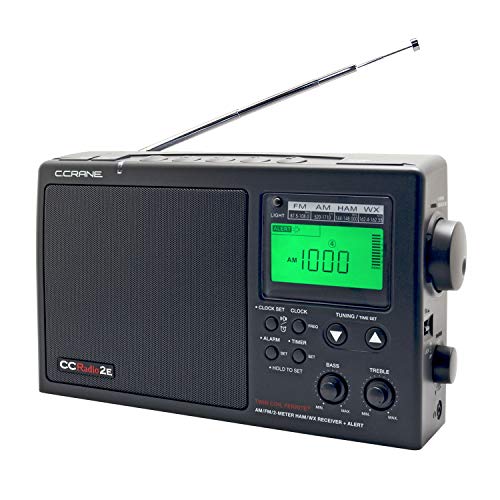
C. Crane CCRadio-2E is the feature-rich choice for emergency information, with NOAA Weather Band and Weather Alert alongside AM, FM and the 2-meter ham band. It weighs 4 pounds and can run from an included AC cord or four D batteries. The manufacturer says a fresh set of D batteries can provide up to 250 hours of runtime. Clock, alarm, sleep timer, display light, headphone jack and five one-touch memory presets add everyday utility. This larger radio is a poor fit if bass adjustment is the priority; its functions do not include a bass control.
Bottom line: Pick this for weather alerts and multiple radio bands.
How to choose a portable radio with enhanced bass
A dedicated bass control is the clearest feature to look for when sound adjustment is your priority. It lets you change bass emphasis separately rather than relying only on the radio’s volume knob. Check the functions you actually need: AM/FM covers ordinary broadcast listening, while shortwave, NOAA weather and ham bands add distinct reception options. Power also determines where a radio is practical: AC is convenient near an outlet, while battery operation is useful away from one. If you want a specific wattage, confirm it before buying; only one model here gives a speaker output figure, and wattage alone does not describe bass response.
What radio bands do you need
AM and FM serve different broadcast ranges, and the BJL-671 also specifies shortwave from 2.8–22 MHz. NOAA Weather Band is a separate function for weather broadcasts, while the CCRadio-2E adds a 2-meter ham band. Use the radio’s actual band list rather than assuming every portable AM/FM set receives shortwave or weather alerts. The table separates the available choices by the kind of listening they support; a band does not guarantee reception in every location, since signal strength and antenna placement matter. For a straightforward station radio, AM/FM may be enough; choose additional bands only if you plan to use them.
| Listening need | Relevant feature | Model |
|---|---|---|
| Adjust bass | Dedicated bass control | VERAVOXES AM/FM Radio with Bass Control |
| Receive shortwave | SW band, 2.8–22 MHz | BJL-671 AM/FM/SW Portable Radio |
| Weather alerts | NOAA Weather Band and alert | C. Crane CCRadio-2E |
Power and portability considerations
Battery format matters when you expect to listen away from an outlet: the options include AA batteries, D batteries, and battery or USB power. The PRUNUS uses four AA cells; the CCRadio-2E uses four D cells, while the first two radios are described as battery-powered without a battery size given. Measure your carrying space before choosing a larger set: the models here range from 7.28 to 11 inches in length. If you need to pack a radio in a small bag, favor a shorter chassis and check the weight as well; only two models provide a weight figure.
Using antennas and tuning controls
Portable radios commonly use a telescopic antenna for FM and shortwave reception, while AM reception often relies on an internal ferrite antenna that can be improved by rotating the radio. Extend the telescopic antenna and reposition the radio if a station sounds weak; walls, metal structures and nearby electronics can interfere with reception. Analog tuning scales favor simple knob operation but may require small adjustments to land on a station. A dedicated bass control, when present, adjusts tonal emphasis rather than reception or volume. Keep volume moderate when using headphones, especially for extended listening, because loud audio can damage hearing.
Frequently Asked Questions
Does a bass control make a radio sound louder?
No, a bass control changes tonal emphasis rather than the radio’s maximum output. Use the volume control to change loudness, and avoid excessive headphone volume to protect hearing.
Can portable radios receive stations without an antenna?
Reception depends on the radio’s antenna system and signal conditions. Extend any telescopic antenna for FM or shortwave, and reposition an AM radio because its internal ferrite antenna is directional.
What does a shortwave radio band add?
Shortwave supports broadcasts beyond ordinary AM and FM, and the BJL-671 specifies coverage from 2.8–22 MHz. Reception varies by location, time and antenna placement.
How many batteries do these portable radios need?
The PRUNUS J03 uses four AA batteries, while the CCRadio-2E uses four D batteries. Check battery format and availability before relying on a radio away from AC power.
Can a portable radio use headphones?
The VERAVOXES radio and CCRadio-2E include a headphone jack. Keep headphone volume moderate, since prolonged loud listening can harm hearing.