
RETC 15 Walkie Talkies: RT22 and RT68 Compared

The Retevis RT22 suits people who want compact walkie-talkies with USB-C charging and about 10 hours of runtime. The search phrase names the RT22, but the choices include RT22 and RT68 models rather than a 15-pack, so choose an RT68 set for a larger team and confirm the pack count before ordering.
We earn a commission if you buy through links on this page. As an Amazon Associate I earn from qualifying purchases. Products are compared on manufacturer specifications, not hands-on testing.
- Best overall: Retevis RT22 4-Pack – The compact 4-pack has USB-C charging and a runtime of about 10 hours.
- Best for six-person teams: Retevis RT68 6-Pack with Earpieces – Includes a six-radio charger and ear-hook earpieces.
- Best for centralized charging: Retevis RT68 10-Pack with 10-Way Charger – Its 10-way charging station is designed to charge 10 radios and batteries together.
| Product | Best for | Pack size | Charging setup | Approximate runtime | Shop |
|---|---|---|---|---|---|
| Retevis RT22 4-Pack | Compact everyday carry | 4 radios | USB-C port | About 10 hours | Check Price on Amazon |
| Retevis RT68 6-Pack with Earpieces | Six-person work teams | 6 radios | Six-way charger | 12 hours | Check Price on Amazon |
| Retevis RT68 6-Pack with Charger | Rugged team use | 6 radios | Six-way charger | 12 hours | Check Price on Amazon |
| Retevis RT68 10-Pack with USB Base | Ten-radio crews | 10 radios | USB charging base | Up to 24 hours | Check Price on Amazon |
| Retevis RT68 10-Pack with 10-Way Charger | Centralized team charging | 10 radios | 10-way charger | 12 hours | Check Price on Amazon |
Retevis walkie-talkies compared
Choose the RT22 for its compact form and USB-C charging, or compare RT68 pack sizes and charging equipment for team use.
Retevis RT22 4-Pack
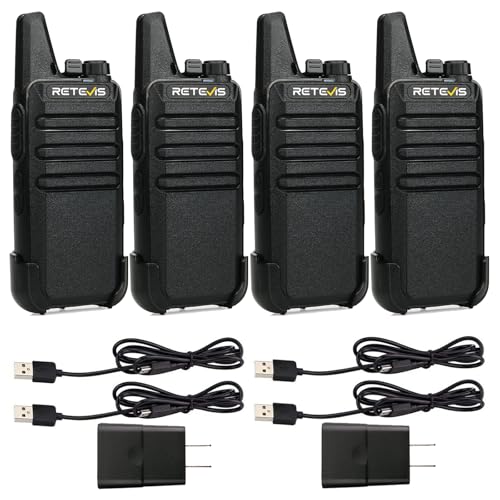
The RT22 stands apart from the RT68 sets with its thumb-length, blunted antenna and compact body. Each radio measures 5.35 by 2.2 by 0.83 inches and weighs 1.62 ounces; the maker says its USB-C-charged battery lasts about 10 hours. A separate belt clip lets the radio lift off without removing the clip, and its 300 mW speaker has squelch. This 4-pack fits small groups that value easy carrying. Its runtime is shorter than the 12-hour RT68 figures, so it may be a poor match for longer shifts.
Bottom line: Choose this set for a small group prioritizing a compact radio and USB-C charging.
Retevis RT68 6-Pack with Earpieces

The RT68 6-pack pairs six radios with a six-way charger and ear-hook earpieces, a different setup from the pocket-focused RT22. Each radio measures 4.56 by 1.96 by 1.37 inches and weighs 4 ounces. The maker says the battery lasts 12 hours, and the charger can charge six radios or batteries at once with overcharge, overvoltage, and short-circuit protection. This arrangement suits coordinated school, retail, or hospitality teams. It is a larger, heavier radio than the RT22, so it is less suited to buyers who prioritize very light pocket carry.
Bottom line: Pick this set when earpieces and six-at-once charging fit the team’s routine.
Retevis RT68 6-Pack with Charger

This RT68 set emphasizes a sealed, non-removable antenna and a multi-unit charger, rather than the RT22’s compact carry design. The six-way station charges up to six radios or batteries simultaneously and has overcharge, overvoltage, and short-circuit protection. Radios measure 4.56 by 1.96 by 1.37 inches and weigh 5 ounces each. The maker says the battery lasts 12 hours; the body is designed to withstand shock and vibration. It suits teams that want a fixed shared charging point. The features do not include earpieces, making it a weaker fit for hands-free communication needs.
Bottom line: Choose this set for a six-radio crew seeking a shared charger and enclosed antenna.
Retevis RT68 10-Pack with USB Base

This RT68 10-pack stands out for its USB charging base and adapter, rather than the separate six-way stations in the smaller kits. Its radios measure 4.56 by 1.96 by 1.37 inches, and each battery has a 1,200 mAh capacity. The maker says the radios can run up to 24 hours; full charging typically takes 3 to 4 hours. A rugged enclosure is claimed to withstand a one-meter fall without damage. This kit suits a larger school, security, or warehouse team. The runtime figure is an upper limit, so crews needing a guaranteed full-shift duration should verify expected operating conditions.
Bottom line: Pick this for a 10-radio crew that prefers a USB base and adapter.
Retevis RT68 10-Pack with 10-Way Charger

The 10-way charging station is the defining feature of this RT68 set: it can charge 10 radios and batteries at once, reducing the need to rotate radios through a smaller charger. Five LED indicators display charging progress, and the station includes USB and Type-C outputs, AC and DC inputs, replaceable slots, and eight protection measures. The ABS radios weigh 8.67 ounces each and have a claimed one-meter fall tolerance. This setup is for larger crews that need a centralized charging point. Unlike the other 10-pack, its features give a 12-hour battery figure rather than an up-to-24-hour claim.
Bottom line: Choose this set when charging all 10 radios together matters most.
How to choose Retevis walkie-talkies
Start with team size and shift length: an individual radio that lasts 10 hours may not cover a full day once breaks and charging logistics are considered. For comparison, the RT22’s runtime is about 10 hours, while RT68 options here cite 12 hours or up to 24 hours. Decide whether everyone needs an earpiece, then whether charging should happen one at a time, six at a time, or across a 10-radio station. FRS radios operate on designated shared channels; privacy codes reduce unwanted chatter but do not make a conversation private. For reliable communication, teams should agree on a channel and code before splitting up.
| Team need | Choice cue |
|---|---|
| Small group, light carry | Compact RT22 |
| Six radios, earpieces | RT68 6-pack with earpieces |
| Charge 10 radios together | RT68 10-way charger set |
FRS range and building coverage
FRS range depends heavily on line of sight: open terrain can allow longer communication, while hills, trees, vehicles, and building walls cut range. Concrete and metal structures are especially disruptive, and a radio’s advertised maximum should not be treated as a guaranteed working distance. A useful decision rule is to test communication at the farthest point of the actual site before assigning radios to a crew; if a message drops, move the user toward a doorway or open area rather than assuming a stronger speaker will extend range. FRS radios are license-free for personal or business use in the United States when compliant with FCC rules, but users must follow channel and power limits.
Charging and battery planning
Plan charging around the full shift, not just the battery’s headline duration. The RT22 is described as lasting about 10 hours, the RT68 sets include a 12-hour claim, and one 10-pack specifies up to 24 hours; actual use can change runtime. Keep a spare charged battery or radio available when a team may outlast its rated run period. Multi-unit docks reduce cable clutter, but a shared station also becomes a single point of failure if it is unplugged or unavailable. Check that the chosen station and adapter match the team’s outlet and storage setup before ordering, especially for a centralized 10-radio charging plan.
Safe radio use in teams
Use radios only on permitted FRS channels and do not assume a privacy code encrypts speech; other users can still hear transmissions on the same channel. Keep messages brief, identify the intended recipient, and avoid transmitting personal or sensitive information. The RT22’s short, blunted antenna is a physical design distinction, while the RT68 options emphasize enclosed antennas or rugged construction; no radio should be treated as protective equipment. For work teams, assign a radio to each role, agree on a backup channel, and make a check-in schedule before separating across a large building or outdoor site.
Frequently Asked Questions
How far can FRS walkie-talkies reach outdoors?
FRS range varies with terrain and obstructions, so a clear line of sight generally gives better results than wooded or hilly ground. Test the actual route at the farthest point your team needs to cover rather than relying on a maximum-range claim.
Do FRS radios need a license in the United States?
FRS radios are generally license-free in the United States when they comply with FCC rules. Use only authorized channels and power levels, and remember that shared channels can be heard by other users.
Do privacy codes make walkie-talkie conversations private?
No; privacy codes filter which transmissions a radio speaker plays, but they do not encrypt the signal. Anyone using compatible equipment on the same channel may still hear the conversation.
How long should walkie-talkies charge before a shift?
A full charge depends on the radio and charger; the RT68 10-pack with USB base gives a 3-to-4-hour charging estimate. Starting a shift with charged radios and keeping a spare available helps avoid gaps when actual runtime falls short of the maker’s figure.
Can FRS radios work inside concrete buildings?
They can communicate indoors, but concrete and metal walls reduce range and may create dead zones. Test each floor and the farthest work area, then relocate radios toward doorways or windows when messages fail.