
Rislone Engine Treatment: 3 Formulas Compared

For most drivers seeking a Rislone engine treatment, Rislone 4102 Xtreme LUBE, 5-Pack is the more targeted choice because its formula focuses on sludge and deposits as well as friction and wear. Choose Rislone 4471 High Performance Oil Treatment, 12-Pack instead if you have an older or higher-mileage engine and specifically want a higher-viscosity oil treatment; Rislone Engine Treatment, 55 Gallons is a 55-gallon engine treatment for bulk use.
We earn a commission if you buy through links on this page. As an Amazon Associate I earn from qualifying purchases. Products are compared on manufacturer specifications, not hands-on testing.
- Best overall: Rislone 4102 Xtreme LUBE, 5-Pack – Its multi-grade formula is aimed at deposits, sludge, friction, and wear.
- Best for older engines: Rislone 4471 High Performance Oil Treatment, 12-Pack – The high-viscosity formula is intended to thicken the oil film in older, higher-mileage engines.
- Best for bulk use: Rislone Engine Treatment, 55 Gallons – The 55-gallon size is intended for buyers who need a bulk quantity.
| Product | Best for | Package size | Formula focus | Intended engine use | Shop |
|---|---|---|---|---|---|
| Rislone 4102 Xtreme LUBE, 5-Pack | Sludge-focused care | 16.9 oz, 5-pack | Multi-grade; deposits and sludge | General engine use | Check Price on Amazon |
| Rislone 4471 High Performance Oil Treatment, 12-Pack | Older engines | 15 oz, 12-pack | High viscosity; thicker oil film | Older or higher-mileage engines | Check Price on Amazon |
| Rislone Engine Treatment, 55 Gallons | Bulk quantity | 55 gallons | Cleans and conditions oil | General engine use | Check Price on Amazon |
Rislone engine treatments compared
Compare each formula’s purpose and package size to match the additive to your engine and buying needs.
Rislone 4102 Xtreme LUBE, 5-Pack
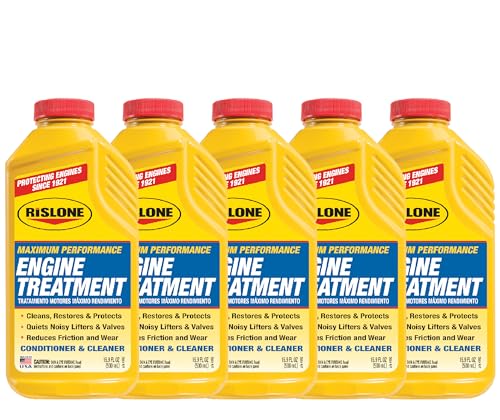
Rislone 4102 Xtreme LUBE, 5-Pack is the sludge-focused option among these treatments, with a multi-grade formula designed to flow across a broader temperature range. Rislone says it removes and helps prevent sludge and deposits, while gradually clearing deposits from areas such as bearing surfaces, piston rings, and ring grooves. The formula is also intended to reduce friction and wear and quiet noisy lifters and valves. This five-pack suits buyers who want several 16.9-ounce containers. Its focus is deposit cleanup, so buyers looking specifically for a thicker oil film in a worn engine may prefer Rislone 4471 High Performance Oil Treatment, 12-Pack.
Bottom line: Choose this if deposit and sludge cleanup are your priority.
Rislone 4471 High Performance Oil Treatment, 12-Pack

Unlike Rislone 4102 Xtreme LUBE, 5-Pack, Rislone 4471 High Performance Oil Treatment, 12-Pack centers on a high-viscosity formula intended to increase oil-film thickness in older and higher-mileage engines. Rislone says the treatment cushions engine parts to reduce metal-to-metal contact and may increase oil pressure in worn engines; the formula is intended for gasoline and diesel engines using conventional, high-mileage, or synthetic oil. The 12-pack contains twelve 15-ounce containers. Its thicker-oil approach is most relevant when that is the specific need, rather than a targeted sludge-removal formula.
Bottom line: Pick this when an older engine needs the higher-viscosity approach.
Rislone Engine Treatment, 55 Gallons

Rislone Engine Treatment, 55 Gallons differs sharply from the smaller containers: it is a 55-gallon quantity, suited to bulk purchasing rather than a typical single-vehicle treatment. Its functions include freeing valves and lifters, maintaining oil viscosity, conditioning engines, and dissolving harmful deposits, along with reducing friction and wear. The specifications do not identify a specialty formula such as the sludge-specific positioning of Rislone 4102 Xtreme LUBE, 5-Pack or the high-viscosity focus of Rislone 4471 High Performance Oil Treatment, 12-Pack. The unusually large volume makes this a practical match only when bulk quantity is the deciding requirement.
Bottom line: Choose this only when you specifically need a bulk quantity.
How to choose a Rislone engine treatment
Choose by the engine concern and formula, not by the shared word “treatment.” Oil additives generally work by changing how the oil behaves or by suspending contaminants; a detergent-oriented formula targets deposits, while a viscosity modifier changes how thick the oil film is. If sludge and dirty oil passages are the concern, favor a formula explicitly aimed at deposits. If an older engine needs a thicker oil cushion, a high-viscosity product is the closer fit. Check your owner’s manual for the required oil viscosity and additive guidance before changing the oil system’s formulation.
For a quick decision, use the condition that matches your goal: deposit concerns point toward a sludge-focused formula, while an older or higher-mileage engine seeking thicker oil points toward a high-viscosity formula. These goals are not interchangeable.
Engine oil viscosity and additives
Engine oil viscosity grades use the SAE J300 system; common passenger-car grades include 0W-20, 5W-30, and 10W-30. The number before W relates to cold-temperature performance, while the second number describes viscosity at operating temperature. An additive that changes effective viscosity can matter if it shifts oil away from the grade the engine maker requires. Use the oil grade on the oil cap or in the owner’s manual as the baseline, and do not select a thickening treatment solely to address a noise or pressure reading.
Oil pressure depends on more than viscosity, including engine temperature, pump condition, bearing clearances, and oil level. A warning light or sudden pressure drop calls for prompt diagnosis rather than relying on an additive as a repair.
Using engine treatments safely
Engine treatments go into the crankcase oil, so the engine’s oil capacity and the additive dose both matter. A typical passenger car may hold roughly 4 to 6 quarts of oil, but truck, performance, and large-displacement engines can require substantially more. Adding a full container without accounting for that volume can overfill the crankcase; check the product dosing directions and the vehicle’s capacity before adding anything.
Too much oil can cause foaming, leaks, or poor lubrication, and additives do not replace oil changes or mechanical repairs. If the engine has a serious knock, an oil-pressure warning, or persistent overheating, stop driving when safety permits and address the underlying fault. Never open a hot engine’s oil fill or work near moving belts and fans.
Sludge cleanup versus thicker oil film
Deposit-focused treatments and high-viscosity treatments address different oil concerns. Sludge forms when oil oxidizes and contaminants accumulate; short trips, extended oil-change intervals, and excessive heat can contribute. A deposit-focused additive is intended to help loosen or suspend contaminants, which then need to be captured by the oil filter or removed at an oil change.
A thicker oil film is a separate strategy that may be relevant in worn engines, but added viscosity is not a substitute for checking the manufacturer’s required grade. Use this comparison to match the formula purpose to the engine condition; for a bulk-size product, the volume itself is the deciding factor.
| Need | Formula direction | Key caution |
|---|---|---|
| Deposit or sludge concern | Deposit-focused treatment | Follow dosing directions and oil-change timing |
| Older engine needing a thicker oil film | High-viscosity treatment | Stay within the engine’s required oil grade |
| Bulk quantity requirement | Large-volume treatment | Confirm the package volume suits the operation |
Frequently Asked Questions
Can engine treatment replace an oil change?
No, an engine treatment is not a substitute for fresh oil and a filter. Oil-change intervals are commonly around 5,000 to 7,500 miles for many modern vehicles, but the manufacturer’s schedule and severe-service conditions determine the right interval.
Can I add engine treatment to synthetic oil?
Some treatments are formulated for use with synthetic oil, but compatibility is product-specific. Check the oil grade required by the engine and the treatment’s directions before adding an additive.
What causes sludge in an engine?
Sludge is oxidized oil mixed with contaminants, and extended oil-change intervals, frequent short trips, and high engine heat can contribute. Keeping oil at the correct level and replacing it on schedule helps limit buildup.
Will thicker oil always raise oil pressure?
No, oil pressure also depends on oil temperature, pump condition, bearing clearances, and engine wear. A sudden warning light or pressure drop needs diagnosis rather than a viscosity change alone.
How much oil does a passenger car engine hold?
Many passenger cars hold about 4 to 6 quarts, though capacity varies by engine and filter configuration. Use the vehicle’s specified capacity and account for additive volume to avoid overfilling.