
Rubber Feet for Cutting Boards: 5 Options Compared

For most cutting boards, Rubber Feet with Stainless Screws, 12-Pack is the clearest fit because its 3/8-inch height and #8 screw compatibility are specified. Choose another option if you need a larger supply or a lower-profile foot.
Screw-on rubber feet are small pads attached to a board’s underside to add grip and lift it off the counter; their height, base width, and screw fit determine whether they suit your board.
We earn a commission if you buy through links on this page. As an Amazon Associate I earn from qualifying purchases. Products are compared on manufacturer specifications, not hands-on testing.
- Best overall: Rubber Feet with Stainless Screws, 12-Pack – The 3/8-inch height and #8 screw fit are specified, making it easier to match to a board.
- Best for assorted projects: Kernmax Rubber Feet, 144-Piece Two-Size Kit – The 144-piece kit includes two sizes for different applications.
- Best for bulk quantity: smseace Rubber Feet, 200-Pack – The pack includes 200 feet, each 0.31 inch high and 0.59 inch wide.
| Product | Best for | Pack count | Height | Width | Shop |
|---|---|---|---|---|---|
| Rubber Feet with Stainless Screws, 12-Pack | Specified screw fit | 12 | 3/8 in | 13/16 in top; 11/16 in bottom | Check Price on Amazon |
| Celuisiva Rubber Feet, 24-Pack | Small project pack | 24 | — | — | Check Price on Amazon |
| Kernmax Rubber Feet, 144-Piece Two-Size Kit | Mixed-size projects | 144 | 0.48 in | 0.78 in | Check Price on Amazon |
| smseace Rubber Feet, 200-Pack | Large supply | 200 | 0.31 in | 0.59 in | Check Price on Amazon |
| Soft Cutting Board Rubber Feet, 200-Pack | Bulk replacement | 200 | 0.31 in | 0.59 in | Check Price on Amazon |
Rubber Feet for Cutting Boards Compared
Compare foot height, size, and pack quantity to find a set that fits your board and installation needs.
Rubber Feet with Stainless Screws, 12-Pack
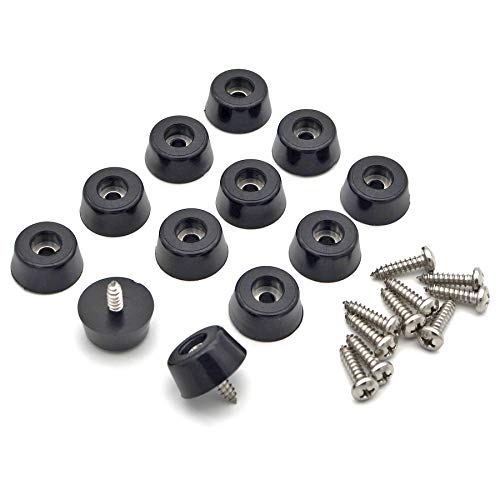
Rubber Feet with Stainless Screws, 12-Pack stands out for its clearly stated dimensions and screw fit, which help when matching feet to a board. The 12-piece set includes matching wood screws; each thermoplastic rubber foot has a built-in stainless steel washer, a 3/8-inch height, and a center hole sized for #8 screws. Its two stated widths distinguish the top from the bottom, useful when checking underside clearance and contact area.
The limitation is quantity: a 12-foot pack is less suited to larger furniture or multi-board projects than bulk assortments. Pick it when the screw compatibility and dimensions matter more than having many spares.
Bottom line: Choose this set when you want a specified #8 screw fit and defined foot dimensions.
Celuisiva Rubber Feet, 24-Pack

Celuisiva Rubber Feet, 24-Pack is the smaller middle-ground pack for buyers who want more feet than a 12-piece set without stepping up to a bulk assortment. The product uses thermoplastic rubber and includes stainless steel screws; its purpose includes cutting boards as well as furniture and electronics. The maker says the feet grip quartz, granite, and marble counters, and recommends drilling a small pilot hole before screwing them in.
That matters if a board must clear a specific counter edge or cabinet; choose it when quantity and material matter more than a precise size match.
Bottom line: Choose this pack for a modest project when exact foot dimensions are not your priority.
Kernmax Rubber Feet, 144-Piece Two-Size Kit

Kernmax Rubber Feet, 144-Piece Two-Size Kit differs from single-size packs by offering two sizes in a 144-piece kit, so it can serve more than one board or project. The maker identifies 304 stainless steel screws and says the rubber feet are shock-absorbent and intended to reduce noise. A reusable storage box keeps the assortment organized, a practical advantage when feet are being used across several items.
The dimensions give one size at 0.48 inch high by 0.78 inch long and 0.7 inch wide, but do not describe the second size. That makes it less straightforward to plan a specific low-clearance fit; it suits varied projects better than a board with a tight height limit.
Bottom line: Choose the assortment for multiple projects that can use two foot sizes.
smseace Rubber Feet, 200-Pack

smseace Rubber Feet, 200-Pack pairs a 200-foot supply with a relatively low 0.31-inch height, making it a practical option for projects where a taller pad is undesirable. Each foot is 0.59 inch in diameter and comes with a self-tapping screw and stainless steel washer. The maker describes the rubber as wear-resistant and says installation uses guide holes followed by tightening the screw.
The pack’s large count can be more than a single cutting board needs, so it makes more sense for several boards or other household projects. Its width and height help with clearance planning, but check the screw length against the board thickness before installation.
Bottom line: Choose this set for a large supply of low-profile feet and verify screw length for your board.
Soft Cutting Board Rubber Feet, 200-Pack

Soft Cutting Board Rubber Feet, 200-Pack is another 200-piece set with 0.31-inch-high, 0.59-inch-wide feet, but it specifically identifies the included screws as 304 stainless steel. The maker says the rubber helps resist sliding and provides a protective layer between furniture and a surface. That combination suits people fitting several boards or other items with the same small-foot dimensions.
The pack’s 200-count is a poor match for someone who only needs a few feet and does not expect to use spares. Unlike a mixed-size kit, this option is presented as one size, so it is best when a 0.31-by-0.59-inch pad matches the intended clearance and footprint.
Bottom line: Choose this bulk set when one 0.31-by-0.59-inch size suits multiple projects.
How to Choose Rubber Feet for Cutting Boards
Choose feet by their height, contact width, screw fit, and the number of boards you plan to outfit. Height controls the lift beneath the board; a 0.31-inch foot raises it less than a 0.48-inch foot, while wider contact can affect how much of the underside the pad occupies. The screw opening and supplied screw also need to match the board material and thickness.
Use a measurable rule: if you need no more than about 3/8 inch of lift, narrow the options to feet at or below that height. Compare the top or base footprint with the board’s underside before drilling, and avoid placing feet where they interfere with handles, grooves, or an edge bevel. For one board, quantity is secondary; for several boards, pack size can matter as much as the individual dimensions.
Rubber Foot Sizes and Counter Clearance
Foot height is the key dimension when a board must clear a counter or sit at a particular angle. The options here range from 0.31 to 0.48 inch where measurements are supplied, so a lower pad creates less lift and a taller pad creates more. Width also matters: a 0.59-inch foot occupies less underside area than a 13/16-inch top.
Measure the board’s underside and intended resting position before installation, then compare both the pad footprint and height. Feet should sit on a flat, solid portion of the board rather than over a bevel or deep groove, where the pad may not sit evenly. A board with a tight cabinet or counter clearance should use a low-profile foot; if clearance is generous, a taller foot may suit the desired lift.
Screw-On Feet Compared by Project Need
Choose a specified-size set when a precise board fit matters, a bulk pack for repeated installations, or an assortment for projects needing different footprints. Screw-on feet attach mechanically, so their usefulness depends on a sound screw hold in the board; soft or thin material needs more care than a thick, solid underside.
The table separates the choices by the measurable condition that most often changes the decision. Counts describe how many feet come in each set, while the height and width help gauge the board’s lift and footprint. A dash means the specifications do not give a usable measurement.
| Project need | Useful choice | Decision point |
|---|---|---|
| Known screw size | Rubber Feet with Stainless Screws, 12-Pack | #8 screw fit |
| Mixed applications | Kernmax Rubber Feet, 144-Piece Two-Size Kit | Two sizes included |
| Lower-profile feet | smseace Rubber Feet, 200-Pack or Soft Cutting Board Rubber Feet, 200-Pack | 0.31-inch height |
| Small pack | Celuisiva Rubber Feet, 24-Pack | 24 feet |
Installing and Caring for Cutting Board Feet
Install screw-on feet on a clean, dry underside and keep each pad flat against the board. A pilot hole helps guide a screw and reduce wandering; its diameter should suit the screw’s core and the board material, rather than the outside thread width. Avoid driving a screw so far that it could emerge through the board’s top, and stop if the material splits or the foot will not sit flush.
After installation, check that the board rests without rocking and that every foot remains firmly attached. Wash the food-contact face as usual, but do not treat screw-on pads as a substitute for cleaning the underside or counter. Dry the underside before storage, especially for wood boards, and periodically check for loose screws, cracked rubber, or a foot that no longer grips securely.
Frequently Asked Questions
How many rubber feet should a cutting board have?
Four feet near the corners are a practical starting layout for a rectangular board, provided each foot sits on a flat area. Larger or flexible boards may need additional support points to prevent rocking.
Do cutting board rubber feet need pilot holes?
A pilot hole is useful for guiding a screw and reducing the chance of splitting wood. Match its diameter to the screw core and board material, and keep the hole shallower than the board thickness.
How high should cutting board feet be?
Choose the lowest height that provides the lift you want; these options with heights span 0.31 to 0.48 inch. If your available clearance is under 3/8 inch, select feet no taller than that.
Can rubber feet go in the dishwasher?
Avoid putting a screw-on footed board through a dishwasher unless its maker approves it; prolonged heat and water can stress rubber, screws, and wood. Hand-wash the board and dry its underside before storage.
How do I stop a cutting board from rocking?
Place feet on level, flat areas near the corners and check that each pad sits flush. If the board still rocks, inspect the counter and board for unevenness and reposition or replace a foot that is loose or damaged.