
Screen Protectors for Eyeglasses: 3 Types Compared

Eyeglass Lens Protector, Large is the closest match for most eyeglass wearers because it combines a large size with a coating claimed to resist scratches and UV exposure. Choose ICON PD Eyeglass Lens Protector, X-Large if you need an extra-large overlay, or consider Scratch Lens Covers Adhesive Film if you specifically want an adhesive film rather than a frame-style cover.
Eyeglass lens protectors are coverings intended to shield lenses; they are not the same as a protector for a phone screen.
We earn a commission if you buy through links on this page. As an Amazon Associate I earn from qualifying purchases. Products are compared on manufacturer specifications, not hands-on testing.
- Best overall: Eyeglass Lens Protector, Large – Large size and a coating claimed to resist scratches and UV exposure.
- Best for extra-large frames: ICON PD Eyeglass Lens Protector, X-Large – The extra-large overlay is described as fitting most standard eyeglasses and sunglasses.
- Best for adhesive film: Scratch Lens Covers Adhesive Film – A film-style cover with claimed bubble-free adhesive application.
| Product | Best for | Size | Protection | Application | Shop |
|---|---|---|---|---|---|
| Eyeglass Lens Protector, Large | Large-size overlay | Large | Scratch and UV protection | Place over lenses | Check Price on Amazon |
| ICON PD Eyeglass Lens Protector, X-Large | Extra-large frames | X-Large | Scratch and UV protection | Place over lenses | Check Price on Amazon |
| Scratch Lens Covers Adhesive Film | Adhesive film | — | Scratch and fingerprint protection | Adhesive film | Check Price on Amazon |
Screen protectors for eyeglasses compared
Compare the size and covering style first, then choose the option that matches your frames and comfort preferences.
Eyeglass Lens Protector, Large
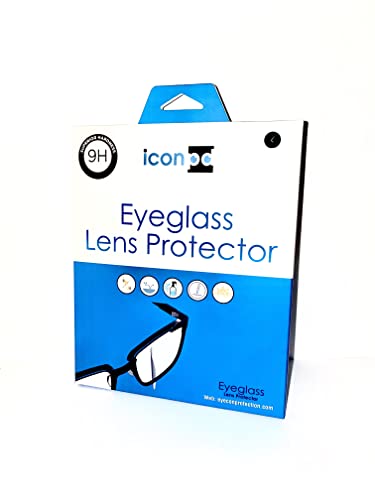
Eyeglass Lens Protector, Large is the large-size option among these protectors, with a coating the maker says is scratch resistant and provides UV protection. The clear covering is intended for prescription glasses and sunglasses, and the maker also claims it is easy to clean and resists smudges. This suits shoppers looking for an overlay rather than a thin adhesive film. The size is its main limitation: buyers whose frames need a larger cover should compare the extra-large option, while smaller frames may need a closer fit check.
Bottom line: Choose this if the large size suits your frame and you want a coating-style cover.
ICON PD Eyeglass Lens Protector, X-Large
ICON PD Eyeglass Lens Protector, X-Large is the extra-large overlay, making it the size-specific alternative to the large option. Its maker says the protector covers glasses against dust, dirt, scratches, and UV rays, and describes it as lightweight and abrasion resistant. The one-size-fits-most fit is aimed at standard eyeglasses and sunglasses, so this is a practical candidate when a larger overlay is needed. Its tradeoff is that shoppers seeking a film applied directly to the lens should consider a different covering style.
Bottom line: Pick this when an extra-large overlay is the better match for your frames.
Scratch Lens Covers Adhesive Film

Scratch Lens Covers Adhesive Film differs from the overlays by using an adhesive film for glasses. Its maker describes the film as having oil and fingerprint coatings and a bubble-free adhesive application, targeting users who want a thin covering rather than a frame-style protector. The product is positioned for activities including outdoor use and gaming, but the maker does not establish a size or fit range. That makes it less straightforward to match to a particular lens shape; choose it only after confirming compatibility with your lens dimensions.
Bottom line: Choose this if you want an adhesive film and can confirm its fit for your lenses.
How to choose an eyeglass lens protector
Start with the covering style: an overlay sits over the lenses, while an adhesive film is applied to the lens surface. The three options here include two overlays in large and extra-large sizes and one film-style cover. Coatings and films can interact with existing lens coatings, so avoid assuming that a protector is compatible with every prescription lens. If you cannot confirm fit or lens compatibility, contact an optical professional before applying anything. For a measurable fit check, compare the protector’s usable width and height with each lens; do not rely on a frame label alone, since lens shapes vary even within a frame size.
Overlay versus adhesive film for glasses
Overlays and films solve the same broad problem in different ways: an overlay covers the lens without being described as adhesive, while a film attaches directly to the lens. An overlay can be removed without peeling adhesive from the lens, but an oversized or poorly aligned cover can interfere with a comfortable fit or view. Film avoids the extra frame-style covering, but precise alignment matters and bubbles can obstruct vision. Use this comparison to choose the application style before comparing specific sizes.
| Covering style | What to compare | Best fit condition |
|---|---|---|
| Overlay | Cover dimensions and frame clearance | When the overlay sits over the full lens without obstructing vision |
| Adhesive film | Lens shape and adhesive compatibility | When the film matches the lens and can be applied smoothly |
Fit and lens compatibility checks
Measure both lenses rather than assuming left and right sides match; some frames use different lens shapes or dimensions. Check that a cover does not block the wearer’s line of sight, touch eyelashes, or press against the face when the glasses are worn. Before using an adhesive product, verify compatibility with the lens material and existing coatings, especially if the lenses have specialty treatments. A protector that fits only part of a lens leaves the edges exposed, while one extending into the wearer’s view can be distracting.
Care and safe use of lens protectors
Keep the protector and lens free of grit before cleaning: trapped dust can scratch a lens when rubbed across its surface. Use a clean microfiber cloth and lens-safe cleaner rather than paper towels or household glass cleaner, which can damage some lens coatings. Remove a cover if it shifts, bubbles into the field of view, or makes vision unclear; a protector should not compromise safe visibility. Lens protectors are not a substitute for certified impact-rated eyewear when a task exposes eyes to flying debris or other hazards.
Frequently Asked Questions
Can a screen protector go on prescription glasses?
Some products are designed for eyeglass lenses, but a phone-screen protector is not automatically suitable. Confirm the lens shape and coating compatibility before attaching an adhesive film.
How do I measure glasses for a lens protector?
Measure the width and height of each lens at its widest points, then compare those measurements with the protector’s usable coverage. Leave enough clearance that the covering does not obstruct the wearer’s view or press against the face.
Can adhesive film affect eyeglass lens coatings?
Adhesives may not be compatible with every lens coating, so check compatibility before applying film. If the lenses have specialty coatings or the film’s fit is uncertain, ask an optical professional first.
What should I do if a lens protector has bubbles?
A bubble in the wearer’s field of view can interfere with clear vision, so remove or reposition the covering rather than wearing it that way. Clean away dust before reapplying, since grit trapped beneath film can scratch the lens.
Do eyeglass lens protectors replace safety glasses?
No; a lens cover is not a substitute for safety eyewear rated for the hazard. For work involving flying particles, use protective eyewear that meets the applicable safety requirements.