
Top Rated Ultrasonic Mouthguard Cleaners Compared

JEDIA 180 mL Ultrasonic Cleaner suits most people because its four modes include three timed cycles and a light-only option. Choose another model if you want a 200 mL tank or UV lights; an ultrasonic cleaner uses high-frequency sound waves in liquid to loosen debris from small surfaces.
We earn a commission if you buy through links on this page. As an Amazon Associate I earn from qualifying purchases. Products are compared on manufacturer specifications, not hands-on testing.
- Best overall: JEDIA 180 mL Ultrasonic Cleaner – Four modes, including 5-, 8- and 10-minute cycles, offer straightforward control.
- Best for UV lights: 48 kHz Ultrasonic Cleaner with UV Lights – Its 48 kHz cleaning system is paired with four UV lights.
- Best for a digital timer: Estefanlo 200 mL Ultrasonic Cleaner – It combines a 45 kHz frequency with a digital auto timer and 200 mL capacity.
| Product | Best for | Capacity | Frequency | Controls and lights | Shop |
|---|---|---|---|---|---|
| JEDIA 180 mL Ultrasonic Cleaner | Simple timed cycles | 180 mL | 45 kHz | 4 modes; light-only mode | Check Price on Amazon |
| 48 kHz Ultrasonic Cleaner with UV Lights | UV light feature | 200 mL | 48 kHz | 4 UV lights | Check Price on Amazon |
| Estefanlo 200 mL Ultrasonic Cleaner | Digital timer | 200 mL | 45 kHz | 3 modes; UVA lights | Check Price on Amazon |
| Househerb 200 mL Ultrasonic Cleaner | 254 nm UV feature | 200 mL | 45 kHz | Digital timer; 254 nm UV | Check Price on Amazon |
Ultrasonic Mouthguard Cleaners
Compare tank capacity, operating frequency and cleaning controls before choosing a cleaner for your appliance.
JEDIA 180 mL Ultrasonic Cleaner

Four preset modes distinguish this cleaner: 5-, 8- and 10-minute cycles plus a light-only setting. The 180 mL tank is removable, and the unit has a visible countdown timer. JEDIA says its 45 kHz ultrasonic waves loosen plaque, stains and buildup from retainers, aligners, dentures and mouthguards. This option suits buyers who want several cycle choices without relying on a UV feature. Its tank is smaller than the 200 mL models here, so check that your appliance can sit fully submerged before choosing it.
Bottom line: Choose it if multiple timed cycles matter more than a larger tank.
48 kHz Ultrasonic Cleaner with UV Lights

A 48 kHz frequency and four UV lights set this model apart from the 45 kHz options. Its 200 mL capacity suits buyers comparing larger tanks, and the maker says the unit is intended for retainers, dentures, aligners, mouthguards, night guards, toothbrushes and jewelry. The maker also claims the UV feature helps eliminate odors; that claim does not replace routine cleaning or appliance-care guidance.
Bottom line: Pick it if you specifically want a 48 kHz unit with UV lights.
Estefanlo 200 mL Ultrasonic Cleaner
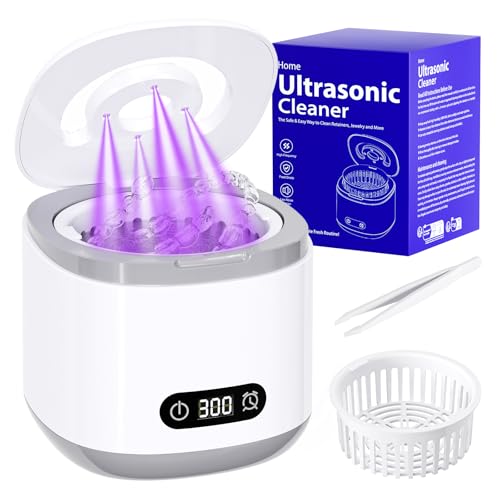
A digital auto timer and three cleaning modes distinguish this 200 mL model. Estefanlo says its 45 kHz vibration technology is designed to loosen plaque, food particles and odors from dental appliances, while four integrated 365 nm UVA lights are included. That combination may appeal to buyers who want a timer and light feature together. The model name identifies three modes, so compare it with the four-mode JEDIA if cycle variety is your priority. Confirm that the appliance fits inside the tank and can be immersed as its care instructions allow.
Bottom line: Choose it if a digital timer and 200 mL tank suit your routine.
Househerb 200 mL Ultrasonic Cleaner

Househerb pairs a digital timer and 200 mL capacity with 254 nm UV lights, a different UV specification from the UVA feature in another model here. The maker says the ultrasonic system reaches 45 kHz and is intended to clean gaps in retainers and dentures; it also claims the UV feature reduces odors. This option is for shoppers comparing both tank size and a specifically identified UV wavelength. Its features do not give the timer’s cycle lengths, so buyers who need a particular duration should verify the available settings before ordering.
Bottom line: Pick it if you want a 200 mL tank with a specified UV wavelength.
How ultrasonic mouthguard cleaners work
Ultrasonic cleaners use high-frequency sound waves in liquid to create tiny bubbles that collapse near surfaces and loosen debris. Frequencies around 40 to 50 kHz are common for small tabletop cleaners; the 45 kHz and 48 kHz models here sit within that range. Frequency alone does not prove a cleaner works better or is safe for every appliance. Use a solution and water temperature permitted for the mouthguard material, since heat can deform some thermoplastics.
Ultrasonic action reaches crevices that are difficult to brush, but it does not replace rinsing or routine manual cleaning. Avoid assuming UV lights sterilize an appliance: UV effectiveness depends on wavelength, exposure time and unobstructed light reaching the surface. Cleaners with a wavelength help distinguish the light specification, but do not establish a medical or sterilization outcome.
How to choose a tank size and cycle
Choose by interior clearance and cycle length, not capacity alone. A 200 mL tank may hold more water than a 180 mL tank, but capacity does not tell you the basin’s usable length, width or depth. With an appliance longer than the tank floor, select a larger interior basin rather than bending the mouthguard to fit. Leave enough room for water to surround the appliance instead of packing it against the walls.
Cycle controls matter when you want repeatable cleaning. One model here offers 5-, 8- and 10-minute cycles, while another identifies three modes without giving their durations in the features. Longer is not automatically better for every material; use the shortest cycle allowed by both the appliance maker and cleaner instructions. Rinse the mouthguard after each cleaning cycle to wash away loosened residue.
Ultrasonic and UV features compared
Ultrasonic vibration loosens particles in liquid, while UV is a separate light-based feature and should not be treated as proof of sterilization. Some models identify a wavelength, such as 365 nm UVA or 254 nm UV; those figures describe the light output, not a guaranteed hygiene result. Keep the appliance positioned so light can reach its surfaces, and do not look directly at an operating UV source.
Use this comparison to match the feature to the decision you care about rather than treating a higher frequency or added light as an automatic upgrade.
| Buyer priority | What to compare |
|---|---|
| Repeatable timed cleaning | Preset cycle lengths and timer display |
| More room for an appliance | Interior basin measurements and usable depth |
| UV specification | Whether wavelength and light type are identified |
Safe care for mouthguards
Keep water cool or lukewarm unless the mouthguard maker permits warmer temperatures, because heat can warp some thermoplastic guards and change their fit. Rinse the guard after ultrasonic cleaning, then let it dry fully before storing it in a ventilated case. Moisture trapped in a closed case encourages odor and microbial growth.
Do not combine cleaning tablets, peroxide, bleach or other chemicals unless both the appliance and cleaner instructions explicitly allow the solution. Abrasive toothpaste can scratch some guard materials, creating rough spots that are harder to clean. Stop using a guard that becomes cracked, warped or painful, and ask a dental professional about fit rather than trying to reshape it with hot water.
Frequently Asked Questions
Can an ultrasonic cleaner replace brushing a mouthguard?
No; ultrasonic cleaning loosens debris but does not remove the need for routine washing. Rinse the appliance after cleaning and follow its maker’s care instructions.
How long should a mouthguard stay in an ultrasonic cleaner?
Use the cycle specified for the appliance and cleaner, rather than assuming a longer cycle is better.
Can hot water damage a mouthguard?
Yes, heat can deform some thermoplastic dental appliances. Use cool or lukewarm water unless the appliance maker explicitly allows warmer water.
Should I add cleaning tablets to an ultrasonic cleaner?
Only use a tablet if the appliance maker and cleaner instructions allow it. Tablet ingredients and appliance materials differ, so avoid mixing cleaning products or using an unapproved solution.
How do I know whether my mouthguard fits the tank?
Compare the appliance’s length and width with the tank’s interior dimensions, and make sure it can sit submerged without bending. Exterior measurements and milliliter capacity do not establish the interior clearance.