
TRQ Brake Rotors and Pads: Kits Compared by Fit

For a vehicle listed in its fit range, TRQ Front and Rear Kit, G-Coated suits drivers replacing both front and rear brakes because it includes ceramic pads and G-coated rotors at all four wheels. Choose a different kit if you need front brakes only or drive another vehicle.
Brake pad-and-rotor kits pair friction pads with replacement rotors; these TRQ sets are vehicle-specific, so match the year, make, model, and trim before choosing.
We earn a commission if you buy through links on this page. As an Amazon Associate I earn from qualifying purchases. Products are compared on manufacturer specifications, not hands-on testing.
- Best overall: TRQ Front and Rear Kit, G-Coated – Includes front and rear ceramic pads plus four G-coated rotors.
- Best for Jeep Compass: TRQ Jeep Compass Front and Rear Kit – Covers front and rear brakes with ceramic pads and four rotors.
- Best for Silverado and SUVs: TRQ Silverado Front Ceramic Kit – A front ceramic pad set and two rotors for listed GM vehicles.
| Product | Best for | Coverage | Rotor coating | Shop |
|---|---|---|---|---|
| TRQ Front and Rear Kit, G-Coated | Four-wheel replacement | Front and rear | G-coated | Check Price on Amazon |
| TRQ Jeep Compass Front and Rear Kit | Jeep Compass | Front and rear | Uncoated | Check Price on Amazon |
| TRQ Silverado Front Ceramic Kit | GM front brakes | Front only | Uncoated | Check Price on Amazon |
| TRQ Subaru Front Ceramic Kit | Subaru front brakes | Front only | Uncoated | Check Price on Amazon |
| TRQ Hyundai and Kia Front Kit | Hyundai and Kia | Front only | Uncoated | Check Price on Amazon |
TRQ brake rotors and pads kits
Compare axle coverage and listed vehicle fit before choosing a ceramic pad-and-rotor set.
TRQ Front and Rear Kit, G-Coated

Unlike the front-only kits, this set covers both axles and includes four G-coated rotors. The package contains one front and one rear ceramic pad set, plus two premium G-coated rotors for each axle. It is listed for select Lexus ES350, Toyota Avalon, and Toyota Camry applications. TRQ says it offers DIY videos for replacement parts, which may help a home mechanic prepare. Its fit range is limited to those vehicles, so drivers with another application need a different kit.
Bottom line: Choose this if your vehicle is in the fit range and you need pads and rotors for both axles.
TRQ Jeep Compass Front and Rear Kit

For the Jeep Compass, this kit supplies front and rear ceramic pad sets and four rotors, but unlike TRQ Front and Rear Kit, G-Coated, the rotors are not identified as G-coated. That makes vehicle fit and axle coverage the main reasons to consider it. The package is intended for a full four-wheel pad-and-rotor replacement on the specified Compass models. TRQ says it provides DIY replacement videos; the kit’s fit range is narrow, so confirm the exact vehicle application before selecting it.
Bottom line: Pick this for a Compass when you want parts for both axles.
TRQ Silverado Front Ceramic Kit

For the Chevrolet trucks and SUVs, this front-only set pairs one ceramic pad set with two rotors; it does not cover the rear axle like TRQ Front and Rear Kit, G-Coated and TRQ Jeep Compass Front and Rear Kit. The fit range includes select Silverado, Tahoe, Suburban, Avalanche, and Express 1500 models, plus Cadillac Escalade applications. TRQ says it offers DIY videos for replacement parts. Buyers planning a complete four-wheel brake job need a separate rear kit, and must verify the exact vehicle fit.
Bottom line: Choose this for the front axle of a vehicle in its GM fit range.
TRQ Subaru Front Ceramic Kit

Subaru and Scion fitment distinguishes this front-axle kit from the GM and Hyundai/Kia options. It includes one ceramic pad set and two front rotors for listed Impreza WRX, Crosstrek, Forester 2.5i, Legacy and Outback, and BRZ and Scion FR-S applications. TRQ says it offers DIY videos for replacement parts. Rear components are not included, so this set is only suitable when front brakes are the job at hand.
Bottom line: Pick this for front-brake work on a Subaru or Scion application.
TRQ Hyundai and Kia Front Kit
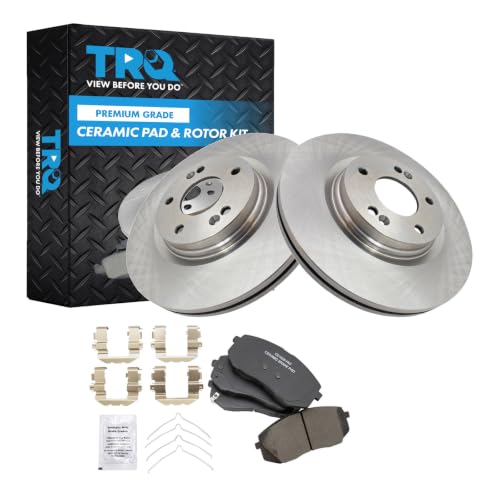
This front kit is the option for listed Hyundai Sonata, Kona Electric, and Kia Optima applications, rather than the Subaru, GM, or four-wheel vehicle ranges. It contains a ceramic pad set and two front rotors. TRQ says its replacement-part videos are intended to make repairs more accessible. The kit covers only the front axle, so a buyer seeking pads and rotors at all four wheels will need to choose a matching rear set separately. Confirm the specific vehicle application before ordering.
Bottom line: Choose it for a Hyundai or Kia when only the front brakes need replacement.
How to choose a TRQ brake pad and rotor kit
Start with vehicle fit, then decide whether the job covers one axle or both. A front kit contains two rotors and one pad set; a four-wheel kit contains four rotors and front and rear pad sets. Match year, make, model, and trim because brake configurations can vary within a model line. For a routine axle replacement, pads and rotors should be compatible with the same application rather than selected by appearance alone. Ceramic describes pad material, while G-coated identifies a rotor coating; neither label establishes fit by itself. If you plan work on both axles at once, choose a kit listing both front and rear components rather than assuming a front kit includes rear parts.
Front-only versus front-and-rear coverage
Front-only kits suit a job limited to the front axle; front-and-rear kits include components for all four wheels. Front brakes commonly handle about 60% to 70% of a passenger car’s braking force because weight shifts forward during deceleration, but the exact share depends on vehicle design and load. That does not mean rear brakes can be ignored: inspect both axles and replace components according to condition and vehicle service guidance.
Use this coverage guide to match the kit contents to the planned job.
| Job scope | Typical kit contents | Choose when |
|---|---|---|
| Front axle | 2 rotors, 1 pad set | Front components need replacement |
| Both axles | 4 rotors, 2 pad sets | Front and rear components need replacement |
Rotor coating can differ between kits, so compare that separately from axle coverage.
Confirm vehicle fit before brake work
Brake fit depends on more than a model name: year, engine, trim, wheel package, and brake configuration can change rotor dimensions and pad shape. Compare the vehicle’s exact application against the kit fit range and reference numbers before starting the job. A rotor must match the hub, caliper, and specified diameter and thickness; a near-match can prevent correct installation or operation. Ceramic pads are a friction-material choice, not a signal that one set fits every vehicle. Check both front and rear requirements if replacing all four corners, and do not reuse an incorrectly sized part simply because its bolt pattern looks similar.
Brake kit installation and safety checks
Brake work involves heavy components and safety-critical stopping systems. Support the vehicle on correctly rated jack stands on a firm, level surface; never rely on a hydraulic jack alone. Brake rotors can weigh several dozen pounds on some larger vehicles, so use controlled lifting and keep fingers clear of pinch points. Clean mating surfaces, torque fasteners to the vehicle maker’s specification, and follow the prescribed pad bedding procedure; improper torque or contaminated friction surfaces can cause noise, vibration, or reduced braking. After installation, verify pedal feel and check for leaks before moving the vehicle, then test at low speed in a safe area.
Frequently Asked Questions
How many rotors come in a brake kit?
A front-axle kit typically has two rotors, while a front-and-rear kit typically has four. Check the kit’s axle coverage to make sure it matches the work planned.
Do brake pads and rotors need replacing together?
Not always; a rotor can remain in service if it meets minimum thickness and has no disqualifying damage or runout. Replace pads when worn, and measure rotor thickness against the vehicle’s service limit before deciding.
How long should new brake pads be bedded in?
Many pad makers use a sequence of moderate stops followed by a cooling period, but the exact procedure depends on the friction material. Follow the specified bedding process and avoid repeated hard stops during it.
Can ceramic brake pads be used on any car?
No; ceramic pads must match the vehicle’s pad shape, caliper, and braking application. Use the exact vehicle fit and approved friction specification rather than choosing by material alone.
Why do brake rotors develop a vibration?
Uneven rotor thickness or deposits on the friction surface can cause pedal pulsation, often most noticeable during braking. Have rotor thickness and runout measured; wheel-fastener torque and hub cleanliness also affect rotor mounting.