
Ultrasonic Squirrel Repellents: 4 Models Compared

For outdoor squirrel activity, 360° Solar Ultrasonic Repellent stands out for its solar power, three motion sensors and 360-degree detection; choose an indoor option if squirrels are getting into an attic instead. These devices use sound or motion-triggered responses to discourage animal activity, but they should not replace sealing entry points or protecting food and wiring.
We earn a commission if you buy through links on this page. As an Amazon Associate I earn from qualifying purchases. Products are compared on manufacturer specifications, not hands-on testing.
- Best overall: 360° Solar Ultrasonic Repellent – Solar power and three sensors provide 360-degree motion detection up to 32 feet.
- Best for attics: Rechargeable Attic Ultrasonic Repellent – Rechargeable design and adjustable sonic and ultrasonic output target dry attic spaces and garages.
- Best for garden beds: Sonic Fortress Pro Solar Repellent 4-Pack – Four units offer motion-triggered response for positioning around multiple garden approaches.
- Best for simple solar setup: Broox Solar Animal Repellent – Solar power, motion detection and a flashing LED combine in one outdoor unit.
| Product | Best for | Power | Detection | Shop |
|---|---|---|---|---|
| 360° Solar Ultrasonic Repellent | Yard coverage | Solar | 360° PIR; up to 32 ft | Check Price on Amazon |
| Rechargeable Attic Ultrasonic Repellent | Attic activity | Rechargeable | — | Check Price on Amazon |
| Sonic Fortress Pro Solar Repellent 4-Pack | Multiple garden zones | Solar | PIR, 110°; approx. 25–30 ft | Check Price on Amazon |
| Broox Solar Animal Repellent | Flashing-light response | Solar | Motion detection | Check Price on Amazon |
Ultrasonic squirrel repellents
Choose by where squirrels are active and whether you want a stationary indoor sound deterrent or an outdoor motion-triggered unit.
360° Solar Ultrasonic Repellent

Three PIR sensors and 360-degree detection distinguish this yard unit from single-direction motion models. The manufacturer says it detects movement up to 32 feet away and describes it as solar-powered and IP65 waterproof. It is intended for outdoor areas such as gardens and yards, and also targets several other animals. Aim it toward the approach you want to monitor and keep in mind that plants, fences and uneven terrain can interrupt a clear detection path. This is a deterrent, not a physical barrier; protect vulnerable plants and close access points separately.
Bottom line: Choose this if you want solar-powered, wide-angle motion detection for a yard.
Rechargeable Attic Ultrasonic Repellent

For indoor squirrel activity, this rechargeable unit is designed for dry attic spaces and garages, unlike the solar yard models. The manufacturer says its adjustable sonic and ultrasonic output is intended to discourage squirrels and other animals from frequently used shelter areas. Its 5-by-5-by-3-inch dimensions may help when placing it near observed travel routes or storage edges. The product is framed for sound-based deterrence without sprays, powders or exposed traps, but it does not physically block entry; close gaps and protect wiring or insulation where needed.
Bottom line: Pick this for a dry attic or garage where a rechargeable sound deterrent fits the setup.
Sonic Fortress Pro Solar Repellent 4-Pack
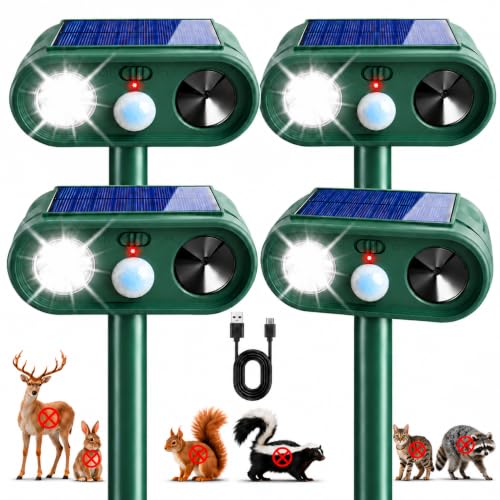
Four motion-activated units make this option suited to several garden approaches rather than a single monitored spot. The manufacturer says the PIR sensors detect movement across a 110-degree angle from approximately 25 to 30 feet under suitable conditions; motion triggers the response, which includes a strobe light. The product targets deer, rabbits and raccoons as well as squirrels. Place each sensor facing an open approach such as a pathway or fence gap, since a limited angle leaves areas outside its view. A deterrent cannot keep squirrels from climbing over or digging beneath a boundary.
Bottom line: Choose this when you want to cover several garden entry routes with motion-triggered units.
Broox Solar Animal Repellent
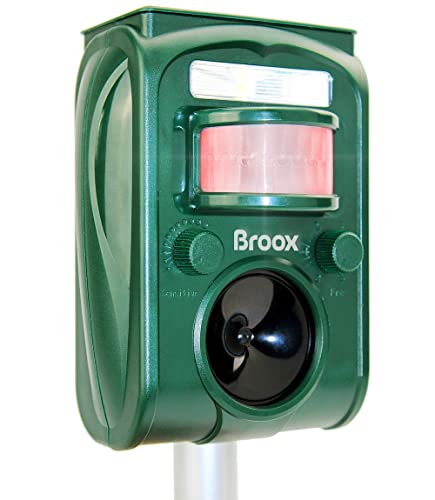
A flashing LED accompanies the ultrasonic response on this single outdoor unit, setting it apart from options described primarily by their sensor layout or multi-unit coverage. The manufacturer says movement triggers ultrasonic sound, an alarm and the flashing light; the product is described as solar-powered and IP65 waterproof. It is intended for several animal types, including squirrels, and measures about 4.33 inches on each side.
Bottom line: Pick this if a solar unit with both sound and a flashing-light response suits your outdoor setup.
How to choose an ultrasonic squirrel repellent
Start with the location: indoor attic units and outdoor motion-triggered devices solve different setup problems. Sound-only units can be placed near observed routes, while a motion-triggered unit needs a clear view of the approach; the sensor range and angle determine how much area one device can monitor. A practical rule is to cover each separate garden entrance rather than assuming one sensor will see around corners or through dense plants. Ultrasonic sound is directional and can be blocked by walls and solid objects, so avoid placing a device behind stored items. Treat sound repellents as one part of control, not a substitute for removing access to food or closing entry points.
Where to place outdoor squirrel deterrents
Outdoor motion sensors work best when aimed at a known route with an unobstructed view. A 25-to-30-foot sensing claim, for example, does not mean the device covers that distance through shrubs, fences or walls; vegetation and placement affect detection. Position units near garden entrances, paths or fence gaps and keep the sensor facing the area squirrels approach from. Solar units also need access to daylight for charging, so a shaded corner may undermine the intended setup. IP65 means protection against dust and water jets, not submersion; do not place a unit where it could sit underwater.
Use this placement guide to match the device type to the problem area.
| Problem area | Device approach | Key setup condition |
|---|---|---|
| Dry attic or garage | Rechargeable sound deterrent | Place near observed routes |
| Open garden approach | Solar motion-triggered deterrent | Keep sensor view clear |
| Several garden approaches | Multiple motion-triggered units | Face each route separately |
Why exclusion matters more than sound alone
Sealing entry points is the durable step when squirrels are already entering a building. Inspect roof edges, vents and openings around utility lines, then use materials suited to the opening; metal mesh is commonly used where rodents may chew through softer materials. Do not seal an opening until you are sure animals are not trapped inside, especially in nesting season. For outdoor plants, barriers such as wire mesh can protect a specific bed more reliably than relying on sound to deter every visit. Remove accessible food sources too: birdseed, pet food and fallen fruit can keep attracting animals even when a repellent is present.
What to expect from ultrasonic devices
Ultrasonic devices emit high-frequency sound, often above the range most adults can hear, and some products pair sound with motion sensing or light. Sound does not pass through solid walls effectively, so one unit cannot be assumed to protect a whole house or yard. Repeated, unchanging stimuli may also become less useful over time as animals adapt, which is why changing access conditions and using physical exclusion matter. If a device has selectable settings, use its instructions to set it up and observe whether activity changes; do not interpret a lack of audible sound as proof that the unit is inactive, since ultrasound may be inaudible to people.
Frequently Asked Questions
Can ultrasonic repellents keep squirrels out of an attic?
An ultrasonic device may be used as a deterrent, but it does not close an entry hole. Find and seal access points only after confirming animals are not trapped inside, and protect vulnerable wiring and insulation.
How far should an outdoor squirrel repellent reach?
A sensor’s range is a maximum under suitable conditions, not a guarantee through obstacles. Keep the path clear and place a unit within its specified range of the route; foliage and barriers can reduce detection.
Do solar squirrel repellents work in shaded gardens?
Solar charging needs daylight, so a persistently shaded position can limit charging. Place the panel where it receives direct sunlight and keep the motion sensor aimed at the animal approach.
Can ultrasonic sound pass through walls or fences?
Ultrasonic sound is readily blocked by solid barriers, so a device on one side of a wall should not be expected to cover the other side. Position indoor units in the same open area as the activity.
Should I use a repellent while squirrels are nesting?
First make sure no animals or young are inside the structure before closing an opening. If an animal may be trapped or a nest is present, get qualified wildlife-removal guidance before sealing access.