
Ultrasonic Tooth Scalers for Dogs: 3 Tools Compared

For an ultrasonic tooth scaler for dogs, Psytpusa Pet Ultrasonic Cleaner is a straightforward option with three modes and a claimed gum-contact sensor; choose PATWING 5-Mode Plaque Remover instead if five modes matter more. These tools are for visible tooth surfaces, not a substitute for a veterinary dental cleaning, which can assess and clean below the gumline.
We earn a commission if you buy through links on this page. As an Amazon Associate I earn from qualifying purchases. Products are compared on manufacturer specifications, not hands-on testing.
- Best overall: Psytpusa Pet Ultrasonic Cleaner – It combines three modes, an LED light and a claimed sensor that stops at gums or soft skin.
- Best for included tools: YunLuna 3-Mode Plaque Remover – It includes two replacement heads plus dental instruments and a double-ended toothbrush.
- Best for mode choice: PATWING 5-Mode Plaque Remover – Five cleaning modes provide more adjustment options than the three-mode tools.
| Product | Best for | Cleaning modes | Gum-contact response | Shop |
|---|---|---|---|---|
| Psytpusa Pet Ultrasonic Cleaner | Simple mode selection | 3 | Stops at gums or soft skin | Check Price on Amazon |
| YunLuna 3-Mode Plaque Remover | Accessory variety | 3 | Stops at gums or soft skin | Check Price on Amazon |
| PATWING 5-Mode Plaque Remover | More mode options | 5 | Activates on hard tartar | Check Price on Amazon |
Ultrasonic Tooth Scalers for Dogs
Compare mode counts, claimed gum-contact behavior and included heads before choosing a tool for visible tooth surfaces.
Psytpusa Pet Ultrasonic Cleaner

Psytpusa Pet Ultrasonic Cleaner pairs three cleaning modes with an LED light and a claimed smart chip that stops operation at gums or soft skin and activates on teeth. The maker gives a vibration range of 20–40 kHz. Its black, single-count package may suit a buyer who wants a small set of operating modes rather than a wider range of settings.
Confirm the included tools before ordering if specific accessories matter; use the scaler only on visible tooth surfaces and leave gumline work to a veterinarian.
Bottom line: Choose this if three modes and a claimed gum-contact stop are your priorities.
YunLuna 3-Mode Plaque Remover
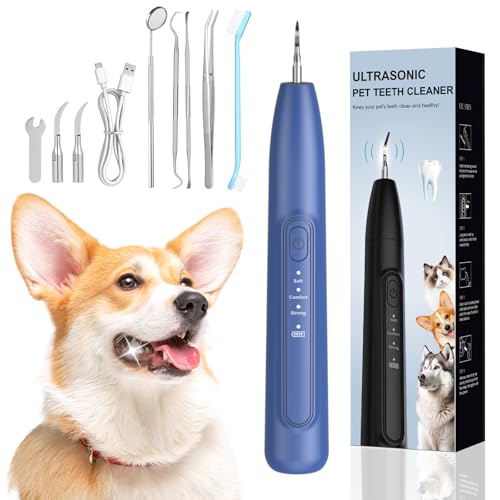
YunLuna 3-Mode Plaque Remover stands out for its accessory set: two replacement cleaning heads, a dental probe, scaler, tweezer, mirror and double-ended toothbrush accompany the three-mode tool. The maker describes a recognition function that starts on tartar, plaque or stains and stops at gums or soft skin, plus an LED light. Navy is the color.
The assortment may suit someone who wants brushing and inspection tools together, but extra instruments do not replace a veterinary exam or professional cleaning. The maker names soft, comfort and strong settings, so buyers who need five distinct modes should consider another option.
Bottom line: Choose this for the broadest named set of included dental tools.
PATWING 5-Mode Plaque Remover
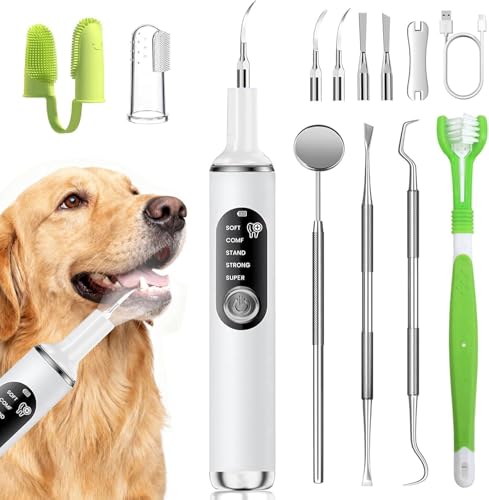
PATWING 5-Mode Plaque Remover differs from the other two tools with five settings: soft, comfort, standard, strong and super. The maker says ultrasonic vibration activates on hard tartar and that no vibration in the air is normal; it also includes a built-in LED light. Its white, single-count package may suit a buyer who wants more adjustment steps while acclimating a dog to handling.
The maker does not describe a gum-contact stop, so do not assume it has the same response described for the other tools. Stop if your dog resists or shows discomfort, and have a veterinarian address deposits near or below the gumline.
Bottom line: Choose this if five named modes are more useful than a claimed gum-contact stop.
How to choose a dog ultrasonic scaler
Choose by mode range, handling tolerance and the kind of buildup you need to address. A scaler is a powered instrument intended to dislodge hard deposits from tooth surfaces; it is not a toothbrush and cannot replace a veterinary dental exam. Begin with the lowest setting and brief handling sessions so your dog can become accustomed to the sound and contact. These tools describe different activation behaviors, so compare each maker’s claim rather than assuming every device responds the same way. If your dog pulls away, bleeds, or appears uncomfortable, stop and ask a veterinarian to assess the mouth. A tool’s LED can improve visibility, but it does not reveal disease or deposits below the gumline.
Home scaling versus veterinary dental cleaning
Home scaling only addresses what you can safely see on the exposed tooth surface; veterinary cleaning can assess periodontal pockets and clean beneath the gumline. Dental disease can be hidden under the gums even when the visible crown looks clean. Veterinary dental procedures commonly use general anesthesia to permit a complete oral exam, probing and dental radiographs, followed by cleaning and polishing. A handheld scaler cannot provide that full assessment. Avoid scraping gum tissue or forcing a tool under the gum edge, where injury can occur. For persistent bad breath, loose teeth, bleeding, facial swelling or difficulty eating, arrange a veterinary exam rather than trying to remove the cause at home.
Brushing and daily dental care
Daily tooth brushing is the home-care standard most likely to limit new plaque buildup; use a soft-bristled brush and toothpaste made for dogs, never human toothpaste. Plaque can mineralize into tartar, which brushing cannot reliably remove once hardened. Introduce brushing gradually: handle the muzzle, touch the lips, then brush a few teeth before extending the session. Focus on the outer tooth surfaces, where plaque often accumulates, and reward calm behavior. Dental chews and other oral-care products can add support, but choose products appropriate to your dog’s size and chewing style to reduce choking or tooth-fracture risk. A scaler is not a substitute for this ongoing prevention routine.
When visible tartar needs a veterinarian
Visible deposits at the gumline, red or swollen gums, persistent odor and loose teeth warrant a veterinary dental assessment rather than more forceful home scraping. A dog may have painful disease below the gum edge without obvious signs, and a home tool cannot examine periodontal pockets or take dental radiographs. Do not use an ultrasonic scaler on a moving, frightened or painful dog: sudden movement can lead to gum or tooth injury. Veterinary teams can determine whether a professional cleaning is needed and whether anesthesia is appropriate for a complete evaluation. At routine visits, ask how often your dog’s mouth should be rechecked; the interval depends on oral findings, age and individual risk.
Frequently Asked Questions
Can I use an ultrasonic scaler on my dog at home?
A home scaler should be limited to visible tooth surfaces, and it cannot replace a veterinary exam or below-gum cleaning. Stop if your dog moves, resists or shows discomfort; sudden movement can injure the mouth.
How often should I brush my dog’s teeth?
Daily brushing is the usual home-care target because plaque can build between sessions. Use a soft brush and toothpaste formulated for dogs, and introduce brushing gradually if your dog is not accustomed to it.
Can a dog scaler clean below the gumline?
No handheld home scaler can provide a complete below-gum assessment and cleaning. Veterinary dental care can include probing and radiographs to find disease hidden beneath the visible tooth surface.
Why does an ultrasonic scaler stop vibrating in the air?
Some devices activate only when their tip contacts a hard surface, so air operation may not trigger vibration. This behavior is product-specific; do not treat silence in air as proof that a tool is functioning safely.
What signs mean my dog needs a dental exam?
Bleeding or swollen gums, loose teeth, persistent bad breath, facial swelling or trouble eating are reasons to arrange a veterinary exam. Visible tartar can coexist with disease hidden below the gumline.