
Vissani Portable Air Conditioner: Models Compared

For a Vissani portable air conditioner for a room up to 150 square feet, Vissani 5,000-BTU Portable AC is the direct match; its 5,000-BTU (DOE) rating is the deciding factor. Choose an alternative if you need a larger stated coverage area, Wi-Fi control or a Follow Me remote.
Portable air conditioners cool indoor air and exhaust heat through a window vent, so window access and room size both matter.
We earn a commission if you buy through links on this page. As an Amazon Associate I earn from qualifying purchases. Products are compared on manufacturer specifications, not hands-on testing.
- Best overall: Vissani 5,000-BTU Portable AC – The only Vissani match, rated at 5,000 BTU (DOE) for spaces up to 150 square feet.
- Best for Follow Me control: BLACK+DECKER BPACT08WT – Its remote can act as a thermostat, and the unit also has fan and dehumidifier modes.
- Best for Wi-Fi: SereneLife SLPAC805W 8,000-BTU AC – Wi-Fi control and stated coverage up to 300 square feet distinguish this model.
| Product | Best for | Cooling capacity | Stated room coverage | Shop |
|---|---|---|---|---|
| Vissani 5,000-BTU Portable AC | Small rooms | 5,000 BTU (DOE) | Up to 150 sq. ft. | Check Price on Amazon |
| BLACK+DECKER BPACT08WT | Remote thermostat | 9,000 BTU; 5,300 BTU SACC | Up to 400 sq. ft. | Check Price on Amazon |
| SereneLife SLPAC805W 8,000-BTU AC | Wi-Fi control | 8,000 BTU | Up to 300 sq. ft. | Check Price on Amazon |
| BLACK+DECKER BPACT14WT Smart AC | Larger rooms | 14,000 BTU; 10,200 BTU SACC | Up to 700 sq. ft. | Check Price on Amazon |
Vissani Portable Air Conditioner and Alternatives
Compare the Vissani match with portable AC alternatives by capacity, stated coverage and control features.
Vissani 5,000-BTU Portable AC
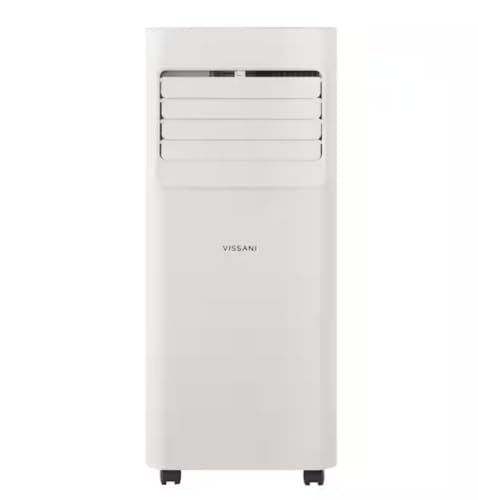
Vissani 5,000-BTU Portable AC is the direct Vissani match in this group, with a 5,000-BTU (DOE) rating and stated coverage up to 150 square feet. Its product name identifies a dehumidifier and remote in addition to air conditioning, and the unit is white. This is the clearest fit for a buyer seeking the Vissani brand for a small room. Its coverage is smaller than the alternatives, so a room larger than 150 square feet calls for a different capacity match.
Bottom line: Choose this model when you want the Vissani brand and your room is within its 150-square-foot coverage.
BLACK+DECKER BPACT08WT

BLACK+DECKER BPACT08WT is a BLACK+DECKER alternative, not a Vissani, and its Follow Me remote can act as a thermostat. The maker identifies a 9,000-BTU rating and 5,300 BTU SACC, with coverage up to 400 square feet; it also functions as a fan and dehumidifier. Casters and side handles support moving it between rooms. Pick it when remote temperature sensing matters more than matching the Vissani name. The two capacity figures use different rating labels, so compare ratings on the same basis when sizing against another unit.
Bottom line: Choose this alternative when Follow Me remote control is a priority.
SereneLife SLPAC805W 8,000-BTU AC

SereneLife SLPAC805W 8,000-BTU AC stands apart from the Vissani model with Wi-Fi capability and a 8,000-BTU cooling capacity. The maker says it covers spaces up to 300 square feet; the unit also has cooling, fan and dehumidifier modes and pulls up to 1.1 liters of moisture per hour. Its noise level is 55 dBA. Consider it for a room that exceeds the Vissani model’s coverage or when Wi-Fi control is useful. The features do not identify a remote, so buyers who require one should confirm that before ordering.
Bottom line: Choose this model for Wi-Fi control and stated coverage up to 300 square feet.
BLACK+DECKER BPACT14WT Smart AC

BLACK+DECKER BPACT14WT Smart AC is the largest-capacity alternative here, with a 14,000-BTU ASHRAE rating and 10,200 BTU SACC. The maker gives coverage up to 700 square feet and includes Wi-Fi, app and voice control, plus fan and dehumidifier modes and a Follow Me remote. That combination suits buyers whose room is substantially larger than the Vissani model’s coverage. Its higher capacity is not automatically a better match for a small room; estimate the room’s cooling need before choosing by the largest number alone.
Bottom line: Choose this alternative when its 700-square-foot coverage and smart controls suit your room.
How to Choose a Portable Air Conditioner
Match cooling capacity to room area before choosing extra controls. A common starting estimate is about 20 BTU per square foot, so a 150-square-foot room begins around 3,000 BTU; direct sun, high ceilings, poor insulation or frequent cooking can raise the need. BTU figures can use different rating methods, so compare DOE with DOE or SACC with SACC rather than treating unlike labels as equivalent. This matters especially when one unit gives multiple capacity numbers. For a room near the maker’s coverage limit, account for heat load instead of relying on the square-foot figure alone.
Window Venting and Room Fit
A portable AC needs an exhaust route, usually through a window, because the cooling process sends room heat outdoors. Measure the window opening and check that the included vent arrangement can seal it; a poorly sealed gap lets outdoor heat back in. Keep the exhaust hose as short and straight as the setup allows, since bends and extra length can impede airflow. Do not treat floor area as the only fit check: confirm clearance around the unit, a suitable outlet, and a path for any condensate handling required by the model. For rooms with limited window access, verify the venting plan before choosing a portable unit.
BTU Ratings and Room Coverage
Capacity labels are not interchangeable: a product may provide an ASHRAE or DOE figure alongside a SACC figure. SACC accounts for effects of the portable unit’s operation, so compare matching rating systems when evaluating two models. The square-foot coverage is a useful starting point, not a guarantee for every room. Sun exposure, ceiling height, insulation and people or equipment generating heat can change the load. This table pairs each product’s rating and room-coverage claim; use like-for-like capacity labels for a closer comparison.
| Model | Capacity label | Stated coverage |
|---|---|---|
| Vissani 5,000-BTU Portable AC | 5,000 BTU (DOE) | Up to 150 sq. ft. |
| BLACK+DECKER BPACT08WT | 9,000 BTU; 5,300 BTU SACC | Up to 400 sq. ft. |
| SereneLife SLPAC805W 8,000-BTU AC | 8,000 BTU | Up to 300 sq. ft. |
| BLACK+DECKER BPACT14WT Smart AC | 14,000 BTU ASHRAE; 10,200 BTU SACC | Up to 700 sq. ft. |
Portable AC Setup and Moisture
Portable air conditioners move heat outdoors, while their dehumidifier mode removes moisture from indoor air. Condensate may need to be emptied or drained depending on the appliance design and conditions; check the setup requirements before placing a unit where a spill would damage flooring. Keep the air intake and outlet clear rather than pushing the unit tightly against furniture. Avoid blocking the window exhaust or leaving the window seal open around it. In humid rooms, moisture removal can be a useful secondary feature, but it does not replace correct cooling-capacity sizing or proper venting.
Frequently Asked Questions
How many BTUs do I need for a 150-square-foot room?
A common starting estimate is about 20 BTU per square foot, or roughly 3,000 BTU for 150 square feet. Strong sun, high ceilings, poor insulation or added heat from people and equipment can increase the needed capacity.
Do portable air conditioners need a window?
Most portable ACs need a way to exhaust hot air outdoors, commonly through a window vent. Measure the opening and check the venting arrangement before purchase; leaving gaps around the seal can let heat back into the room.
What is the difference between SACC and ASHRAE BTU?
ASHRAE and SACC are different cooling-capacity rating methods, so their figures should not be compared as if they were measured identically. Compare products using the same rating label, such as SACC against SACC.
How often should a portable air conditioner be drained?
There is no single interval that applies to every portable AC because condensate production changes with humidity, temperature and operating mode. Check the unit’s drainage setup and inspect it regularly during humid weather to avoid overflow.
Can a portable air conditioner cool multiple rooms?
Portable AC coverage is intended for a defined area, and walls and closed doors limit cool-air movement. For dependable cooling, size the unit for the occupied room rather than adding the square footage of separated rooms.