
Wind Deflectors for Motorcycles: Types and Fit Compared

For a clip-on extension with four adjustable angles, choose PACEWALKER Adjustable Clip-On Extension; the right wind deflector depends on whether your bike has a windshield, suitable headlight mounts, or compatible forks. Riders seeking lower-body coverage or a headlight-mounted flyscreen should choose a different style.
We earn a commission if you buy through links on this page. As an Amazon Associate I earn from qualifying purchases. Products are compared on manufacturer specifications, not hands-on testing.
- Best overall: PACEWALKER Adjustable Clip-On Extension – Its 3.93-inch extension offers four adjustable angles and fits many existing motorcycle windshields.
- Best for leg coverage: Kiawnia Front Fork Deflectors – The pair of fork deflectors is designed to redirect wind around the legs.
- Best for round headlights: LisylineAuto 5–7-Inch Headlight Flyscreen – Its mounting design targets motorcycles with 5- to 7-inch round headlights and side screws.
| Product | Best for | Deflector type | Mounting fit | Size or adjustment | Shop |
|---|---|---|---|---|---|
| PACEWALKER Adjustable Clip-On Extension | Windshield extension | Clip-on windshield extension | Most motorcycle windshields | 3.93 in; 4 angles | Check Price on Amazon |
| Motoforti 28.5-cm Clip-On Deflector | Clear adjustable extension | Clip-on windshield extension | Most motorcycles with windshield | 11.22 × 4.53 in; adjustable | Check Price on Amazon |
| Kiawnia Front Fork Deflectors | Lower-body wind protection | Front fork deflectors | Selected Honda, Kawasaki, Yamaha models | Pair; brackets and clamps | Check Price on Amazon |
| LisylineAuto 5–7-Inch Headlight Flyscreen | Round-headlight bikes | Headlight-mounted flyscreen | 5–7 in round headlight with side screws | 5–7 in headlight fit | Check Price on Amazon |
Wind deflectors for motorcycles by type and fit
Match the deflector’s mounting location to your motorcycle before comparing adjustment and coverage.
PACEWALKER Adjustable Clip-On Extension

Unlike fork shields or headlight-mounted screens, this clip-on extension adds height to an existing windshield. The extension is 3.93 inches tall and has four adjustable angles. The maker says it is intended to reduce wind noise and helmet vibration, and lists fit for many Honda, Suzuki, Kawasaki, Yamaha, Harley-Davidson, and Aprilia motorcycles, scooters, and dirt bikes. Choose it when the bike already has a windshield that can accept a clip-on. The fit is broad rather than tied to a specific model, so riders with unusual windshield shapes should confirm clamp compatibility before ordering.
Bottom line: Choose this if your bike has a windshield and you want an adjustable extension.
Motoforti 28.5-cm Clip-On Deflector

The Motoforti extension is a clear, 11.22-by-4.53-inch panel with a bracket that adjusts vertically or side to side, unlike the angle-focused design of some clip-on extensions. Its bracket spacing is 8.27 inches, and it uses M4 × 0.75 thread sizing. The maker describes the transparent plastic as allowing an unobstructed view and lists broad fit for motorcycles with a windshield, including several Japanese and European brands. It suits riders who want to reposition a clear spoiler. The 8.27-inch bracket spacing is a key fit check if your windshield or mounting area is narrow.
Bottom line: Choose this for a clear clip-on panel with adjustable position.
Kiawnia Front Fork Deflectors

These Kiawnia shields mount at the front forks, so they target airflow around the legs rather than extending a windshield. The package includes two deflectors, two brackets, and fork clamps. The maker says the design redirects wind around the legs and helps block external elements; the motorcycle families include select Honda Shadow, VT, and VTX models, Kawasaki Vulcan Classic, and Yamaha V-Star models. This style suits riders seeking lower-body coverage. Fit is model-dependent, so confirm the fork and motorcycle match before ordering rather than assuming the broad model-family names cover every year or trim.
Bottom line: Choose these when your priority is fork-mounted lower-body coverage.
LisylineAuto 5–7-Inch Headlight Flyscreen
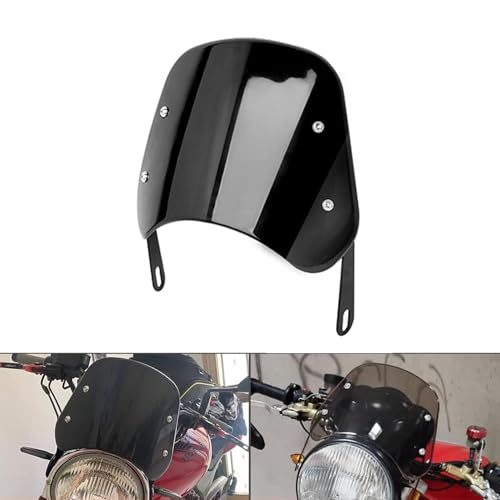
Unlike windshield extensions, this LisylineAuto flyscreen attaches at the headlight bracket and is sized for 5- to 7-inch round headlights. Installation uses the screws on both sides of the headlight to secure the screen and mounting bracket. The maker says the screen is intended to reduce airflow and help shield against bugs and debris. It suits a motorcycle with the specified headlight size and side screws, including compatible cafe racer-style setups. A bike without those side screws is outside the mounting fit, even if its headlight diameter falls in range.
Bottom line: Choose this for a compatible round-headlight setup without a windshield.
How to choose a motorcycle wind deflector
Choose by mounting location first: windshield extensions attach to an existing screen, fork deflectors sit beside the front wheel, and flyscreens can mount at the headlight. A windshield extension changes airflow above the original screen, while fork shields target the legs; they are not interchangeable solutions. Check what the bike already has before comparing adjustability or material. A clip-on extension needs a compatible edge or clamping surface, and a headlight flyscreen requires the specified bracket arrangement. If your bike has a round headlight measuring 5 to 7 inches with screws on both sides, the headlight-mounted style may fit; without those side screws, look at another mount type. For model-specific fork or triple-tree parts, verify the exact motorcycle configuration rather than relying on brand alone.
| Riding need | Deflector style | Fit condition |
|---|---|---|
| Extend existing screen | Clip-on windshield extension | Compatible windshield edge |
| Redirect airflow by legs | Front fork shields | Compatible fork and model |
| Add a small front screen | Headlight-mounted flyscreen | 5–7-inch round light with side screws |
Windshield extension size and placement
Windshield extensions are most useful when they can be placed where airflow clears the helmet rather than striking its visor or upper edge. Screen height, rider height, seat position, and helmet shape all affect that airflow, so a universal extension cannot guarantee the same result on every motorcycle. Start with a small angle or position change, then reassess at a safe, legal speed; do not adjust a screen while moving. A panel that is too tall or poorly aligned can enter the rider’s sightline, and loose clamps can shift under wind load. Keep the clear viewing area unobstructed and inspect the mounting hardware before riding. When comparing extensions, distinguish panel height from overall screen height: a 3.93-inch extension adds that much panel, not necessarily that much effective wind relief.
How fork and headlight deflectors differ
Fork deflectors and headlight flyscreens solve different airflow problems. Fork-mounted panels place a barrier beside the lower legs, while a headlight flyscreen directs airflow around the front of a compact motorcycle. Neither should be treated as a substitute for a larger windshield if the goal is to alter airflow around the helmet. Mounting fit matters more than broad claims of universal compatibility: fork diameter, bracket location, headlight diameter, and side-screw access determine whether a part can attach correctly. A 5- to 7-inch headlight range is a measurable starting point, but the mounting screws still need to match. Likewise, fork shields named for several model families can still differ in clamp or fork arrangement. Do not force a bracket onto a mount that does not align.
Installation and safety checks
Check clear sightlines and secure mounting before every ride after installing or repositioning a wind deflector. Motorcycle windscreens and attached spoilers can change airflow and create turbulence, so begin with conservative adjustments and reassess before longer or faster rides. Use the mounting hardware as intended, tighten fasteners evenly, and verify that the screen cannot contact controls, cables, or the headlight through steering movement. For clamp-on panels, inspect the clamp and bracket after the first short ride because vibration can loosen hardware. A deflector must never obscure the road or interfere with steering. Replace cracked or heavily scratched transparent panels when damage affects visibility; a clear panel is only useful if the rider can see through it safely.
Frequently Asked Questions
Do motorcycle wind deflectors reduce helmet buffeting?
They can change airflow, but the result depends on screen height, angle, rider position, and helmet shape. Make small adjustments while parked and evaluate them on a safe ride before relying on a new setting.
How do I measure a motorcycle headlight for a flyscreen?
Measure across the round headlight’s diameter, not around its circumference. A 5- to 7-inch screen also needs the specified side mounting screws to attach correctly.
Can a windshield extension fit every motorcycle?
No; extensions require a windshield edge and a clamp that matches its shape and thickness. Confirm the mounting surface and bracket spacing before choosing a universal-style part.
Where do motorcycle fork deflectors attach?
Fork deflectors mount beside the front wheel on compatible fork or clamp points. Check the motorcycle model and fork arrangement, since broad model-family fit does not confirm every trim.
Can a wind deflector block a rider’s view?
Yes, a poorly positioned or damaged screen can obstruct the sightline. Keep the road view clear through the windscreen and check visibility from your normal seated riding position before riding.