
VIVOSUN Grow Lights: Three Models Compared by Fit

For most small indoor gardens, VIVOSUN LumaLight 100W is the most versatile VIVOSUN grow light here because its 100W fixture is sized for 2×2- or 2×4-foot tents. Choose VIVOSUN LumaLight 500W instead for a 4×4-foot tent, or VIVOSUN T5 1-Foot Grow Light, 4-Pack if you need linkable strips for seedlings and a timer-and-dimming controller.
LED grow lights supply plant-usable light indoors; matching the light’s intensity and coverage to the crop and growing area matters more than wattage alone.
We earn a commission if you buy through links on this page. As an Amazon Associate I earn from qualifying purchases. Products are compared on manufacturer specifications, not hands-on testing.
- Best overall: VIVOSUN LumaLight 100W – Its 100W output and stated 2×2/2×4-foot fit cover common small tent setups.
- Best for 4×4 tents: VIVOSUN LumaLight 500W – The 500W bar fixture is designed for 4×4-foot coverage.
- Best for seedling shelves: VIVOSUN T5 1-Foot Grow Light, 4-Pack – The four 1-foot strips include a timer and dimming controller and can be linked.
| Product | Best for | Power | Coverage or size | Control | Shop |
|---|---|---|---|---|---|
| VIVOSUN LumaLight 100W | Small grow tents | 100W | 2×2 or 2×4 ft | Smart dimming; GrowHub sold separately | Check Price on Amazon |
| VIVOSUN LumaLight 500W | Large grow tents | 500W | 4×4 ft | Smart dimming; GrowHub compatible | Check Price on Amazon |
| VIVOSUN T5 1-Foot Grow Light, 4-Pack | Seedling shelves | 28W total | Four 1-ft strips | Timer and dimming controller | Check Price on Amazon |
VIVOSUN grow lights compared
Compare tent coverage, form factor and controls to match a fixture to your growing space.
VIVOSUN LumaLight 100W
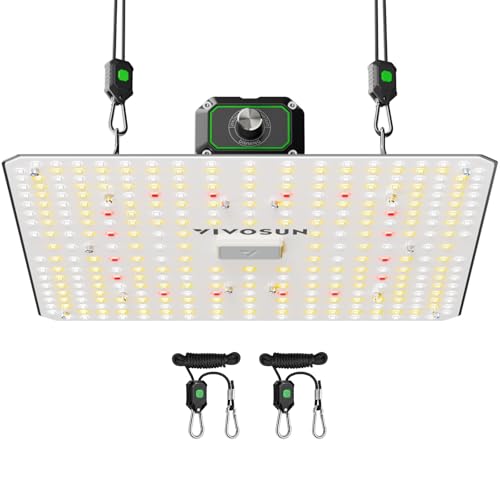
For a small tent, this 100W LumaLight is the most flexible fixture in this group: its fit includes both 2×2- and 2×4-foot spaces. It combines white, blue, red and far-red LEDs, with 3000K and 5000K white LEDs plus 660nm and 730nm diodes. VIVOSUN says the spectrum supports growth from seedlings through harvest, and the fixture can be controlled through the app when paired with a separately sold GrowHub. That separate controller is a limitation if app-based scheduling is essential; the fixture alone does not provide that setup.
Bottom line: Choose this for a compact tent when you want smart dimming as an option.
VIVOSUN LumaLight 500W
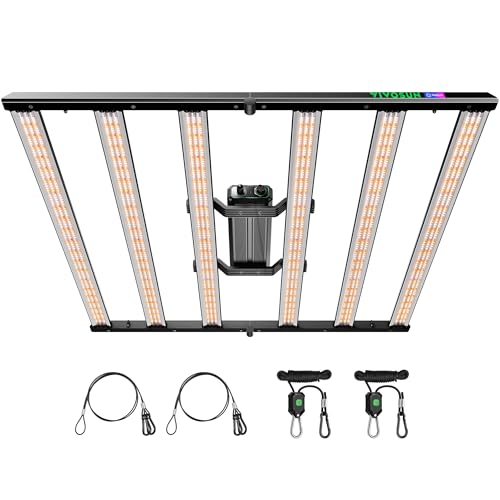
The 500W LumaLight is the only model here designed for a 4×4-foot tent, and its bar-matrix layout differs from the smaller fixture’s compact form. It uses white, blue, red and far-red LEDs, including 3000K and 5000K white light. VIVOSUN says its micro-lens optics can raise PPFD by up to 20% and that the fixture reaches up to 0.89 uniformity; those are maker performance claims, not a substitute for matching intensity to each crop. Its large footprint is a poor fit for a shelf or small tent, so measure the growing area before choosing it.
Bottom line: Choose this for a 4×4-foot tent that needs a larger bar-style fixture.
VIVOSUN T5 1-Foot Grow Light, 4-Pack

For shelves and narrow growing spaces, this four-pack uses four separate 1-foot strips rather than a single tent fixture. Each strip is 7W, for 28W total, and the lights have 5000K LEDs, a timer and dimming controller. VIVOSUN positions these strips for seedlings, vegetables and flowers, and says their lenses spread light evenly.
Bottom line: Choose this for seedlings or small areas where separate linkable strips are useful.
How to choose a VIVOSUN grow light
Match light intensity and illuminated area to the crop before comparing wattage. A useful planning measure is daily light integral (DLI), calculated as PPFD × light hours × 0.0036; for example, 300 μmol/m²/s for 16 hours gives 17.3 mol/m²/day. As a broad starting range, many leafy crops grow under about 200–400 μmol/m²/s, while fruiting crops often need roughly 400–600; species, growth stage and ambient light change the target. A light’s wattage does not tell you the PPFD at the canopy, so look for a PPFD map for the intended hanging height. For a 4×4-foot canopy, choose the 500W model designed for that coverage; for a smaller tent, the 100W model is a closer match.
Coverage and hanging height for indoor plants
Use the fixture’s intended footprint as a starting point, then check light intensity across the whole canopy. The 100W model is designated for 2×2- or 2×4-foot tents, while the 500W unit is designed for 4×4-foot coverage; the T5 pack consists of four 1-foot strips instead of a tent footprint. PPFD usually falls as the fixture is raised, and a closer light can create brighter center spots than edges. Keep a consistent canopy distance and measure at several points if a PPFD meter is available. For seedlings, dim or raise a fixture if leaves bleach, curl or show dry patches; for stretching seedlings, increase light gradually rather than abruptly.
LED bars, tent fixtures and strip lights compared
Fixture shape helps determine where light can be placed: bar arrays span a canopy, while short strips can be arranged over trays or shelves. The 500W model uses a bar matrix and is intended for a 4×4-foot area; the four T5 strips are each 1 foot long and can be linked. A compact fixture is simpler for a small tent, but strip placement may better follow a narrow shelf layout. This table matches form to common growing spaces, not crop-specific light needs.
| Growing setup | Fixture type | Decision point |
|---|---|---|
| 2×2 or 2×4 ft tent | 100W compact LED | Pick for small tent footprint |
| 4×4 ft tent | 500W bar fixture | Pick for larger canopy |
| Seedling shelf or trays | Four 1-ft strips | Pick when separate strips fit layout |
Timers, dimming and safe placement
Set a consistent photoperiod with a timer, then adjust light intensity to the plant’s stage instead of extending the day to compensate for weak intensity. Many indoor growers use roughly 12–18 hours of light for vegetative growth, while flowering schedules depend on plant species; photoperiod-sensitive plants need particular care with uninterrupted darkness. The T5 pack includes a timer and dimming controller, while the LumaLight 100W requires a separately sold GrowHub for app control. Keep powered fixtures away from water and mist, secure them above the canopy, and avoid overloading a circuit with multiple high-wattage devices. Leave room for airflow around the fixture and check cables for damage before operation.
Frequently Asked Questions
How many hours should a grow light run each day?
Many indoor growers use about 12–18 hours of light during vegetative growth, but the suitable photoperiod depends on crop and growth stage. Photoperiod-sensitive flowering plants may require a specific uninterrupted dark period.
What does PPFD measure for a grow light?
PPFD measures photosynthetic photons reaching a square meter each second, in μmol/m²/s. Measure or consult a map at canopy height because intensity changes with fixture distance and across the growing area.
How far above seedlings should an LED grow light hang?
There is no universal distance because output and optics differ between fixtures; use a PPFD target at the seedling canopy rather than wattage alone. Raise or dim the light if leaves bleach or curl, and increase intensity gradually if seedlings stretch.
Can grow lights stay on all night?
Most plants benefit from a dark period, and 24-hour light is not a safe default for plant growth. Use a timer to provide a consistent schedule, especially for photoperiod-sensitive crops that rely on uninterrupted darkness.
Can a grow light get wet while watering plants?
Keep an energized grow light and its connections dry; do not spray or water above exposed electrical fixtures. Switch off power before moving a fixture or handling connections near a spill.