
Best Exhaust Repair Tape: 4 Wraps Compared by Heat Rating

J-B Weld ExhaustWeld Repair Wrap is the strongest starting point for most exhaust tape repairs because its fiberglass wrap is rated to resist 1,100°F once fully cured. Choose a different product if you need a longer roll, a kit designed for a low-temperature tail section, or a heat shield wrap rather than a patch.
Exhaust repair tape is a wrap or tape applied over a damaged exhaust section; it is not a substitute for replacing badly corroded or structurally weakened metal.
We earn a commission if you buy through links on this page. As an Amazon Associate I earn from qualifying purchases. Products are compared on manufacturer specifications, not hands-on testing.
- Best overall: J-B Weld ExhaustWeld Repair Wrap – Fiberglass wrap with a 1,100°F resistance after curing.
- Best for longer roll: AMOGATO Fiberglass Aluminum Foil Tape – A 2-inch-wide fiberglass-reinforced foil tape in a 66-foot roll.
- Best for muffler kit format: ABRO Exhaust Tape Repair Kit – Aluminum tape and a high-temperature bonding agent are packaged as a repair kit.
- Best for low-temperature tail section: AMIZUHE Fiberglass Exhaust Repair Wrap – The maker identifies this resin-impregnated fiberglass wrap for the exhaust tail section.
| Product | Best for | Format | Size | Shop |
|---|---|---|---|---|
| J-B Weld ExhaustWeld Repair Wrap | High-heat wrap | Fiberglass resin wrap | 2 × 72 in | Check Price on Amazon |
| AMOGATO Fiberglass Aluminum Foil Tape | Long foil roll | Fiberglass foil tape | 2 in × 66 ft | Check Price on Amazon |
| ABRO Exhaust Tape Repair Kit | Kit-style patch | Aluminum tape kit | Pack of 1 | Check Price on Amazon |
| AMIZUHE Fiberglass Exhaust Repair Wrap | Tail-section wrap | Resin fiberglass wrap | 4 in × 15 ft | Check Price on Amazon |
Exhaust Repair Tape Compared
Compare the repair material, roll dimensions and stated heat limits before choosing a wrap.
J-B Weld ExhaustWeld Repair Wrap

J-B Weld ExhaustWeld Repair Wrap is the only option here with a cured heat resistance above 1,000°F: J-B Weld says the fiberglass wrap resists up to 1,100°F after curing. The 2-inch-by-72-inch strip uses a specially formulated resin and can cure with heat in 20 minutes or without heat in 2 hours, according to the maker. It is intended for manifolds, catalytic converters, mufflers and tailpipes. Choose it when the repair area suits a narrow wrap; the 72-inch length may be limiting for a larger section.
Bottom line: Pick this for a narrow fiberglass wrap repair where the cured heat rating is the deciding factor.
AMOGATO Fiberglass Aluminum Foil Tape
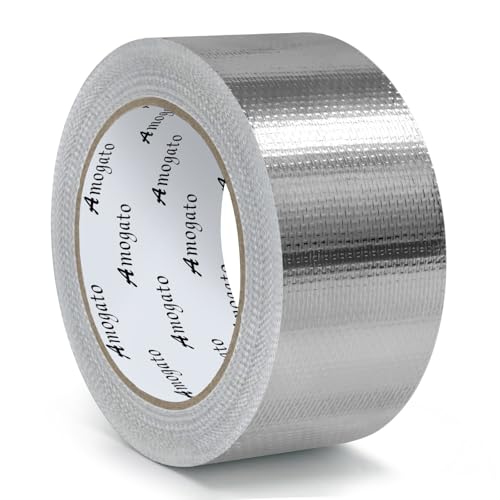
AMOGATO Fiberglass Aluminum Foil Tape comes as a 66-foot roll, much longer than the short repair wraps here, and combines aluminum foil with fiberglass reinforcement. The maker rates it to 500°F and positions it for exhaust-pipe, muffler and HVAC duct sealing. Its length suits repeated small repairs or long runs where a roll format is useful. The tradeoff is its lower stated heat limit than the cured fiberglass wrap option, so do not assume it suits hotter exhaust locations; compare the application temperature with the tape’s rating.
Bottom line: Choose this when a long foil-and-fiberglass roll matters more than a higher stated heat limit.
ABRO Exhaust Tape Repair Kit

ABRO Exhaust Tape Repair Kit is the kit-format option, using aluminum and a high-temperature bonding agent rather than a resin-impregnated fiberglass strip. ABRO says the tape is intended to seal cracks and holes in mufflers, pipes and joints, and describes the repair as hardening under heat. The package is identified as a single kit.
Bottom line: Pick this for a kit-style aluminum tape repair when the repair area’s heat requirement is confirmed.
AMIZUHE Fiberglass Exhaust Repair Wrap

AMIZUHE Fiberglass Exhaust Repair Wrap stands out for its broad 4-inch width and 15-foot roll, making it the longest wrap by length among the resin-impregnated repair options. The maker identifies it for the low-temperature tail section of an exhaust and says the strip must be soaked in water for 3–5 seconds before use; the working window is 5 minutes. Its intended location is the key limitation: do not treat this as a universal wrap for hotter parts such as a manifold or converter.
Bottom line: Choose this for a wider repair on the low-temperature tail section, not for a hotter exhaust location.
How to Choose Exhaust Repair Tape
Start with the damaged location and the product’s temperature limit; a tape suitable for a tail section may not suit a hotter area near the engine. Exhaust repair products also differ in how they bond: resin-impregnated fiberglass wraps cure into a rigid patch, while foil-based tapes use adhesive or bonding compounds. Match the repair material to a clean, sound surface and the maker’s application method. A wrap cannot restore strength to metal that is badly rusted, split, or missing. Use this decision rule: if the damaged section is structurally weak or the leak is at a joint that cannot be wrapped securely, arrange a proper exhaust repair instead of relying on tape.
Where Exhaust Repair Wrap Can Fit
Exhaust temperatures are not uniform: the manifold and front pipe see hotter conditions than the tail section, and load and engine design affect actual temperatures. That makes the location-specific rating more useful than a generic “high heat” label. A 500°F tape and a wrap rated to 1,100°F after curing are not interchangeable solely because both mention exhaust use. Compare the product’s temperature limit against the intended location, and keep the wrap away from moving parts and components that the product is not intended to cover. For damaged metal near a catalytic converter or manifold, use a repair product expressly suitable for that location or have the section repaired professionally.
Repair Tape Types and Tradeoffs
Fiberglass repair wraps impregnated with resin are meant to cure into a hardened patch, while foil-backed tape stays in tape form and relies on adhesive or a bonding agent. A heat-shield wrap is different: it wraps intact exhaust parts to manage radiant heat rather than sealing a leak. This distinction prevents a common mistake—using a heat wrap as though it were a hole-repair compound. The table separates these approaches by their intended role; the actual product temperature rating and application directions still decide whether a particular item fits.
| Type | Typical purpose | Key check |
|---|---|---|
| Resin fiberglass repair wrap | Hardened patch over compatible damage | Cure method and heat rating |
| Foil repair tape | Sealing or covering compatible areas | Adhesive temperature limit |
| Exhaust heat wrap | Heat management on intact parts | Not a leak-repair substitute |
Exhaust Leak Safety and Repair Limits
An exhaust leak can allow carbon monoxide into the cabin, and carbon monoxide has no smell; exhaust odor is not a reliable safety test. Stop driving and get the vehicle inspected if fumes enter the cabin, occupants develop headache or dizziness, or the leak is near the passenger compartment. Repair tape is best treated as a limited repair for compatible damage, not a way to make a corroded pipe structurally sound. Exhaust parts can remain hot after the engine is off, so let the system cool fully before handling it. Keep the repair away from fuel, wiring, rubber hoses and other heat-sensitive parts, and confirm that the material is secure before restarting the vehicle.
Frequently Asked Questions
Can exhaust repair tape fix a large hole?
Exhaust repair tape is not a dependable fix for a large hole or weakened pipe wall. If corrosion has removed metal or the damaged section flexes, replace or professionally repair the exhaust section rather than covering it.
How long does exhaust repair wrap take to cure?
Cure time depends on the wrap and whether heat is used. For the J-B Weld wrap, the maker gives 20 minutes with applied heat and 2 hours without heat; other products may use different steps.
Can I use exhaust tape near the catalytic converter?
Only use a tape whose heat limit and intended application cover that location. Exhaust temperature changes with position and engine load, so a tail-section repair product should not be assumed suitable near the converter.
Is exhaust heat wrap the same as repair tape?
No. Repair tape is intended to cover or seal compatible damage, while exhaust heat wrap manages radiant heat around intact components. Heat wrap should not be treated as a leak seal.
Is it safe to drive with an exhaust leak?
An exhaust leak can expose occupants to carbon monoxide, which has no smell. If exhaust fumes enter the cabin or anyone feels dizzy or gets a headache, stop driving and seek inspection.