
Electric Kettle for Car: 4 Options Compared by Fit

For a compact electric kettle for car use, FVPE 450ml 12V/24V Kettle is the closest match because it supports automatic 12V/24V recognition and holds 450ml. LINGYOKY 400ml 12–24V Kettle is a smaller 400ml option with a 30–35 minute boil time, while Sunsbell 650ml 12V Travel Kettle is a larger 650ml 12V model.
Choose based on your vehicle’s outlet voltage and the time you can allow for heating; these kettles use vehicle power rather than a household outlet.
We earn a commission if you buy through links on this page. As an Amazon Associate I earn from qualifying purchases. Products are compared on manufacturer specifications, not hands-on testing.
- Best overall: FVPE 450ml 12V/24V Kettle – Its automatic 12V/24V recognition and 450ml capacity balance vehicle compatibility and compact size.
- Best for temperature control: LINGYOKY 400ml 12–24V Kettle – It offers adjustable keep-warm settings from 86°F to 203°F and an LCD display.
- Best for larger capacity: Sunsbell 650ml 12V Travel Kettle – Its 650ml capacity is greater than the other options.
| Product | Best for | Capacity | Voltage | Heating time | Shop |
|---|---|---|---|---|---|
| FVPE 450ml 12V/24V Kettle | Mixed vehicle use | 450ml | 12V/24V | — | Check Price on Amazon |
| LINGYOKY 400ml 12–24V Kettle | Timed heating | 400ml | 12–24V | 30–35 min | Check Price on Amazon |
| Sunsbell 650ml 12V Travel Kettle | Larger servings | 650ml | 12V | 45 min to 212°F | Check Price on Amazon |
| 420ml 12V/24V Stirring Kettle | Stirring drinks | 420ml | 12V/24V | 15–20 min to boil | Check Price on Amazon |
Electric Kettles for Car Use
Compare capacity, vehicle voltage compatibility, and heating features before choosing a kettle for the cabin.
FVPE 450ml 12V/24V Kettle

The FVPE stands out for automatic recognition of 12V and 24V power, making it the most flexible choice here for drivers who may use different vehicle types. Its 450ml stainless steel inner liner and adjustable 86°F–203°F temperature range cover small servings and warm-water settings. The maker also includes boil and keep-warm modes. Its 9-inch height may be harder to accommodate in a shallow cup holder or tight console, so measure the available space before choosing it.
Bottom line: Choose this if you need a compact kettle that can switch between 12V and 24V vehicles.
LINGYOKY 400ml 12–24V Kettle

The LINGYOKY is the only option here with a 30–35 minute boil time, useful for planning a stop or break around heating. It holds 400ml, has a 304 stainless steel interior, and supports 12V–24V vehicle outlets. Its keep-warm mode adjusts from 86°F to 203°F, and the LCD display makes settings visible. The smaller capacity gives less room than the 450ml and 650ml alternatives, so it suits one modest serving better than sharing.
Bottom line: Pick this when a heating estimate and adjustable keep-warm settings matter most.
Sunsbell 650ml 12V Travel Kettle
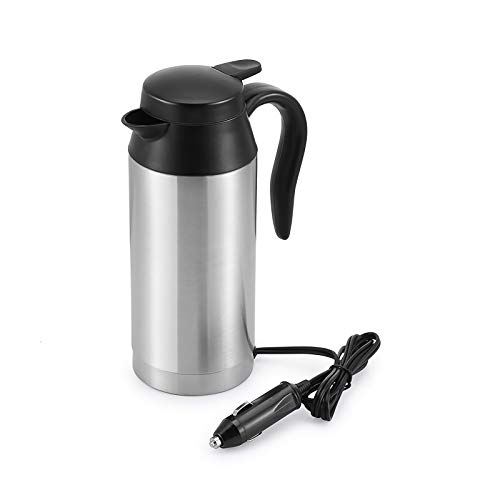
The Sunsbell offers 650ml, the largest capacity among these choices, and is the only one with a target of 212°F in about 45 minutes. It connects through a 12V cigarette-lighter cable and has an electronic thermostat, indicator light, sealed lid band, and nonslip base. The larger volume can suit a longer drive or more than one small serving. Unlike the 12V/24V options, it is specified for 12V only, so check your vehicle outlet before selecting it.
Bottom line: Choose this if capacity matters more than 24V compatibility or faster heating.
420ml 12V/24V Stirring Kettle

The 420ml kettle adds automatic stirring, a feature the other options do not describe, and its maker says it boils water in 15–20 minutes. It supports 12V/24V power, uses a 304 stainless steel liner, and has adjustable temperature control, auto shut-off, and boil-dry protection. The maker says insulation can preserve heat for up to 24 hours when plugged in, so that function depends on continued vehicle power. Its lower capacity than the 450ml and 650ml models matters for larger servings.
Bottom line: Pick this for automatic stirring and a shorter heating window.
How to choose a car electric kettle
Start with outlet voltage, then decide how much water you need and how long you can wait. A 12V accessory socket is common in cars, while many trucks and RVs also use 24V systems; a 12V-only kettle is not interchangeable with a 24V outlet. Heating in a vehicle is relatively slow: the options quote 15–20 minutes, 30–35 minutes, or about 45 minutes, depending on model and claim. Choose 400–450ml for a single modest serving and consider 650ml when the extra capacity matters. A useful decision rule: if your vehicle may be either 12V or 24V, choose an explicitly dual-voltage model rather than assuming voltage recognition.
Use this quick comparison to match the main trade-off to your drive.
| Need | Look for | Trade-off |
|---|---|---|
| Small serving | 400–450ml | Less water per heating cycle |
| More water | 650ml capacity | Longer stated heating time |
| 12V and 24V vehicles | Dual-voltage compatibility | Confirm the outlet matches the kettle |
Car outlet voltage and kettle fit
Match the kettle’s voltage to the vehicle outlet before plugging it in. Passenger cars commonly provide 12V accessory power; heavy trucks and some recreational vehicles may use 24V, and a kettle designed only for 12V should not be treated as 24V-compatible. Capacity also affects physical fit: these models range from 400ml to 650ml, while the two compact cylinder-style options are about 9 inches tall. Measure the console or storage location, not just the cup-holder opening, because a kettle that fits a holder may still need clearance for its lid and cable. Keep hot liquid upright and secured; a moving vehicle can spill boiling water, so heat and pour only when safely parked.
Temperature settings and keep-warm use
Adjustable temperature control is useful when you want water below a full boil, but a keep-warm feature is not the same as reheating a cold drink. Two models give an adjustment range of 86°F to 203°F; another describes boiling to 212°F, while the 420ml model claims boiling to 212°F and heat preservation when connected to power. Vehicle-powered heating can take tens of minutes, so start well before you need the drink and avoid expecting a kettle to behave like a household countertop model. For safety, let steam escape away from your face, keep the lid closed while heating, and wait until parked before handling or pouring a hot vessel.
Cleaning and safe use in a vehicle
Empty the kettle after use and let it cool before cleaning; mineral scale can build up faster where tap water is hard, and periodic descaling helps preserve heating efficiency. Stainless steel interiors still need a rinse and dry, and electrical plugs or cords should stay dry. Never heat an empty vessel: boil-dry protection is named for some options, but it is a backup rather than permission to run the kettle without water. Do not leave a hot, filled kettle unsecured in a moving cabin, and avoid placing it where a sudden stop could turn it into a spill hazard. Check that the accessory socket’s rating supports the appliance before using it, especially if other high-draw devices share the vehicle circuit.
Frequently Asked Questions
How long does a car electric kettle take to boil?
The models here give estimates from 15–20 minutes to about 45 minutes, depending on the model and target temperature. Vehicle voltage, starting water temperature, and fill amount affect the actual wait, so allow extra time rather than planning to boil while driving.
Can I use a 12V kettle in a 24V truck?
Only use a kettle that explicitly supports 24V or automatic 12V/24V recognition. A 12V-only model is not a safe substitute for a 24V-compatible appliance; verify the vehicle outlet voltage before connecting it.
What capacity is enough for one car drink?
A 400–450ml kettle is a compact choice for one modest serving, while 650ml provides more water in one cycle. Remember that filling closer to capacity can lengthen heating time.
Can a car kettle keep water warm without power?
The described 420ml model says its heat-preservation function requires the kettle to remain plugged in. Treat keep-warm as powered operation unless the specific model expressly says otherwise, and do not leave a kettle connected unattended.
Is it safe to pour boiling water while driving?
No; wait until the vehicle is safely parked before handling or pouring hot water. A sudden stop can spill near-boiling liquid, so secure the kettle upright and keep it away from passengers while moving.