
Clove Oil Bug Spray: 3 Options Compared by Use

For a general household clove oil bug spray, FortaGrow Peppermint & Clove Spray, 16 oz is the closest match because it is ready to use and identifies a 2% clove oil formula. Choose EcoPest Clove Oil Bed Bug Spray, 128 oz instead for a bed bug-targeted product; BugMD Plant-Powered Concentrate, 3.7 oz is a plant-powered concentrate, but its ingredients do not establish that it contains clove oil.
Essential-oil sprays are contact treatments, so they are not interchangeable with residual pesticides or a complete bed bug control plan.
We earn a commission if you buy through links on this page. As an Amazon Associate I earn from qualifying purchases. Products are compared on manufacturer specifications, not hands-on testing.
- Best overall: FortaGrow Peppermint & Clove Spray, 16 oz – A ready-to-use household spray with 2% clove oil and a broad set of named target pests.
- Best for bed bugs: EcoPest Clove Oil Bed Bug Spray, 128 oz – A large-format indoor spray specifically identified as a bed bug treatment with clove oil.
- Best for concentrate format: BugMD Plant-Powered Concentrate, 3.7 oz – One 3.7-ounce concentrate is described as making a 32-ounce spray bottle.
| Product | Best for | Format | Clove oil | Pest focus | Shop |
|---|---|---|---|---|---|
| FortaGrow Peppermint & Clove Spray, 16 oz | General household pests | Ready-to-use spray | 2% | Spiders, ants, gnats, roaches, and more | Check Price on Amazon |
| EcoPest Clove Oil Bed Bug Spray, 128 oz | Bed bug treatment | Ready-to-use spray | Included; percentage unspecified | Bed bugs; stink bugs | Check Price on Amazon |
| BugMD Plant-Powered Concentrate, 3.7 oz | Concentrate users | Concentrate | Not identified | Ants, mosquitoes, roaches, mites, moths | Check Price on Amazon |
Clove Oil Bug Sprays
Match the spray to the pest and application format; a general household product is not automatically a bed bug treatment.
FortaGrow Peppermint & Clove Spray, 16 oz
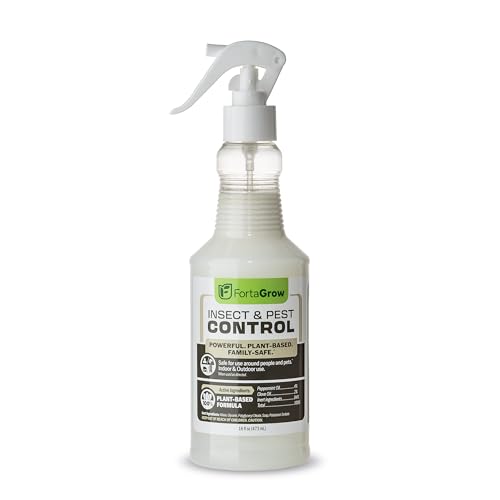
Unlike the bed bug-specific option, this ready-to-use spray is aimed at a broader group of household pests. FortaGrow says the formula contains 4% peppermint oil and 2% clove oil, and targets spiders, ants, gnats, roaches, flies, and beetles. The 16-ounce bottle needs no mixing, making it suited to spot applications around places such as baseboards and entryways. Its limitation is scope: the named targets do not make it a dedicated bed bug treatment, so choose a product specifically labeled for bed bugs when that is the problem.
Bottom line: Choose this for a ready-to-spray option targeting several common household pests.
EcoPest Clove Oil Bed Bug Spray, 128 oz

This is the bed bug-focused option, rather than a general-purpose spray with a broad list of household pests. The product name identifies clove oil, and the maker says its formula also includes cottonseed oil and kills bed bugs by contact; the 128-ounce container suits buyers planning a larger treatment area. The maker does not give a clove oil percentage, so do not compare its concentration with FortaGrow Peppermint & Clove Spray, 16 oz. Contact sprays also require reaching the pest directly, and this should not be treated as a stand-alone guarantee against an established infestation.
Bottom line: Choose this when bed bugs are the specific target and you want a large-format product.
BugMD Plant-Powered Concentrate, 3.7 oz

Unlike FortaGrow Peppermint & Clove Spray, 16 oz and EcoPest Clove Oil Bed Bug Spray, 128 oz, this is a concentrate rather than a ready-to-use clove oil spray. BugMD says the 3.7-ounce bottle makes a 32-ounce spray bottle and can be used indoors or outdoors against pests including ants, mosquitoes, roaches, mites, moths, and spiders. Check whether the complete label names clove oil before choosing it specifically for that ingredient.
Bottom line: Choose this only if concentrate format matters more than confirmed clove oil content.
How to choose a clove oil bug spray
Start with the pest, because a general household spray and a bed bug product serve different jobs. Contact sprays work when the liquid reaches the insect; they do not necessarily provide lasting control after the treated surface dries. Check that the product label names the pest and the application surface you intend to treat. For bed bugs, prioritize products labeled for bed bugs and do not rely on a broad claim about household insects. A useful decision rule is to choose a ready-to-use product if you need to treat a small area immediately, and a concentrate only when you can measure and mix it exactly as directed. Keep all pesticides in their original container and away from children and pets.
What clove oil sprays can and cannot do
Clove oil sprays are botanical pesticide products, but “plant-based” does not mean harmless or universally effective. Clove oil’s main aromatic constituent is eugenol, and concentrated essential oils can irritate skin, eyes, or airways; avoid spraying people, pets, food, and food-contact surfaces unless the label expressly permits it. Contact action also means hidden pests can escape a spray that only reaches exposed surfaces. For bed bugs, sprays are only one part of control: inspect seams, bed frames, and nearby furniture, and use heat laundering where fabric care labels allow. Never combine a spray with another pesticide or use it in a way the label does not allow.
Ready-to-use spray versus concentrate
Ready-to-use sprays avoid measuring, while concentrates require accurate dilution and a compatible spray bottle. Mixing errors can make a solution too weak to work or unnecessarily concentrated, so measure the water and product using the directions on the container rather than estimating. This comparison shows what each product’s format and stated pest focus indicate.
| Need | Choose by format | Important limit |
|---|---|---|
| Spot treatment without mixing | Ready-to-use spray | Match the target pest and surface on the label |
| Preparing a larger spray bottle | Concentrate | Measure dilution precisely |
| Bed bug problem | Product labeled for bed bugs | Contact spray alone may not reach hidden insects |
Do not treat concentrate and ready-to-use products as equal volumes of active ingredient; only compare them when the label gives enough formulation information to do so.
Safe application and common mistakes
Use the label as the boundary for where and how a pesticide spray can be applied. Keep children and pets away during application and until the label’s re-entry condition is met; a product claim about being safe when dry is not a reason to ignore the full directions. Avoid spraying electrical outlets, flames, or hot surfaces, and ventilate indoor areas if the label directs it. A common mistake is spraying a broad area repeatedly without confirming the target pest or whether the surface is permitted. If insects persist after label-compliant use, reassess the pest identification and use a suitable integrated control step rather than increasing the dose or frequency.
Frequently Asked Questions
Does clove oil bug spray work on bed bugs?
A spray labeled for bed bugs may kill insects it directly contacts, but exposed-surface contact treatment may miss bed bugs hiding in seams, frames, or cracks. Use the product only as its label directs and combine it with inspection and other appropriate control measures.
How often should clove oil bug spray be applied?
There is no universal interval; use the reapplication schedule on the product label. For FortaGrow Peppermint & Clove Spray, 16 oz, the maker calls for application at least twice a week, but do not transfer that schedule to another formula.
Can clove oil spray be used around pets?
Only use a pesticide where its label allows, and keep pets away during application and until the label’s re-entry directions are met. Essential oils can irritate or harm animals if inhaled, ingested, or applied directly, so never spray a pet.
Can essential oil spray go on kitchen counters?
Only if the label permits that surface and gives any needed food-contact precautions. Keep spray off food, dishes, and food-preparation areas unless the label provides instructions for safe use there.
Should clove oil bug spray be diluted?
A ready-to-use formula should not be diluted unless its label directs it; a concentrate must be mixed at the specified ratio. For example, the maker says BugMD Plant-Powered Concentrate, 3.7 oz makes a 32-ounce bottle, so follow its full mixing directions rather than guessing.