
Nu Finish Scratch Doctor: Paint and Glass Options

For paint scrapes, scuffs, haze, and swirls, Nu Finish Scratch Doctor, 6.5 oz is the direct Nu Finish Scratch Doctor match because it is a 6.5 oz car scratch remover. Choose Nu Finish Scratch Doctor Glass Kit instead for glass, or a polish or compound for a different paint-care approach.
Scratch removers work by refining the surface around a mark, so they are intended for surface defects rather than scratches that cut through the clear coat or paint.
We earn a commission if you buy through links on this page. As an Amazon Associate I earn from qualifying purchases. Products are compared on manufacturer specifications, not hands-on testing.
- Best overall: Nu Finish Scratch Doctor, 6.5 oz – A direct Scratch Doctor paint remover for scrapes, scuffs, haze, and swirls.
- Best for glass: Nu Finish Scratch Doctor Glass Kit – A two-step kit with glass polish, ceramic sealant, an applicator, and two sponges.
- Best for paint correction: Meguiar’s Ultimate Compound, 15.2 oz – A separate compound intended to remove scratches, swirls, oxidation, and water spots.
| Product | Best for | Intended surface | Package size | Application | Shop |
|---|---|---|---|---|---|
| Nu Finish Scratch Doctor, 6.5 oz | Paint surface marks | Paint, boats, motorcycles, chrome | 6.5 oz | Scratch remover | Check Price on Amazon |
| Nu Finish Scratch Doctor Glass Kit | Glass polishing | Glass | 4 fl oz polish; 2 fl oz sealant | Two-step polish and seal | Check Price on Amazon |
| Nu-Finish NF-76 Liquid Car Polish | General surface polish | Cars, boats, motorcycles, chrome | 16 oz | Polish | Check Price on Amazon |
| Nu Finish Once a Year Polish and Sealant, 16 oz | Polish and protection | Paint and chrome | 16 fl oz | Polish and sealant | Check Price on Amazon |
| Meguiar’s Ultimate Compound, 15.2 oz | Compound correction | Gloss paint and clear coat | 15.2 oz | Compound | Check Price on Amazon |
Nu Finish Scratch Doctor and Alternatives
Match the product to the surface and the kind of finish work you need.
Nu Finish Scratch Doctor, 6.5 oz

Unlike the glass kit and general polishes, this is the direct Scratch Doctor option for paint scrapes, scuffs, haze, and swirl marks. The 6.5 oz bottle is also intended for fiberglass boats, motorcycles, airplanes, and chrome household appliances, and its features say it removes bugs and grime. The maker says it reduces the appearance of scratches.
It suits surface marks on compatible finishes. A scratch that catches a fingernail may extend beyond the surface layer, so this type of product may not erase it; test a small, inconspicuous area first and avoid pressing hard.
Bottom line: Choose this for Scratch Doctor paint and surface-mark use.
Nu Finish Scratch Doctor Glass Kit
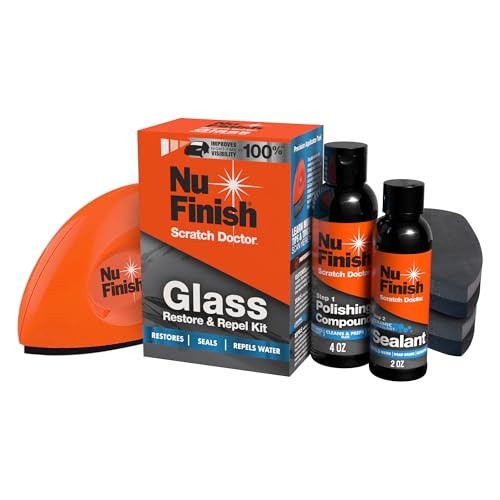
Unlike the paint-focused Scratch Doctor, this kit is specifically for glass and pairs a polishing compound with a ceramic glass sealant. It includes a 4 fl oz polish, a 2 fl oz sealant, a precision applicator, and two reusable sponges. Its two-step process calls for polishing first, then applying sealant sparingly and buffing after a 10-minute wait; the sealant needs 90 minutes to cure.
Choose it for glass cleaning and sealing, not for paint scratches. The instructions call for lifting the wipers and removing large debris before polishing, then rinsing and drying the glass completely.
Bottom line: Choose this when the work is on glass rather than painted panels.
Nu-Finish NF-76 Liquid Car Polish

Unlike the targeted Scratch Doctor remover, NF-76 is a 16 oz liquid car polish positioned for restoring finish and shine. The maker says it uses zinc cross-linking polymer emulsions and can be applied in direct sunlight; it is also intended for boats, motorcycles, and chrome. The bottle size is larger than the 6.5 oz Scratch Doctor bottle.
This is a fit for buyers seeking a broader polish rather than a product explicitly focused on paint scrapes and swirls. The feature set does not identify a scratch-size limit, so use it for general finish care rather than assuming it will correct deeper paint damage.
Bottom line: Choose this for a general-purpose polish across several vehicle surfaces.
Nu Finish Once a Year Polish and Sealant, 16 oz

Unlike the basic liquid polish, this 16 fl oz product combines polish and paint sealant, with 3-in-1 ceramic technology. Its features say it helps repair fine scratches, swirls, and scuffs, renews shine on paint and chrome, and forms a protective barrier with water beading. The maker also says it needs no rubbing or buffing.
It is the closer Nu Finish alternative when the goal includes sealing after polishing, rather than a dedicated Scratch Doctor scratch-removal product. Its focus is fine surface marks; do not treat a deep gouge or paint chip as a polishing problem.
Bottom line: Choose this when polish and a paint-sealing step are both priorities.
Meguiar’s Ultimate Compound, 15.2 oz

Unlike the Nu Finish options, this is a separate brand’s compound, with a focus on scratches, swirls, oxidation, and water spots. The 15.2 oz product is described as suitable for clear coats and gloss paints, and its features mention use by hand or with a dual-action polisher. The maker says its micro-abrasive technology restores clarity and shine without hazing.
Choose it for paint correction rather than for glass treatment or a combined polish-and-seal product. Abrasive compounds remove a small amount of finish as they refine defects, so start gently on a small area and avoid repeated aggressive passes.
Bottom line: Choose this for a paint compound aimed at several surface defects.
How to choose a scratch remover for car paint
Choose a paint scratch remover based on the surface and the mark, not just the word “scratch.” Clear-coat finishes have a transparent top layer over color; light scuffs and transfer marks may be on or near that layer, while a deep scratch can expose primer or metal. A polish or compound can refine surface defects, but it cannot replace missing paint. If a mark catches a fingernail, shows a different color, or exposes metal, consider touch-up or professional repair rather than repeated polishing.
Use the product’s purpose as the first filter: paint-focused Scratch Doctor and compound products are not interchangeable with a glass polish kit. For any abrasive product, work on a clean, cool surface and begin with light pressure on a small test area. Stop if the finish changes unexpectedly.
Paint scratch remover versus polish and compound
A scratch remover, polish, and compound all refine a surface, but the terms signal different intended jobs. Compounds are generally the more corrective choice for heavier defects, while polishes refine gloss and lighter imperfections; a named scratch remover is targeted at surface marks rather than deep paint loss. Formulas vary, so match the manufacturer’s surface and task.
The table separates the options by job, not by a guarantee of results.
| Product type | Typical purpose | Choose when |
|---|---|---|
| Scratch remover | Surface scrapes and scuffs | Marks are confined to the finish surface |
| Polish | Gloss and lighter finish refinement | Shine is the main goal |
| Compound | More corrective defect removal | Surface defects include swirls or oxidation |
| Glass polish and sealant | Glass cleaning and treatment | The target is windshield glass |
Do not select a paint product for glass or a glass treatment for painted panels. A measurable rule helps: if a scratch catches a fingernail, stop treating it as a light surface mark and assess repair options.
How to use a scratch remover without harming paint
Clean the panel before polishing because trapped grit can create additional fine scratches. Work in a shaded, cool area when possible, unless the product’s directions specifically allow a different condition; a hot panel dries product quickly and makes residue harder to manage. Apply a small amount and use light, even pressure on a limited area rather than working across the whole vehicle at once.
Inspect the area between passes and stop when the mark improves or if the paint looks dull, uneven, or unusually thin. Abrasive correction removes some finish, so repeated hard rubbing is not a safe way to chase a deep mark. Keep compounds away from unapproved surfaces and follow the product-specific directions for application and cleanup.
When to use a glass polishing kit
A glass polishing kit belongs on glass, not vehicle paint. Lift windshield wipers and remove loose debris before polishing so grit does not drag across the pane. Polish and rinse the glass before applying a sealant; applying a water-repellent coating over residue can leave an uneven result.
Allow the product’s full cure time before judging the finish. In the Nu Finish glass kit, the sealant directions call for a 10-minute wait before buffing and a 90-minute cure; temporary cloudiness while drying is described as normal. Keep glass treatments off paint and avoid driving with obstructed visibility while a coating is hazy or curing.
Frequently Asked Questions
Can car scratch remover fix a deep scratch?
A scratch remover is meant for surface-level marks and cannot replace missing paint. If the scratch catches a fingernail or reveals a different color, use a repair approach suited to exposed paint rather than repeated polishing.
Should I use scratch remover on a hot car panel?
Work on a cool panel unless the product directions expressly allow direct-sun application. Heat can make polish dry before it is evenly worked, leaving residue or uneven correction.
How can I tell if a car scratch is through the clear coat?
A scratch that catches a fingernail or exposes a contrasting color may pass through the clear coat. Stop abrasive polishing at that point, since removing more finish will not replace the missing paint.
Can I use a windshield glass polish on car paint?
No, choose a product intended for the surface being treated. Glass polishing compounds and sealants are designed for glass, while paint scratch removers are intended for painted finishes.
Why should I test scratch remover in one small area?
A small test spot shows how the finish responds before you treat a larger panel. Use light pressure and stop if the paint turns dull, changes color, or looks uneven.