
Best Mower Deck Spray: 4 Mo-Deck Options Compared

Flyleaf PRO Mo Deck with CanGun1 is the best mower deck spray for most owners because its three 11-ounce cans include a CanGun1 lever for targeted application. Choose a single-can option if you want to try a coating first, or the 12-can case if you maintain several machines.
Mower deck sprays leave a coating intended to help clippings release more easily; they do not replace removing packed grass after mowing.
We earn a commission if you buy through links on this page. As an Amazon Associate I earn from qualifying purchases. Products are compared on manufacturer specifications, not hands-on testing.
- Best overall: Flyleaf PRO Mo Deck with CanGun1 – Three 11-ounce cans and a CanGun1 lever provide targeted spraying.
- Best for one can: Stens Mo-Deck 11 oz – A single 11-ounce aerosol is an uncomplicated choice for one mower.
- Best for blades and catchers: Mo Deck Non Stick Mower Spray – Its uses include mower blades, decks and grass catchers.
- Best for multiple mowers: Mo-Deck Mower Blade Spray, Case of 12 – The case contains twelve 11-ounce cans.
| Product | Best for | Pack count | Notable feature | Shop |
|---|---|---|---|---|
| Flyleaf PRO Mo Deck with CanGun1 | Targeted spraying | 3 cans | CanGun1 lever | Check Price on Amazon |
| Stens Mo-Deck 11 oz | Single-can use | 1 can | Polymer coating | Check Price on Amazon |
| Mo Deck Non Stick Mower Spray | Blade and catcher use | 1 can | Blades, decks, catchers | Check Price on Amazon |
| Mo-Deck Mower Blade Spray, Case of 12 | Several machines | 12 cans | Case pack | Check Price on Amazon |
Mower Deck Sprays
Compare the can sizes, pack counts and application or use distinctions before choosing a coating for your mower.
Flyleaf PRO Mo Deck with CanGun1

For targeted application, this three-can Mo Deck pack adds a CanGun1 spray lever to the 11-ounce aerosol cans. The maker says the pressurized nonstick coating helps reduce clipping buildup and corrosion on mower decks. The lever is intended to improve control in tighter spots and reduce hand strain. This option suits owners who want more than one can and value a spray handle; the limitation is that a three-can pack may be more than needed for someone maintaining just one small mower.
Bottom line: Choose this if a spray lever and three-can supply suit your routine.
Stens Mo-Deck 11 oz

For a single-can purchase, Stens Mo-Deck comes as one 11-ounce aerosol with a polymer coating. The maker says the coating builds over time and helps keep grass and dirt from sticking to mower decks; its uses also include reducing snow adhesion on outdoor equipment. Shake-and-spray application keeps the format simple. This suits someone maintaining one mower or wanting to try a coating before buying a larger pack. Its limitation is the one-can quantity, which is less convenient when treating multiple machines.
Bottom line: Choose this for one mower or a first trial of a deck coating.
Mo Deck Non Stick Mower Spray

For broader mower-part use, this 11-ounce Mo Deck spray is identified for blades, decks and grass catchers. The maker says its polymer coating is formulated to reduce clipping buildup and clogging, and lists use with push mowers, lawn tractors and farm tractor decks. That range makes it a fit for owners who want one product for several mower components. The limitation is that the pack is a single can, so a multi-machine maintenance routine may call for more than one.
Bottom line: Choose this if you want a spray designated for decks, blades and catchers.
Mo-Deck Mower Blade Spray, Case of 12
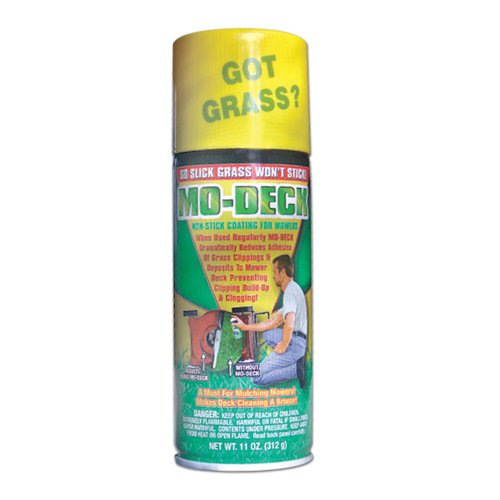
For maintaining several machines, this Mo-Deck option comes as a case of twelve 11-ounce cans. Its product name identifies it as mower blade spray, while the maker identifies it as deck spray. The case format reduces the need to replenish cans as often when multiple mowers need treatment. It suits a property or equipment routine with repeated use. Its limitation is the large quantity: for a single mower or occasional seasonal application, a one-can choice may be a better match.
Bottom line: Choose the case if you regularly maintain multiple mowers.
How to Choose Mower Deck Spray
Choose by pack size and the parts you intend to coat, rather than by the word “nonstick” alone. Deck sprays typically leave a thin film intended to reduce adhesion; they are not a substitute for removing wet, packed clippings. Clean off grass first and let the deck dry so debris is not trapped under the coating. Apply a light, even layer rather than a heavy wet coat, which can collect dust and debris. If you maintain one mower, a single 11-ounce can is a straightforward starting point; if you service several machines regularly, a multi-can pack reduces interruptions. Check compatibility with the deck material and the product label before use, especially if you plan to spray parts beyond the deck.
Using Spray Safely on a Mower Deck
Shut off the engine, remove the key or disconnect the spark-plug lead, and wait until the blades stop completely before cleaning or spraying beneath a mower. Aerosol propellants can ignite, so keep spray away from flames, sparks, hot exhaust parts and other ignition sources; work with ventilation and follow the can’s safety label. A practical rule is to spray only when the engine and deck are cool and the surface is dry. Keep coating off belts, pulleys and other drive parts unless the product specifically approves that use, because residue can interfere with traction. Let the coating dry as directed before mowing, and never reach under a deck while blades could turn.
Preparing a Deck for a Nonstick Coating
Remove stuck grass before applying a coating; spraying over residue cannot clear a clogged deck. For dried buildup, use a plastic scraper or suitable deck-cleaning tool with the mower safely disabled, then brush away loosened material and let the surface dry. Avoid striking blades or scraping in a way that damages the deck finish. Wet grass packs more readily than dry clippings, so mowing when the lawn is dry and avoiding overly tall grass can reduce buildup between cleanings. Apply a thin coat only after preparation, and inspect the underside periodically; a coating does not eliminate routine cleaning. If the deck is damaged or badly corroded, address that condition rather than expecting spray to repair it.
Choosing a Can or Multi-Can Pack
Pack count is the clearest distinction among these choices: the range includes one-can options, a three-can pack with an application lever, and a twelve-can case. This table shows the pack formats and the extra use or application feature that separates each choice.
| Need | Pack choice | Distinguishing feature |
|---|---|---|
| Try one can | Single 11-ounce can | One-unit format |
| Targeted spraying | Three 11-ounce cans | CanGun1 lever |
| Coat more mower parts | Single 11-ounce can | Identifies blades, decks and catchers |
| Maintain multiple machines | Twelve 11-ounce cans | Case pack |
Frequently Asked Questions
How often should I apply mower deck spray?
Apply it when the deck has been cleaned and dried, then reapply as needed rather than using a fixed interval. Wet mowing, heavy clipping buildup and deck cleaning can wear away a coating sooner.
Should I spray a mower deck before or after cleaning?
Clean the deck first, then apply spray to a dry surface. A coating over packed grass will not remove the clog and may trap debris against the deck.
Can mower deck spray go on the blades?
Some products are designated for blades, while others are described for decks; use a blade only when that product’s label permits it. Disable the mower and wait for the blades to stop before working underneath.
Is mower deck spray safe to use near a hot engine?
No—wait until the engine, exhaust and deck are cool before spraying. Aerosol propellants can ignite, so keep the can and spray away from flames, sparks and hot surfaces.
Does mower deck spray stop all grass buildup?
No coating should be treated as a replacement for cleaning or dry mowing conditions. Remove packed clippings, and apply only a thin layer to a clean, dry deck.