
Best Door Edge Guard: 4 Car Protection Types Compared

For most drivers, SYOAUTO 32-Foot Black U-Channel Guard is the strongest starting point because its rubber U-channel uses internal metal clips instead of adhesive and comes in a 32-foot roll. Choose XPEL Clear Door Edge Protection Film instead if you want clear protective film, or Eytool Clear 16-Foot Rubber U-Channel if clear rubber trim is your preference; check door edge thickness before choosing a clip-on or channel-style guard.
We earn a commission if you buy through links on this page. As an Amazon Associate I earn from qualifying purchases. Products are compared on manufacturer specifications, not hands-on testing.
- Best overall: SYOAUTO 32-Foot Black U-Channel Guard – Its internal metal clips hold the U-channel without adhesive, and the 32-foot roll covers more edge than the other trim options.
- Best for clear film: XPEL Clear Door Edge Protection Film – The clear film roll is 1/2 inch wide and 100 feet long.
- Best for narrow edges: EPDM Self-Adhesive U-Channel Trim – It specifies a fit range of 0 to 5/64 inch and can bend around curved edges.
| Product | Best for | Attachment | Length | Color | Shop |
|---|---|---|---|---|---|
| SYOAUTO 32-Foot Black U-Channel Guard | Clip-on rubber trim | Metal clips | 32 ft | Black | Check Price on Amazon |
| Eytool Clear 16-Foot Rubber U-Channel | Clear rubber trim | Built-in adhesive | 16 ft | Clear | Check Price on Amazon |
| XPEL Clear Door Edge Protection Film | Clear protective film | Adhesive film | 100 ft | Clear | Check Price on Amazon |
| EPDM Self-Adhesive U-Channel Trim | Narrow edge fit | Self-adhesive | 10 ft | Black | Check Price on Amazon |
Best door edge guards for cars
Compare the attachment style and length, then confirm the guard’s fit against your door edge before installation.
SYOAUTO 32-Foot Black U-Channel Guard

For a long clip-on rubber option, SYOAUTO 32-Foot Black U-Channel Guard uses internal metal clips rather than adhesive and comes in a 32-foot roll. The maker says the clips reinforce the trim and that it can be cut to length and pushed onto the door edge; a rubber mallet can make fitting easier. This style suits drivers who want a black U-channel and prefer mechanical grip over adhesive. Its color and channel profile may be a poor match for someone seeking nearly invisible protection, and the door edge thickness still needs to match the channel.
Bottom line: Choose this if you want black clip-on trim and your door edge fits its channel.
Eytool Clear 16-Foot Rubber U-Channel
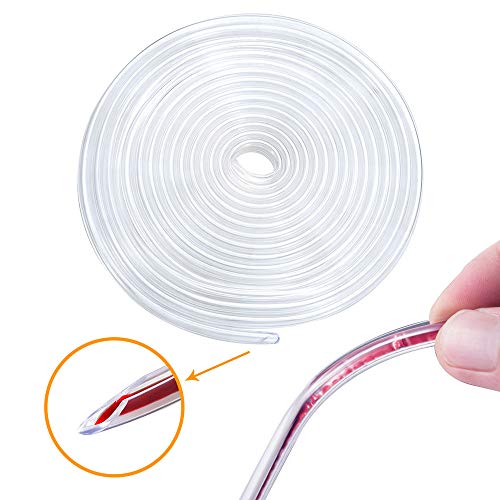
Unlike the clip-on option, Eytool Clear 16-Foot Rubber U-Channel is clear TPO rubber with built-in double-sided adhesive, supplied in a 16-foot length. The maker says it pushes onto the edge and recommends warming the trim in cold weather to help it adhere; a rubber mallet may help seat it. This is a reasonable choice when a transparent look matters more than avoiding adhesive.
Bottom line: Pick this for clear adhesive-backed rubber trim when 16 feet covers your doors.
XPEL Clear Door Edge Protection Film

XPEL Clear Door Edge Protection Film is the only film-style choice here: its clear protective strip is 1/2 inch wide and 100 feet long, rather than a rubber channel. The maker describes it as a barrier against minor scratches, chips and dings, and gives a DIY method using scissors and a cleaned door edge. Its long roll can suit someone protecting several edges or keeping material for later. Film requires careful surface preparation and smooth application; buyers who want a thicker, edge-wrapping rubber profile should choose a channel-style guard instead.
Bottom line: Choose this if you prefer clear adhesive film over a rubber channel.
EPDM Self-Adhesive U-Channel Trim

EPDM Self-Adhesive U-Channel Trim stands out by specifying a narrow edge-fit range of 0 to 5/64 inch, with a 10-foot length of black EPDM rubber trim. The maker says the flexible channel can bend around tight corners and can be cut with scissors, making it suited to short or curved edges within that fit range. EPDM is commonly chosen for outdoor rubber parts because it resists weathering, but this strip is shorter than the 16- and 32-foot choices. Measure the edge carefully before relying on the range.
Bottom line: Pick this for short, narrow edges that fall within its specified fit range.
How to choose a door edge guard
Choose the attachment style first: a U-channel grips the door edge, while a film strip adheres to its surface. Clip-on channels avoid adhesive but depend on a close fit; adhesive-backed rubber combines a channel shape with bonding tape, and film is a thinner surface barrier. Measure the folded door edge with calipers or a ruler before selecting a channel; even a small mismatch can make it loose or difficult to seat. For this group, EPDM Self-Adhesive U-Channel Trim gives an explicit range of 0 to 5/64 inch, while SYOAUTO 32-Foot Black U-Channel Guard calls for checking edge thickness without giving a range. Pick a transparent option if matching the paint visually matters, and black trim if a visible dark edge is acceptable.
Door edge guard types and trade-offs
Rubber channels protect by covering the edge, while film protects by sticking to the painted surface. A channel may wrap around the metal edge, but only if its opening suits the door thickness; an oversized channel can shift, and an undersized one can be hard to install. Film avoids channel sizing, though its narrow width requires accurate placement along the edge. The products here include EPDM and TPO rubber, plus clear film. EPDM is a common outdoor elastomer valued for weather and ozone resistance; TPO is a thermoplastic elastomer family used in automotive trim. Do not assume material alone guarantees fit or durability: check the strip’s application method and the edge dimensions.
How to measure and install an edge guard
Measure the door edge at several points before cutting, because folded edges, seams and curves can change the fit along one door. Clean and dry the surface before applying adhesive film or tape; dirt, wax and moisture can interfere with bonding. For adhesive-backed trim, warm, dry conditions generally help pressure-sensitive adhesives bond, while cold surfaces can make installation harder. Press along the full length and avoid stretching the material, which can pull it back from corners. Clip-on trim is typically seated by pushing it over the edge; a rubber mallet can help, but use light taps to avoid damaging paint. Test the door’s opening and closing clearance after installation.
Common door edge guard fit mistakes
The most common mistake is ordering a U-channel without measuring the edge thickness. Measure the metal edge itself, not the total thickness including a loose existing guard, and compare that number with the product’s fit range. A second mistake is assuming a longer roll means a wider or better-fitting strip; length only determines how much edge can be covered. Plan for each door’s edge length and allow a little extra for clean cuts. Avoid placing adhesive over dirt, wax or wet paint, and do not force a channel that will not seat with gentle pressure. Keep guards clear of hinges, latches and weather seals so they cannot obstruct door movement.
Frequently Asked Questions
How do I measure a car door edge for a guard?
Measure the folded metal edge at a straight section with a ruler or calipers, then check more than one spot if the edge has seams or curves. For a channel, the opening must accommodate the measured thickness without slipping or requiring force.
Are adhesive film and rubber edge guards the same?
No. Film is a thin adhesive strip applied to the painted edge, while a rubber channel covers the edge and may use clips or adhesive to stay in place. Choose film for a low-profile barrier and a channel when you want a wraparound trim profile.
Can I cut a door edge guard to length?
Most rubber trim and protective film can be trimmed with scissors or a sharp utility blade, though the cutting method depends on the material. Measure each section first and cut a little conservatively to avoid leaving a gap.
What temperature is best for adhesive door trim?
Adhesive-backed trim generally bonds more reliably to a clean, dry surface in mild, warm conditions than on a cold surface. The Eytool maker specifically suggests warming its trim with hot air in winter; avoid overheating paint or the trim.
Will a door edge guard fit every car?
No universal fit can be assumed for channel-style guards because door edge thickness and shape differ. Measure the edge and verify it falls within the guard’s fit range before installation.