
12 Volt DC Motor: 4 Options Compared by Fit

For a compact hobby build, AUTOTOOLHOME 12V Mini Brushed Motor is the closest match because it accepts 6–12 volts and has a 2.3 mm shaft. Choose a geared motor instead when low-speed output, a larger shaft, or a controller matters more than a simple motor.
A 12-volt DC motor converts DC electrical power into rotation; geared versions trade speed for torque and can have different mounting and shaft requirements.
We earn a commission if you buy through links on this page. As an Amazon Associate I earn from qualifying purchases. Products are compared on manufacturer specifications, not hands-on testing.
- Best overall: AUTOTOOLHOME 12V Mini Brushed Motor – Its 6–12V range and compact 2.3 mm shaft suit small hobby and replacement projects.
- Best for controlled speed: Copkim JGB37-520 60 rpm Kit – The 60 rpm geared motor kit includes a PWM controller, bracket, and couplings.
- Best for faster geared output: Greartisan 12V 550 rpm Gear Motor – Its 550 rpm output is faster than the other geared options.
- Best for holding position: BRINGSMART 12V 12 rpm Worm Gear Motor – The worm gear motor has a self-locking output when unpowered.
| Product | Best for | Output speed | Shaft | Included components | Shop |
|---|---|---|---|---|---|
| AUTOTOOLHOME 12V Mini Brushed Motor | Small hobby builds | — | 2.3 mm diameter | Motor | Check Price on Amazon |
| Copkim JGB37-520 60 rpm Kit | Speed control projects | 60 rpm | 6 mm D-shaft | Controller, bracket, couplings, screws | Check Price on Amazon |
| Greartisan 12V 550 rpm Gear Motor | Faster geared output | 550 rpm | D-shaped shaft | Motor with gearbox | Check Price on Amazon |
| BRINGSMART 12V 12 rpm Worm Gear Motor | Self-locking mechanisms | 9 rpm rated; 12 rpm no-load | 8 mm shaft | Motor with worm gearbox | Check Price on Amazon |
12 Volt DC Motors
Compare these motors by output speed, shaft dimensions, gearing, and included project hardware.
AUTOTOOLHOME 12V Mini Brushed Motor
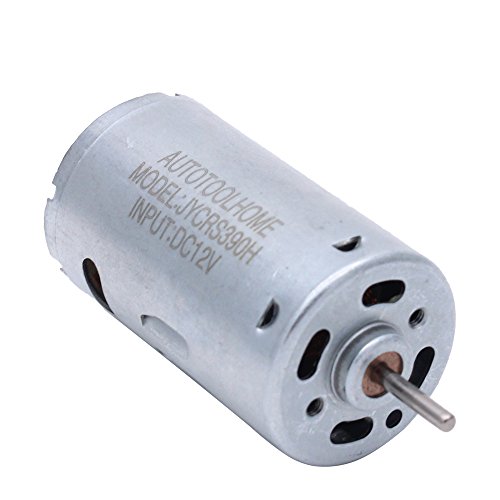
AUTOTOOLHOME 12V Mini Brushed Motor is the compact brushed option here, with a 6–12V operating range and a 2.3 mm output shaft. Its shaft is approximately 12 mm long, making shaft diameter and usable length key checks when matching a gear, pulley, or coupler. The maker positions it for RC cars, toy cars, model projects, and DIY repairs. This is the simplest fit when a small motor is needed, but it does not provide the gearing or controller included with some alternatives; choose another option if the mechanism needs a specified low output speed or a gear reduction.
Bottom line: Choose this for small builds that need a compact brushed motor and compatible 2.3 mm shaft.
Copkim JGB37-520 60 rpm Kit
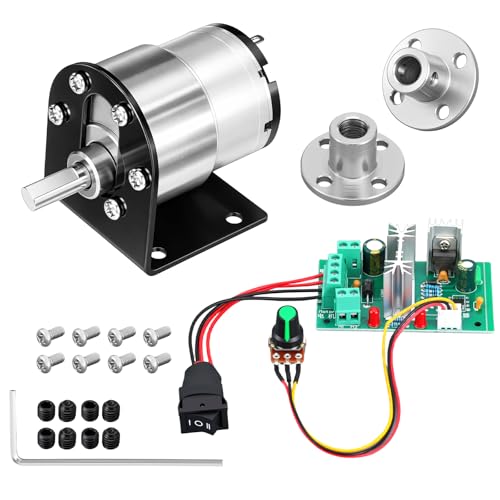
Copkim JGB37-520 60 rpm Kit stands out by including a PWM speed controller alongside a 60 rpm JGB37-520 geared motor. Its 6 mm D-shaft and mounting bracket make it a more complete starting point for a small mechanism than a bare motor. The kit also includes two flange couplings, mounting screws, M3 screws, and a hex wrench. The maker gives a load torque of 2.0 kgf·cm, so treat that as a maker claim rather than a guarantee for every setup. This kit suits projects needing speed adjustment, but its 6 mm shaft will not directly match the much narrower shaft on a mini hobby motor.
Bottom line: Pick this when a geared motor, mounting hardware, and PWM controller belong in the build.
Greartisan 12V 550 rpm Gear Motor

Greartisan 12V 550 rpm Gear Motor offers the fastest output speed among the geared choices, at 550 rpm, with a 37 mm gearbox diameter. Its centered D-shaped output shaft and positive-negative rotation suit mechanisms that need a geared drive with reversible direction. The maker says speed can be reduced but not increased, so plan for the 550 rpm ceiling rather than expecting a controller to make it faster. The shaft diameter and mounting dimensions matter before pairing it with a bracket or coupler; unlike the kit option, this motor does not include a controller or mounting hardware in the specifications.
Bottom line: Choose this when a 550 rpm geared output and reversible direction fit the mechanism.
BRINGSMART 12V 12 rpm Worm Gear Motor

BRINGSMART 12V 12 rpm Worm Gear Motor is the slowest option, with a 9 rpm rated speed and 12 rpm no-load speed, and its worm gear output is self-locking when unpowered. Its output shaft measures 8 mm and sits perpendicular to the motor shaft, a layout that can suit rotating curtains or other mechanisms where holding position matters. The maker gives a rated current of 1.6 A and a no-load current of 350 mA; size the power supply and wiring with those figures in mind. The slower output and larger shaft make it a poor fit for a compact RC replacement that expects a small straight-shaft motor.
Bottom line: Pick this when a slow output and self-locking behavior are more important than compact shaft compatibility.
How to choose a 12 volt DC motor
Choose by the load, output speed, shaft fit, and available current, not voltage alone. A 12V label describes the intended supply voltage; it does not establish that two motors have matching torque, speed, or mounting. For a mechanism that needs controlled slow movement, start with a geared motor and compare its rated speed with the motion required. For a small toy or RC replacement, match the original motor’s physical size, shaft diameter, and wiring before choosing a motor. Brushed DC motor speed generally changes with applied voltage and load, while a PWM controller varies average power by switching the supply rapidly. A controller cannot make a geared motor exceed its mechanical speed limit, and a gear reduction often increases torque while lowering output speed.
Use the output shaft as a hard compatibility check: a 2.3 mm shaft does not fit a 6 mm or 8 mm coupling without a correctly sized adapter.
Motor speed, gearing, and torque
Compare rated speed with no-load speed because a motor turns more slowly when it drives a load. BRINGSMART 12V 12 rpm Worm Gear Motor separates those figures clearly: 9 rpm rated versus 12 rpm no-load. For Copkim JGB37-520 60 rpm Kit, the maker gives 60 rpm and a load-torque figure of 2.0 kgf·cm; the exact performance in a finished mechanism will depend on load, friction, supply, and mounting. Gear reduction lowers output speed and can increase available output torque, but the gearbox and motor still have limits. A worm gear may resist back-driving, yet self-locking is not a substitute for a safety brake when a falling or suspended load could injure someone. Do not choose from a high-torque phrase alone; compare a defined torque rating and speed at the intended operating load.
Use this selection guide to narrow motor type before checking fit.
| Need | Motor type to consider | Check before assembly |
|---|---|---|
| Compact hobby replacement | Small brushed motor | Shaft diameter, length, voltage |
| Controlled low-speed movement | Geared motor with PWM controller | Rated output speed and controller current |
| Position holding while unpowered | Worm gear motor | Self-locking behavior and load limits |
Shaft and mounting compatibility
Match shaft diameter, shape, and usable length before ordering a coupler or gear. A round 2.3 mm shaft, a 6 mm D-shaft, and an 8 mm shaft are not interchangeable; a D-shaft also needs a compatible flat-sided hub to transmit torque securely. Measure the shaft diameter with calipers when possible, and compare shaft extension and mounting-hole spacing with the old motor or CAD drawing. For a replacement, also verify the motor body can clear adjacent parts and that wires reach without tension. A coupling that is too large can slip, while forcing a mismatched hub onto a shaft can damage either part. Select by fit first, then confirm that the chosen motor’s speed and load capability suit the mechanism.
Power supply and safe wiring
Use a regulated 12V DC supply only for a motor rated for 12V operation, and size it for the motor’s current under load and at startup. A motor can draw substantially more current when starting or stalled than it draws while spinning freely, so no-load current alone is not enough to size a supply. BRINGSMART 12V 12 rpm Worm Gear Motor lists 350 mA no-load current and 1.6 A rated current; those figures help distinguish its operating conditions. Secure the motor before energizing it, keep fingers clear of shafts and gears, and avoid prolonged stalls because stalled motors can overheat. Add appropriate overcurrent protection and use wiring sized for the current. Reversing the positive and negative connections reverses direction on many brushed DC motors, but check that the mechanism and controller support the resulting motion.
Frequently Asked Questions
Can I run a 6V motor from a 12V supply?
Only if the motor is rated to accept 12V; otherwise, use a suitable lower-voltage supply or regulator. Applying twice the rated voltage can increase speed and heat, shortening motor life or causing failure.
How do I match a motor shaft to a gear?
Measure the shaft diameter and length, then match the hub shape as well as the diameter. For example, a 6 mm D-shaft needs a hub designed for a 6 mm D-shaft, not just a 6 mm round bore.
Why does a DC motor slow down under load?
A motor slows when the driven load demands more torque than it can sustain at its current voltage and gearing. Reduce friction or load, or use a gear reduction and a motor rated for the required torque.
Can a PWM controller increase motor speed?
A PWM controller can adjust speed below the motor’s supply-limited range, but it cannot raise a geared motor above its mechanical speed capability. Check the controller’s current rating against the motor’s operating and startup demands.
What power supply does a 12V motor need?
Use a 12V DC supply with current capacity suited to the motor’s load and startup draw. A motor’s no-load current is not a safe stand-in for its rated or stall current.