
Red Light Therapy Feet: 4 Foot Devices Compared

For a targeted foot-and-ankle wrap with adjustable heat, LTW Flagship Foot Wrap is the closest match; choose another style if you want full-foot coverage, a detachable pad, or a wipe-clean surface.
Red light therapy devices use LEDs at selected wavelengths, but wavelength and LED count alone do not establish a treatment dose or a medical benefit.
We earn a commission if you buy through links on this page. As an Amazon Associate I earn from qualifying purchases. Products are compared on manufacturer specifications, not hands-on testing.
- Best overall: LTW Flagship Foot Wrap – The pair is designed for the ankle, heel, sole and toes, with five light levels and three heat settings.
- Best for wipe-clean care: Kaoudt Full-Foot TPU Device – The full-foot design uses a TPU surface intended to be wiped clean.
- Best for flexible coverage: 450-LED Therapy Boots and Pad – The boots unzip into a pad for use on other body areas.
- Best for zippered fit: 216-LED Zippered Foot Device – The detachable zippered design offers four modes and five light levels.
| Product | Best for | LED count | Controls | Shop |
|---|---|---|---|---|
| LTW Flagship Foot Wrap | Heat settings | 101 tri-chip LEDs | 3 heat settings; 5 light levels | Check Price on Amazon |
| Kaoudt Full-Foot TPU Device | Wipe-clean surface | 160 three-in-one LEDs | 3 modes; 5 levels; 10–90 min timer | Check Price on Amazon |
| 450-LED Therapy Boots and Pad | Multi-area use | 450 tri-chip LEDs | 3 pulse modes; 5 intensity levels | Check Price on Amazon |
| 216-LED Zippered Foot Device | Zippered coverage | 216 three-in-one LEDs | 4 modes; 5 light levels; 10–90 min timer | Check Price on Amazon |
Red Light Therapy Feet Devices
Compare each device’s coverage, controls and construction to find a format that suits your intended use.
LTW Flagship Foot Wrap

Unlike the other choices, this pair combines foot-and-ankle targeting with three selectable heat settings. LTW says it uses 101 tri-chip LEDs at 660nm and 850nm and provides irradiance up to 75mW/cm²; the controls include five light levels and a pulse mode at level 5. The maker also gives heat settings of 120°F, 130°F and 140°F. Choose it if you want a pair intended for the heel, sole, toes and ankle rather than a boot or multipurpose pad. Heat may be a poor fit for anyone with reduced temperature sensation, who may not detect excessive warmth promptly.
Bottom line: Pick this pair if targeted coverage and adjustable heat are priorities and you can monitor warmth safely.
Kaoudt Full-Foot TPU Device

The wipe-clean TPU surface sets this full-foot device apart from the fabric-like wrap and boot formats. Kaoudt says the unit has 160 three-in-one LEDs, a maximum output of 20W, three modes, five levels and a timer adjustable from 10 to 90 minutes. Its dimensions are 11.8 by 11.0 by 9.5 inches, so consider the footprint and how your feet will sit on it before choosing. The design suits buyers who want a surface that can be wiped after use. It is a single device rather than the pair format offered by LTW Flagship Foot Wrap.
Bottom line: Choose this if a wipe-clean surface and full-foot format matter more than a pair of wraps.
450-LED Therapy Boots and Pad

The unzip-to-pad design makes this option more adaptable than foot-only formats. Its 450 tri-chip LEDs use 660nm red and 850nm near-infrared light, and the maker describes an ergonomic boot shape intended to cover feet, ankles, calves and knees. Three pulse modes and five intensity levels provide selectable settings; included Velcro straps help secure the flexible pad for use on other areas. Choose it if you want one wrap-style device that can be rearranged beyond the feet. The fields do not give dimensions, so buyers who need a precise fit should confirm the usable coverage before ordering.
Bottom line: Pick this if you want a boot that can convert into a flexible pad for other areas.
216-LED Zippered Foot Device
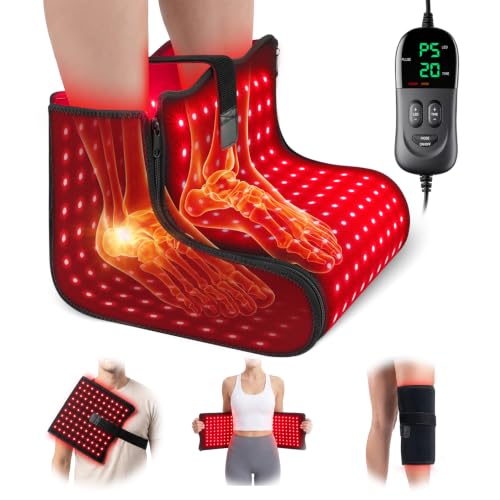
This zippered design combines dual-wavelength LEDs with a detachable format and a 10-to-90-minute timer. The product uses 216 three-in-one LEDs, with one 660nm red and two 850nm near-infrared emitters per chip, and offers four modes and five light levels. A TPU film surface is described as easy to clean, giving it a different care approach from a fabric boot. Consider it if you want adjustable settings and a zippered shape. Unlike 450-LED Therapy Boots and Pad, the fields do not describe converting it into a general-purpose pad, so it may be less suitable for buyers seeking broad repositioning.
Bottom line: Choose this if a zippered format, multiple modes and a timer suit your routine.
How to Choose Red Light Therapy for Feet
Start with coverage and controls, not LED count alone. A foot-only wrap, a platform-style full-foot device and a boot that converts to a pad serve different positioning needs; choose the shape that can sit securely over the area you intend to expose. Wavelengths around 660nm are in the red range, while 850nm is near-infrared; a wavelength does not tell you the dose reaching skin. Irradiance is power per area, commonly expressed in mW/cm², while exposure duration also matters. For example, 10mW/cm² for 100 seconds equals 1J/cm² at the measured surface. Treat maker performance figures as device claims, not proof of a health outcome. If warmth is included and foot sensation is reduced, avoid heat unless a clinician says it is appropriate.
Coverage and Fit for Foot Devices
Choose the form factor by the area you need to position, not by the highest LED count. A boot-style shape can surround more of the foot and lower leg, while a flat pad needs to be repositioned or secured to reach a different surface. For devices with dimensions, compare those measurements with the space available and how your feet will rest; for wraps, check that closures can hold the device without constriction. The specifications do not establish shoe-size compatibility or a universal fit range, so confirm fit before ordering if exact sizing is essential. Keep the light source positioned as designed and do not stare directly at LEDs; near-infrared light may be difficult to see even though it can still reach the eyes.
Red and Near-Infrared Light Settings
Red and near-infrared wavelengths are distinct bands, and devices often pair visible red around 660nm with near-infrared around 850nm. LED count is not a direct measure of delivered dose: chip design, spacing, distance from skin, operating power and exposure time all affect irradiance at the target. A timer controls duration, while pulse modes change how light is emitted; neither setting by itself establishes a clinically appropriate schedule. Use this table to compare what the formats offer, then consider fit and controls together rather than treating one specification as a performance ranking.
| Need | Format to consider | Decision point |
|---|---|---|
| Target the foot and ankle | Pair wrap | Check placement and warmth controls |
| Wipe-clean contact surface | TPU-covered device | Check size and cleaning method |
| Reposition for other areas | Unzippable boot-pad | Check pad coverage and securing method |
Safe Use and Care for Foot Light Devices
Heat and reduced sensation are the key safety concern for foot devices: nerve conditions can make warmth harder to judge, increasing the risk of unnoticed overheating. Do not use a heat setting on skin that cannot reliably sense temperature, and stop if the skin becomes uncomfortably hot or irritated. Avoid looking directly into LEDs, particularly at close range. Clean a surface only with a method compatible with its material; a TPU surface can generally be wiped, but that does not mean the entire device is washable or safe to immerse. Keep electrical controls and connectors dry, and inspect wraps and cables for damage before use. People with a diagnosed condition or implanted medical device should ask a clinician before relying on light therapy.
Frequently Asked Questions
Does 850nm light look visible to the eye?
Near-infrared light at 850nm is outside the range most people see as visible light, so an operating device may appear dimmer than its output suggests. Avoid staring into LEDs even when they do not look bright.
What does irradiance mean on a foot light device?
Irradiance is optical power delivered per unit area, commonly expressed in milliwatts per square centimeter. A dose estimate also needs exposure time; for instance, 10mW/cm² for 100 seconds equals 1 joule per square centimeter at the measured surface.
Can foot red light devices also produce heat?
Some devices add adjustable heat, which is separate from wavelength and light intensity. If foot sensation is reduced, avoid heat settings unless a clinician confirms they are appropriate, since excessive warmth may go unnoticed.
Is a higher LED count always more powerful?
No; LED count alone does not establish irradiance at the skin or total dose. Chip arrangement, distance, power and session duration also matter, so compare those measurements when available.
How should I clean a TPU-covered foot device?
Use a wipe compatible with the surface and keep controls, connectors and electrical components dry. A wipe-clean cover does not mean the whole device can be immersed or machine-washed.