
Pumps for Rain Barrels: 4 Options Compared by Use

For most garden rain barrel setups, FLUENTPOWER 1/2 HP Rain Barrel Pump is the clearest fit because it is a submersible pump made for rainwater irrigation, with a 1/2 HP motor and 1,050 GPH maximum flow rating. Choose a different option if you need manual transfer or a pressure pump for a separate hose system.
Rain barrel pumps move stored rainwater to a hose or irrigation line; the best type depends on power access, outlet fittings and how much lift the water needs.
We earn a commission if you buy through links on this page. As an Amazon Associate I earn from qualifying purchases. Products are compared on manufacturer specifications, not hands-on testing.
- Best overall: FLUENTPOWER 1/2 HP Rain Barrel Pump – A submersible pump intended for rainwater irrigation with automatic or manual control.
- Best for manual transfer: TERA PUMP Emergency 55-Gallon Drum Pump – Manual piston action with a 47.2-inch discharge hose for transferring water from a drum.
- Best for pressurized hose use: ECO-WORTHY 33-Series 110V Diaphragm Pump – A 110V AC diaphragm pump with a pressure switch and garden-hose adapters.
| Product | Best for | Pump type | Power or operation | Rated capacity | Shop |
|---|---|---|---|---|---|
| FLUENTPOWER 1/2 HP Rain Barrel Pump | Garden irrigation | Submersible utility | 1/2 HP electric | 1,050 GPH max | Check Price on Amazon |
| TERA PUMP Emergency 55-Gallon Drum Pump | Manual transfer | Manual piston drum pump | Manual | Up to 5.5 GPM | Check Price on Amazon |
| Hand Operated 55-Gallon Drum Pump | Hand pumping | Manual drum pump | Manual | 7 GPM | Check Price on Amazon |
| ECO-WORTHY 33-Series 110V Diaphragm Pump | Pressurized hose | Diaphragm pressure pump | 110V AC | 4.0 GPM | Check Price on Amazon |
Pumps for Rain Barrels
Match the pump to your water source, available power and irrigation setup before choosing.
FLUENTPOWER 1/2 HP Rain Barrel Pump

Unlike the manual drum pumps, this model is specifically intended for rain barrel garden irrigation and offers automatic or manual control. The 1/2 HP submersible pump is rated for up to 1,050 GPH and a 36-foot maximum head; its tethered float starts and stops pumping as water levels change. The extension pipe brings the outlet toward the barrel rim for hose access, and the power cord is 26 feet long. It suits a barrel near an outlet and an irrigation hose with compatible fittings. Actual flow falls as lift, hose length or nozzle restriction increases.
Bottom line: Choose this for rainwater garden irrigation when a powered submersible setup fits.
TERA PUMP Emergency 55-Gallon Drum Pump

Manual piston action sets this option apart from powered irrigation pumps; the maker rates transfer at up to 5.5 GPM. It has a 33.4-inch suction tube and a 47.2-inch flexible discharge hose with a nozzle holder, plus an air-vent cap that controls siphon flow. This can suit someone moving water from a drum without an electrical connection. Its drum-oriented tube and hand operation make it less convenient than a submersible pump for routine garden watering from a rain barrel. Confirm the barrel opening accommodates the suction tube.
Bottom line: Pick this for occasional manual transfer when a drum-style setup works.
Hand Operated 55-Gallon Drum Pump

This is another hand operated drum pump, with a 7 GPM capacity in its name rather than an electric motor or float control. That mix makes it a possible manual-transfer option, not a purpose-built rain barrel irrigation pump. It suits buyers who need hand operation and can verify the pump itself and its connections match their container; the barrel fitting claims should not be assumed to describe the pump.
Bottom line: Consider it for hand transfer only after verifying the pump and barrel connection.
ECO-WORTHY 33-Series 110V Diaphragm Pump
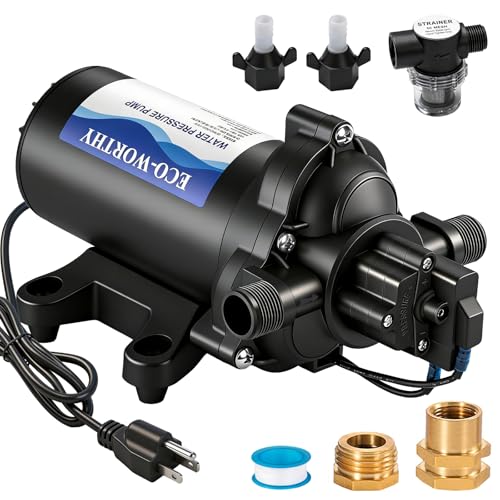
Unlike a submersible rain barrel pump, this 110V AC diaphragm model is designed to switch on demand as water pressure changes. The maker gives a 4.0 GPM flow capacity, a 50 PSI pressure switch and self-priming up to 9.8 vertical feet; garden-hose adapters are included. It may suit a pressurized hose arrangement where AC power is available and the suction lift stays within that limit. It is not described as a rain barrel pump, so it is a less direct choice; check that the inlet, hose fittings and water level work with the installation.
Bottom line: Choose this for a powered pressure-hose setup, not a simple submerged barrel pump.
Choosing a rain barrel pump by setup
Choose a submersible utility pump for routine garden watering when the barrel can hold the pump; choose a manual drum pump when occasional transfer matters more than continuous flow. A pressure diaphragm pump is a different arrangement: it uses a pressure switch to start and stop as demand changes, and needs a suitable suction connection and power supply. Maximum flow and maximum head are separate limits, not promises of the flow at your hose end. A long or narrow hose, high lift and restrictive nozzle all reduce delivered flow. For an installation more than 9.8 feet above the water source, a pump limited to 9.8 feet of self-priming lift is beyond its range. Confirm outlet fittings before assembling the system.
Understanding pump flow and lift
Use the pump’s head rating to judge elevation, and treat its GPH or GPM rating as a maximum rather than a guaranteed irrigation rate. A pump moving water upward must overcome vertical lift as well as friction from the hose and fittings; a smaller hose bore or long run adds resistance. Keep all comparisons in the same units: 60 GPH equals 1 GPM. A useful decision rule is to choose a pump whose maximum head exceeds the vertical rise from the barrel water surface to the outlet, then allow extra capacity for hose losses. Garden nozzles can sharply restrict flow, so select a nozzle and hose that suit the pump rather than judging output by the label alone.
Rain barrel water and pump safety
Rain barrel water should be treated as nonpotable, even when it looks clear; use it for gardens, not drinking or cooking. Leaves, roof grit and other debris can obstruct an intake, so fit a screen or filter at the barrel inlet and keep sediment from reaching the pump. A submersible pump must remain under water while operating unless its maker explicitly permits otherwise; running a pump dry can damage it. Disconnect power before reaching into a barrel or handling a submerged electric pump, and use a protected outdoor electrical connection. Keep hoses and electrical cords arranged to avoid trip hazards and standing water near plugs.
Manual drum pumps versus electric pumps
Manual piston and lever pumps move liquid through repeated hand action, so they can work without an electrical supply but require continued effort. Electric utility pumps move water without repeated pumping and suit longer irrigation runs when power and hose routing are available. Pressure diaphragm pumps are intended to maintain a pressurized outlet and cycle with demand, rather than simply lifting water from a barrel. Match the pump type to the task before comparing rated output: hand transfer, submerged irrigation and pressurized hose service are distinct jobs. Do not use a pump for a liquid outside its compatibility, and do not assume that a drum pump’s fit applies to every rain barrel opening.
Frequently Asked Questions
How much flow does a rain barrel pump need?
A small garden hose can use far less than a pump’s maximum rating once lift and hose resistance are included. Compare the pump’s flow and head ratings, then use a wider, shorter hose and fewer restrictive fittings when you need more delivered water.
Can I leave a rain barrel pump underwater?
Only a pump designed for submersion should stay underwater, and it must remain submerged while running unless its maker permits otherwise. Disconnect power before handling a submerged electric pump, and never run a pump dry.
Can rain barrel water be used for drinking?
Treat rain barrel water as nonpotable, even when it appears clear. Use it for outdoor irrigation, and keep it separate from drinking-water plumbing.
Why is my rain barrel pump flow lower than its rating?
Maximum flow ratings are measured apart from the losses caused by vertical lift, hose length, hose diameter and nozzle restriction. A longer or narrower hose and a higher outlet generally mean less water reaches the end.
Will a drum pump fit a rain barrel?
Not necessarily: drum openings, barrel lids and pump suction-tube dimensions can differ. Measure the opening and verify the pump’s tube and outlet connections before choosing a drum-style pump.