
Best Reducer Transition Strip for Uneven Floors Compared

The solid oak overlap reducer suits most people seeking a reducer transition strip for uneven floors because its profile is made to bridge a 3/4-inch height difference. Choose another option if your height change is smaller or your flooring edge needs a different profile.
A reducer strip covers the edge between flooring surfaces at different heights; measure the change and confirm the lift range before ordering.
We earn a commission if you buy through links on this page. As an Amazon Associate I earn from qualifying purchases. Products are compared on manufacturer specifications, not hands-on testing.
- Best overall: Solid Oak Overlap Reducer, 3/4 in. – Its solid oak overlap profile is sized for a 3/4-inch height difference.
- Best for small height changes: Heonay PVC Adhesive Reducer, 3.3 ft. – The PVC strip is sized for a 1/5- to 2/5-inch transition.
- Best for longer runs: Bnell PVC Reducer, 6.56 ft. – Its length is 6.56 feet and it is intended for 15- to 20-mm transitions.
| Product | Best for | Height range (in.) | Material | Length | Shop |
|---|---|---|---|---|---|
| Solid Oak Overlap Reducer, 3/4 in. | 3/4-inch transitions | 3/4 in. | Solid oak | 36 in. | Check Price on Amazon |
| Heonay PVC Adhesive Reducer, 3.3 ft. | Small transitions | 0.2–0.4 in. | PVC | 39.6 in. | Check Price on Amazon |
| Bnell PVC Reducer, 6.56 ft. | Longer transitions | 0.59–0.79 in. | PVC | 78.72 in. | Check Price on Amazon |
| NEICAGNE Aluminum Transition Strip, 48 in. | Wide thresholds | — | Aluminum alloy | 48 in. | Check Price on Amazon |
Reducer transition strips for uneven floors
Match the strip’s height range and profile to the measured flooring change before choosing by material or length.
Solid Oak Overlap Reducer, 3/4 in.
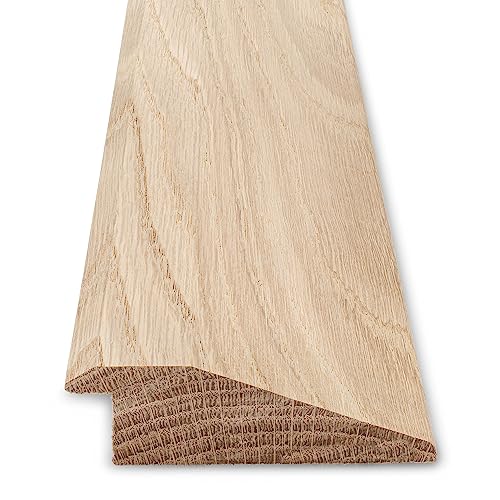
This solid oak overlap reducer is the clearest fit when adjoining floors differ by 3/4 inch. Its profile is 3 1/2 inches wide and 3 feet long, and the maker describes it for covering exposed flooring edges between finished surfaces such as wood, laminate, tile or vinyl. The overlap design suits a doorway where one flooring edge needs covering rather than a narrow adhesive strip. It is less suitable when the measured height change differs from 3/4 inch; check the profile and overlap against the floor edges before ordering.
Bottom line: Choose this when the height difference is 3/4 inch and an oak overlap profile suits the flooring edges.
Heonay PVC Adhesive Reducer, 3.3 ft.

The Heonay strip covers a smaller transition than the oak reducer, with a 1/5- to 2/5-inch size range and a 3.3-foot length. It is PVC with a light gray wood-grain finish and double self-adhesive tapes; the maker positions it for connecting surfaces such as carpet, tile and hardwood. That adhesive format can suit a short, straight threshold where the surfaces are flat. The maker cautions that it is not suitable for uneven surfaces, so avoid it if the floor itself is irregular rather than simply at a different height.
Bottom line: Choose this for a short, flat threshold with a 1/5- to 2/5-inch change.
Bnell PVC Reducer, 6.56 ft.

The Bnell PVC edging spans 6.56 feet, making it the longest measured strip among these options. Its maker gives a 15- to 20-mm transition range, or about 0.59 to 0.79 inch, and describes it for carpet-to-tile transitions and doorway or room entrances. The black trim is 73 mm wide. This is a useful candidate for a long run where the height falls within that range, but its soft PVC profile is a different choice from solid oak; verify that the width and flexible edging suit the adjoining floor materials.
Bottom line: Choose this for a longer run with a measured height change of 15 to 20 mm.
NEICAGNE Aluminum Transition Strip, 48 in.

The NEICAGNE strip differs from the other options by using a 4-inch-wide aluminum profile rather than a defined reducer height range. It is 48 inches long and 2 mm thick; the maker says it can be cut to length and attached with 3M adhesive without drilling. The black finish and moisture-resistant aluminum construction may suit a doorway needing a broad, wipe-clean threshold cover.
Bottom line: Choose this when a 4-inch-wide aluminum cover fits and the required height is confirmed.
How to choose a reducer transition strip
Measure the vertical difference between finished floor surfaces before comparing materials. A reducer must bridge that measured rise while overlapping or covering the exposed higher edge; a mismatch can leave a gap or a raised lip. Typical transition profiles are selected by the floor-height change and edge geometry, not by strip length alone. Use a straightedge across the floors and measure the gap beneath it at the edge, then compare that number with the maker’s range. For example, a 3/4-inch rise points toward a profile explicitly sized for that change, while a 1/5- to 2/5-inch range suits a smaller step. If the floor is uneven along the run, correct or assess the substrate rather than assuming a straight strip will conform.
Reducer strip materials and attachment
Material changes how a threshold handles wear and installation. PVC profiles are lighter and may use adhesive backing, while solid wood needs a profile and overlap that match the floor edges; aluminum gives a rigid cover that can be cut to length. Adhesive needs clean, dry, flat surfaces, and dust or texture can weaken the bond. A transition at a doorway also needs secure attachment because a loose edge can become a trip hazard. Avoid placing a reducer where a door will drag over it, and check that the installed profile does not obstruct the door swing. For a wood reducer, account for the overlap as well as the rise so the higher flooring edge remains covered.
Measure flooring height and width correctly
Measure both the height change and the length of the opening; these dimensions answer different fit questions. Height determines whether the ramp or overlap can bridge the step, while length determines whether the piece covers the full doorway. Convert millimeters to inches consistently: 15 to 20 mm is about 0.59 to 0.79 inch. Measure at several points across the opening because floor height can vary side to side, and use the largest rise to avoid selecting a too-shallow reducer. Check the available width against the threshold and adjacent flooring edges. A broad cover may conceal more edge, but width alone does not establish that a profile can handle a particular height difference.
| Measured change | Profile to consider | Fit condition |
|---|---|---|
| 1/5–2/5 in. | Adhesive PVC strip | Flat surfaces and short threshold |
| 15–20 mm | PVC edging | Confirm flooring edge and width |
| 3/4 in. | Solid oak overlap reducer | Match overlap to exposed edge |
Prevent loose edges and trip lips
A transition should sit securely, cover the flooring edge and avoid creating a sharp or unstable lip. Before attachment, dry-fit the piece and check the door clearance with the door opened and closed. Adhesive profiles need firm contact across their full length; a dusty, damp or textured floor can compromise adhesion. Cut-to-length aluminum profiles should be deburred so the cut end is not sharp. Do not rely on a reducer to correct a loose or damaged subfloor, and replace a strip that shifts or develops a raised edge. At a doorway with wheelchair or walker traffic, prioritize a gradual, stable surface and confirm the profile’s rise and anchoring method rather than treating a decorative threshold cover as a ramp.
Frequently Asked Questions
How do I measure a flooring height difference?
Lay a straightedge across the two finished floors and measure vertically from the lower floor to the straightedge at the edge. Check several points across the doorway and choose a profile that accommodates the largest rise.
Can a reducer strip cover an uneven floor?
A reducer bridges different floor heights, but it is not a fix for a wavy or unstable surface. Measure the rise across the opening; if it changes from side to side, address the underlying floor or verify the profile can sit securely.
How wide should a doorway transition strip be?
The strip must cover the exposed flooring edge while fitting within the threshold and door clearance. Measure the opening and overlap needed; a 4-inch-wide profile is substantially broader than a 73-mm trim.
Should I use adhesive or screws for a transition strip?
Adhesive can suit flat, clean surfaces and avoids drilling, while a mechanically fastened profile may be preferable where the floor or traffic makes adhesive unreliable. Keep adhesive fully bonded along the run and avoid a loose edge that could create a trip hazard.
Can I cut an aluminum transition strip to fit?
The NEICAGNE maker says its 48-inch aluminum strip can be measured and cut to length. Remove burrs from the cut end and confirm the height profile before attachment.