
Sky View 70 Telescope: 5 Refractors Compared

National Geographic Sky View 70 is the closest match for someone seeking the National Geographic Sky View 70: its 70mm aperture, 400mm focal length, and panhandle mount distinguish it from the alternatives. Choose another refractor if you need a carry bag, binoculars, or a different focal length.
A refractor gathers light through a front lens; aperture and mount stability matter more to comfortable viewing than chasing the highest advertised magnification.
We earn a commission if you buy through links on this page. As an Amazon Associate I earn from qualifying purchases. Products are compared on manufacturer specifications, not hands-on testing.
- Best overall: National Geographic Sky View 70 – It is the named Sky View 70 model, with a 70mm aperture, 400mm focal length, and panhandle mount.
- Best for remote photos: Gskyer 70mm 400mm AZ Refractor – Its included phone adapter and wireless camera remote support hands-free phone operation.
- Best for travel: Celestron Travel Scope 70 – The 70mm refractor comes with a backpack and a no-tool setup.
| Product | Best for | Focal length | Distinctive included gear | Shop |
|---|---|---|---|---|
| National Geographic Sky View 70 | Named model match | 400 mm | Panhandle mount; phone adapter | Check Price on Amazon |
| Gskyer 70mm 400mm AZ Refractor | Remote phone photos | 400 mm | Carry bag; wireless remote | Check Price on Amazon |
| 70mm 300mm Beginner Refractor | Shorter focal length | 300 mm | Phone adapter; 1.5x erecting eyepiece | Check Price on Amazon |
| Celestron Travel Scope 70 | Backpack travel | — | Backpack; full-height tripod | Check Price on Amazon |
| MaxUSee 70mm Travel Telescope Bundle | Telescope and binoculars | — | 10×50 binoculars; backpack | Check Price on Amazon |
Sky View 70 Telescope and Alternatives
Compare these 70mm refractors by focal length and the accessories that change how you can use them.
National Geographic Sky View 70
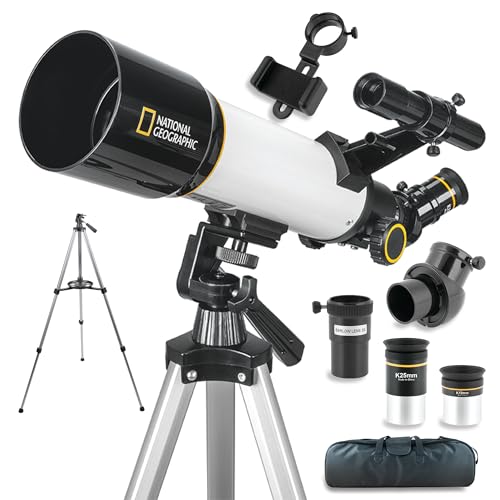
The National Geographic Sky View 70 is the only named-model match here, pairing a 70mm aperture with a 400mm focal length and panhandle mount. It includes two eyepieces, a 3x Barlow lens, a diagonal, and a smartphone adapter. The combinations are 16x, 40x, 48x, and 120x. It suits beginners who want the specific Sky View 70 configuration and simple Moon photography support. Its limitation is that a phone adapter does not stabilize the telescope or guarantee sharp photos; steady focusing and a stable mount still matter.
Bottom line: Choose this if you specifically want the National Geographic Sky View 70 and its panhandle controls.
Gskyer 70mm 400mm AZ Refractor

The Gskyer differs from the Sky View 70 by including both a carry bag and a wireless camera remote. It has a 70mm aperture, 400mm focal length, two eyepieces, a 3x Barlow lens, and a 5×24 finder scope; the maker describes its optics as fully coated. A phone adapter and remote make it a fit for someone prioritizing hands-free phone operation. The features call its mount an AZ mount but give no control-handle detail, so shoppers who specifically want panhandle control should compare that point before choosing.
Bottom line: Pick this for the included bag, finder scope, and wireless phone remote.
70mm 300mm Beginner Refractor

The 300mm focal length makes this 70mm refractor the shorter-tube option among the models with a focal length. Its package includes 20mm and 6mm eyepieces, a 1.5x erecting eyepiece, a 3x Barlow lens, and a phone adapter; the maker gives a 15x–150x range. The maker says the glass is fully multi-coated. This suits buyers who want the erecting eyepiece for upright views of daytime subjects as well as astronomy. The maximum magnification figure is not a promise of equally useful detail at every setting.
Bottom line: Choose it if the 300mm focal length and erecting eyepiece fit your intended use.
Celestron Travel Scope 70

The Celestron Travel Scope 70 stands apart with a backpack and a full-height tripod designed for transport. It is a 70mm refractor for daytime and night viewing, and the maker says it has fully coated glass lenses and sets up without tools. That travel-oriented package suits beginners who expect to carry the telescope between observing locations or use it for scenery as well as the Moon and planets.
Bottom line: Pick this for a backpack-ready kit and daytime as well as night use.
MaxUSee 70mm Travel Telescope Bundle
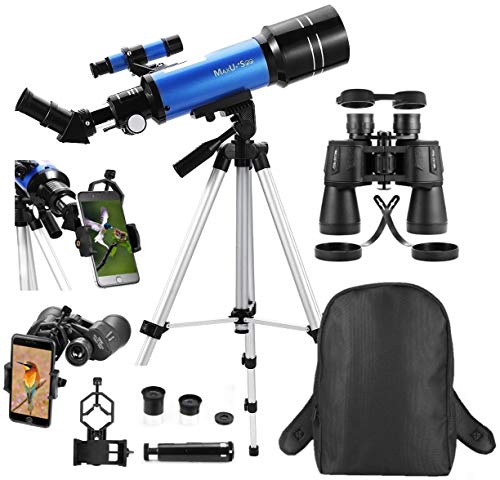
The MaxUSee package is the only option here that adds 10×50 binoculars alongside a 70mm telescope. Its telescope includes a 45-degree diagonal prism, two 1.25-inch Kellner eyepieces, a 3x Barlow lens, and a smartphone adapter; the maker gives a 20x–132x magnification range. The bundle suits travelers who want one set for binocular-style viewing and telescopic observation. The binoculars add another optical tool, but the specifications do not give this telescope’s focal length, so focal-length comparisons with the 400mm and 300mm models are not possible.
Bottom line: Choose this if having 10×50 binoculars in the same travel bundle matters.
How to choose a 70mm refractor telescope
For a beginner refractor, compare aperture, focal length, mount control, and the eyepieces before considering a high maximum-magnification figure. A 70mm aperture gathers light through a 70mm objective lens; a common rough upper magnification rule is about 2x aperture in millimeters, or around 140x for 70mm, but atmospheric turbulence and optical quality often limit useful detail below that. Focal length divided by eyepiece focal length gives magnification, and a Barlow multiplies it. A 400mm tube with a 20mm eyepiece gives 20x before any Barlow. For the Moon, begin at low power to locate the target, then increase magnification only while the image remains sharp. A steadier mount often matters more than the largest number printed for magnification.
Mounts and accessories for telescope use
For quick manual aiming, an altitude-azimuth mount moves up-down and left-right, while a panhandle can provide a longer grip for those adjustments. A finder scope helps locate a target before you look through the main telescope; align it on a distant object in daylight, never the Sun. A diagonal redirects the viewing angle, and an erecting prism can make terrestrial scenes appear upright. Phone adapters hold a smartphone at the eyepiece, but a remote can reduce shake from tapping the screen. On a tripod, extend the legs only as much as needed and avoid a loose center column; vibration makes focusing harder. Accessories affect convenience, but they do not increase the telescope’s aperture or resolve atmospheric blur.
Safe telescope viewing and basic care
Never aim a telescope at the Sun unless it has a secure, purpose-made solar filter covering the front aperture; ordinary sunglasses, eyepiece filters, and phone adapters are not safe substitutes. A telescope concentrates sunlight and can cause permanent eye injury in an instant. For night use, cap the objective when the telescope is not being used and avoid touching exposed optical surfaces. Store eyepieces dry and capped, and remove dust with a blower rather than rubbing grit across a lens. Refractors generally do not need the mirror alignment called collimation in reflector telescopes, though a hard impact can still misalign optical components. For planetary viewing, let the telescope sit outdoors for about 20 to 30 minutes when moving it from a warm room into colder air; temperature differences can soften the image.
Frequently Asked Questions
What can a 70mm telescope show clearly?
A 70mm refractor can show lunar craters, Jupiter’s larger moons, Saturn’s rings under favorable conditions, and bright star clusters. Fine detail depends on focus, sky steadiness, and light pollution; begin at low magnification and increase only while the image stays crisp.
How much magnification is useful for a 70mm telescope?
About 140x is a common rough upper rule for a 70mm aperture, using roughly 2x per millimeter, but many nights support less. Atmospheric turbulence, focus, and mount vibration can make a lower setting show more usable detail.
Can I use a telescope to look at the Sun?
Never observe the Sun through a telescope without a secure solar filter designed to cover the front aperture. Eyepiece filters and sunglasses are unsafe because concentrated sunlight can cause permanent eye damage.
Why does my telescope image look shaky?
Tripod vibration, a loose mount, or touching the focus control can make the view shake; even a small disturbance is more visible at high magnification. Keep the tripod on firm ground and use the lowest magnification that shows the detail you want.