
Best 22LR Laser Bore Sight Options Compared by Fit

The BOOLIT EYE .22LR/223REM is the best fit for most buyers because it is a brass, caliber-specific insert and gives a 15-to-100-yard sighting range. Choose a different option if you need spare batteries, a 9mm companion bore sight, or a .22LR-only model.
A laser bore sight projects a beam from the barrel to help align an optic before live-fire confirmation; it does not replace checking zero with ammunition.
We earn a commission if you buy through links on this page. As an Amazon Associate I earn from qualifying purchases. Products are compared on manufacturer specifications, not hands-on testing.
- Best overall: BOOLIT EYE .22LR/223REM – Brass .22LR/223REM insert with a 15-to-100-yard sighting range.
- Best for spare batteries: Tipfun .22LR 3-Set Kit – Includes 12 batteries and spare O-rings.
- Best for 9mm pairing: StrongTools .22LR/9mm Kit – The kit includes .22LR/223REM and 9mm bore sights.
| Product | Best for | Caliber fit | Laser class and wavelength | Shop |
|---|---|---|---|---|
| BOOLIT EYE .22LR/223REM | Range flexibility | .22LR/223REM | Class IIIa; 630–680 nm | Check Price on Amazon |
| StrongTools .22LR/9mm Kit | 9mm pairing | .22LR/223REM and 9mm | Class IIIa; 630–680 nm | Check Price on Amazon |
| Tipfun .22LR 3-Set Kit | Battery spares | .22LR/223REM, 6 mm, .243 caliber | Class IIIA; wavelength — | Check Price on Amazon |
| Sightmark .22LR Boresight | .22LR-only fit | .22LR | Class IIIA; 632–650 nm | Check Price on Amazon |
22LR Laser Bore Sights
Compare the caliber fit and kit contents first, then use the laser as a preliminary alignment aid rather than a confirmed zero.
BOOLIT EYE .22LR/223REM

The BOOLIT EYE pairs .22LR and .223REM fit with a 15-to-100-yard sighting range, making it the range-flexible choice here. Its brass body inserts directly into the barrel, without a silencer, and the maker says the red dot measures 1 inch at 50 yards. The distance varies with lighting, with darker conditions extending visibility. This option suits someone who wants one barrel-insert tool for either listed caliber. The limitation is that the kit contents do not give a battery count, so buyers who need spares should favor a package that specifies them.
Bottom line: Pick this if you want a brass insert for .22LR or .223REM and a long sighting range.
StrongTools .22LR/9mm Kit

The StrongTools kit is the only option here that pairs .22LR/223REM with a separate 9mm bore sight. Its contents include both caliber tools, machined brass construction, and a Class IIIa red laser rated at no more than 4.9 mW. That makes it a practical match for a buyer who wants to work with firearms in both caliber groups without choosing a .22LR-only package. Avoid direct eye exposure to the beam.
Bottom line: Choose this if your setup includes both a .22LR/223REM firearm and a 9mm firearm.
Tipfun .22LR 3-Set Kit

The Tipfun package stands out for its 12 upgraded batteries and spare O-rings, giving it the clearest supply of replacement parts among these choices. The maker lists fit for .22LR, .223REM, 6 mm, and .243 caliber and describes the tool as a brass insert for use directly in the barrel without a silencer. It suits a buyer who values spare batteries or needs one of those additional listed calibers.
Bottom line: Pick this if spare batteries or its additional listed calibers matter most.
Sightmark .22LR Boresight
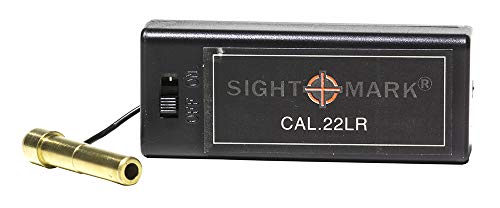
The Sightmark is the clearest .22LR-only choice, with a Class IIIA red laser at 632–650 nm. The maker positions it for quick bore alignment and travel, so it suits buyers who want a compactly marketed single-caliber option rather than a multi-caliber kit. Its wavelength range is narrower than the ranges given for the other products, which can help when comparing laser specifications.
Bottom line: Choose this if you need a .22LR-specific bore sight and value a wavelength range.
How to choose a 22LR laser bore sight
Start with the exact caliber and the way the tool fits the firearm; barrel-insert models must match the bore and are used without a silencer. A laser bore sight gives a rough alignment reference by projecting a beam along the bore, while ammunition-based zeroing confirms where the bullet actually impacts. At 50 yards, a 1-inch dot subtends about 2 MOA, so dot size and visibility affect how precisely you can compare the beam with a reticle. Choose a sighting range that covers your intended setup, but treat the beam as an initial reference, not proof of zero. For this group, match the tool to the firearm caliber before weighing batteries or wavelength.
Laser class and safe handling
Class IIIa visible lasers in these products are rated below 5 mW, but the beam still must not enter anyone’s eyes. Keep the bore pointed in a safe direction, remove ammunition from the work area, and verify the firearm is unloaded before inserting a bore sight; never look into the muzzle to inspect the laser. A laser can reflect from shiny surfaces, so avoid directing it toward mirrors or reflective targets. The laser wavelength ranges here fall in the red visible spectrum, but ambient light and distance affect how clearly a dot can be seen. Use the maker’s safety warning as a minimum, not a reason to treat the beam as harmless.
What a laser bore sight can and cannot confirm
A bore sight helps bring an optic’s reticle near the bore line before live fire, which can reduce the initial adjustment needed at the range. It cannot account for bullet drop, ammunition variation, barrel behavior, or the distance at which the firearm is ultimately zeroed. A 50-yard laser reference does not automatically set a 50-yard impact zero, because the beam and projectile follow different paths. Confirm alignment by firing at a safe, appropriate target and adjusting from actual impacts. For a .22LR rifle, the intended zero distance should reflect how the firearm will be used; do not assume one beam alignment works at every distance.
Caliber fit and kit contents
Caliber names on bore sights determine whether the tool is intended for a firearm; do not assume a .22LR tool fits a different bore simply because calibers appear together in a package. A chamber- or barrel-insert design also requires the correct geometry and clearance, and suppressors or other muzzle devices may prevent proper insertion. The table separates the fit from kit extras so buyers can narrow choices without treating spare batteries as a compatibility feature.
| Need | Relevant distinction | Choice direction |
|---|---|---|
| Use with 9mm | Includes a separate 9mm tool | Choose a two-caliber kit |
| More battery spares | 12 batteries included | Choose the package with spares |
| .22LR only | Single-caliber fit | Choose a .22LR-specific model |
| Distance reference | 15 to 100 yards stated | Choose a model with a range |
Frequently Asked Questions
Does a laser bore sight zero a .22LR rifle?
No; a laser bore sight gives a preliminary bore-to-optic alignment, not a confirmed bullet zero. Fire at the intended zero distance and adjust from the actual impacts.
Can I use a .22LR bore sight with a suppressor?
The barrel-insert models here specify use without a silencer. A muzzle device can block insertion, so remove it only if safe and permitted for your firearm setup.
How far away can a red bore sight be seen?
Visibility depends on ambient light, target contrast, and laser output; one model gives a 15-to-100-yard range and says darker conditions extend visibility. A visible dot at that distance is not a statement of zeroing accuracy.
Are Class IIIa bore sight lasers safe to look at?
No; keep the beam out of all eyes even when its rated power is below 5 mW. Point the firearm in a safe direction and confirm it is unloaded before using a bore sight.
What does laser wavelength mean for a bore sight?
Wavelength identifies the laser’s light range, measured in nanometers; the red options here specify ranges around 630 to 680 nm.