
Best Rug Grippers for Tile Floors: 4 Options

ZONGOOL 12-Piece Rug Tape suits most people looking for rug grippers for tile floors because its 12 strips are sized for corner placement and the maker describes them as washable and reusable. Choose GORILLA GRIP 2 × 3 ft Rug Pad instead if you want a nonadhesive pad that covers a 2-by-3-foot area, or GORILLA GRIP Extra Long Edge Grippers if you need longer edge strips.
We earn a commission if you buy through links on this page. As an Amazon Associate I earn from qualifying purchases. Products are compared on manufacturer specifications, not hands-on testing.
- Best overall: ZONGOOL 12-Piece Rug Tape – The 12 strips measure 6.3 by 1.2 inches and are made for tile as well as other hard floors.
- Best full-size pad: GORILLA GRIP 2 × 3 ft Rug Pad – The nonadhesive pad covers a 2-by-3-foot area and is listed for tile floors.
- Best for rug edges: GORILLA GRIP Extra Long Edge Grippers – Its eight rectangular grippers measure 6.5 by 2 inches for placement along straight rug edges.
- Best for more pieces: Tiergrade 16-Piece Rug Tape – The 16-piece set is described for tile floors and uses thin, reusable grippers.
| Product | Best for | Count | Size | Shop |
|---|---|---|---|---|
| ZONGOOL 12-Piece Rug Tape | Corner placement | 12 strips | 6.3 × 1.2 in. | Check Price on Amazon |
| GORILLA GRIP 2 × 3 ft Rug Pad | Full-area coverage | 1 pad | 24 × 36 in. | Check Price on Amazon |
| GORILLA GRIP Extra Long Edge Grippers | Long rug edges | 8 grippers | 6.5 × 2 in. | Check Price on Amazon |
| Tiergrade 16-Piece Rug Tape | More attachment points | 16 pieces | 5.7 × 2.95 in. | Check Price on Amazon |
Rug Grippers for Tile Floors
Match the attachment style and coverage to the rug rather than choosing by piece count alone.
ZONGOOL 12-Piece Rug Tape

ZONGOOL 12-Piece Rug Tape is a corner-oriented strip set for buyers who want multiple small attachment points rather than one full-area pad. Each of the 12 pieces measures 6.3 by 1.2 inches, and the maker describes the strips as washable, reusable, and suitable for tile, laminate, and hardwood floors. The A and B labels are intended to simplify corner application. This format can suit small rugs or mats where the corners are the main concern. It is less suited to someone seeking continuous support under a large rug; confirm compatibility with your tile finish before applying adhesive.
Bottom line: Choose this if you want multiple narrow strips for rug corners.
GORILLA GRIP 2 × 3 ft Rug Pad

GORILLA GRIP 2 × 3 ft Rug Pad differs from the adhesive-strip options by using a reversible, nonadhesive open-grid pad under the rug. The 2-by-3-foot size makes it a match for a rug of that size, and the maker identifies tile, vinyl, and hardwood as compatible floor types. The open grid is designed to let the floor breathe, and the pad is described as vacuum-friendly. Choose this style when you want coverage across the rug rather than separate corner or edge grips. Its fixed 2-by-3-foot dimensions are a limitation for rugs outside that footprint.
Bottom line: Pick this for a 2-by-3-foot rug when you want a nonadhesive underlay.
GORILLA GRIP Extra Long Edge Grippers

GORILLA GRIP Extra Long Edge Grippers uses rectangular edge grippers rather than corner-only stickers, making it the option here aimed at straight rug borders. The eight pieces measure 6.5 by 2 inches, and the maker says they can be placed along longer sides for added hold. Tile is among the named floor types. The maker also reports lab comparisons on vinyl and hardwood; those performance claims do not establish a tile-specific result. The edge-focused shape suits rugs that shift or curl along a straight side, but buyers seeking full coverage under a rug should consider a pad instead.
Bottom line: Choose these when your main concern is grip along long, straight rug edges.
Tiergrade 16-Piece Rug Tape
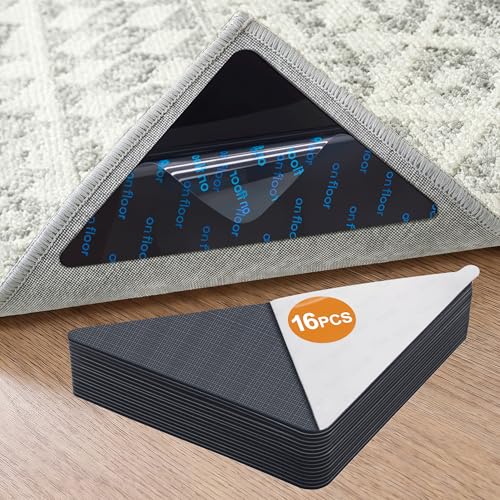
Tiergrade 16-Piece Rug Tape offers 16 thin grippers, more pieces than the other adhesive sets in this comparison. The maker describes the grid backing as suitable for tile and hardwood, reusable, and removable without residue; it can be wiped with clean or soapy water. Its triangular design is intended to increase contact with the rug and floor. The larger piece count gives buyers more potential placement points across a rug. This is still an adhesive-style product, not a broad under-rug layer, so it may not be the right choice for anyone who wants nonadhesive coverage beneath the entire rug.
Bottom line: Pick this if you want a 16-piece adhesive set with reusable grippers.
How to Choose Rug Grippers for Tile Floors
Choose between adhesive strips and a nonadhesive underlay based on how much of the rug needs support. Corner or edge strips concentrate grip at attachment points, while a pad spreads contact beneath a larger area. Measure the rug and the area you want covered before selecting a size; a common rule is to make an under-rug pad about 1 inch smaller than the rug on every side so it stays hidden. Tile grout lines and texture can change how well a flat gripper contacts the floor, so position strips on the tile surface rather than directly across a deep grout channel when possible. If you need a full-size underlay, match the pad dimensions to the rug rather than relying on piece count.
Adhesive Strips Versus Nonadhesive Pads
Adhesive strips attach at selected points, while a nonadhesive pad sits between the rug and floor. The difference matters most when a rug has curled corners or edges, or when you want coverage under its full footprint. Use this guide to match attachment style to the problem:
| Need | Style to consider |
|---|---|
| Hold corners or selected edges | Adhesive strips or grippers |
| Cover a measured rug area | Nonadhesive rug pad |
| Keep the floor free of adhesive | Nonadhesive rug pad |
Tile is not one uniform surface: smooth glazed tile, textured tile, and grout create different contact conditions. A full pad also needs to lie flat; a pad that is too large can protrude beyond the rug and become a trip edge. Before buying an adhesive product, verify that its adhesive is compatible with your tile finish.
How to Place Grippers on Tile
Start with a clean, dry floor and a rug laid flat, because dust, grit, and moisture can interfere with contact. Place corner grippers where they can stay flat against both surfaces; edge pieces belong along straight sections rather than bunched fabric or a thick binding. Avoid positioning a strip across a grout groove if that keeps the adhesive from sitting evenly. On a larger rug, add support at points where edges lift or shift, following the product’s placement guidance. For a pad, center it beneath the rug and keep it roughly 1 inch inside each edge. Recheck after moving furniture or vacuuming, and stop using any arrangement that leaves a raised or loose edge.
Frequently Asked Questions
Do rug grippers work on every type of tile?
No single grip style works equally on every tile surface. Smooth glazed tile, textured tile, and wide or recessed grout lines change how much contact a strip or pad can maintain, so check compatibility with the finish and keep contact points flat.
Should a rug pad be the same size as the rug?
A common fit rule is to make the pad about 1 inch smaller than the rug on each side. That keeps the pad concealed and reduces the chance of a pad edge protruding where people walk.
Can I put rug grippers over grout lines?
Avoid spanning a deep grout line when it prevents a strip from lying flat. Place adhesive contact points on the tile face where possible, since uneven support can reduce contact.
How do I keep rug grippers from losing grip?
Keep the floor and gripper contact surfaces clean and dry. Dust, grit, or moisture can interfere with contact, and a rug or pad that has shifted should be repositioned before people walk across it.
Are adhesive rug grippers safe for tile finishes?
Compatibility depends on the adhesive and the tile finish. Verify the product works with your particular tile before applying it, especially if the surface has a coating or delicate finish.