
80 Amp EV Charger Options Compared by Fit and Power

The Autel MaxiCharger is the 80 amp EV charger to consider first if you want app controls and up to 19.2 kW; its J1772 connector and hardwired design are key fit points. Choose another option if you need a different connector or cable length.
An 80A Level 2 charger is hardwired equipment for charging from a 240V circuit, and the vehicle’s onboard charger determines whether it can use the full output.
We earn a commission if you buy through links on this page. As an Amazon Associate I earn from qualifying purchases. Products are compared on manufacturer specifications, not hands-on testing.
- Best overall: Autel MaxiCharger 80A – Offers app controls, adjustable current, and up to 19.2 kW with a J1772 connection.
- Best for outdoor use: Grizzl-E Ultimate 80A J1772 – Combines an 80A output with a metal Type 4 enclosure and Wi-Fi monitoring.
- Best for cable reach: PRIMECOM 80A Smart Charger – Offers an 18.5-foot cable and adjustable current settings from 24A to 80A.
| Product | Best for | Power | Connection | Shop |
|---|---|---|---|---|
| Autel MaxiCharger 80A | App-based control | 19.2 kW | J1772 | Check Price on Amazon |
| Grizzl-E Ultimate 80A J1772 | Outdoor installation | 19.2 kW | J1772 | Check Price on Amazon |
| PRIMECOM 80A Smart Charger | Cable reach | — | Vehicle plug varies | Check Price on Amazon |
80 Amp EV Chargers
Compare current, connection type, and control features before choosing a hardwired charger for your home or workplace.
Autel MaxiCharger 80A

The Autel MaxiCharger pairs an 80A maximum output with app-based session controls, distinguishing it from the other options here. Autel says it delivers up to 19.2 kW and about 70 miles of range per hour; actual charging speed depends on the vehicle and conditions. The app can schedule sessions, adjust current, and show energy use. Its hardwired J1772 setup suits owners whose vehicle accepts that connector and who want remote management. The limitation is connector fit: drivers needing a different plug should compare the alternatives before choosing.
Bottom line: Pick this if app controls and a J1772 connection suit your charging setup.
Grizzl-E Ultimate 80A J1772
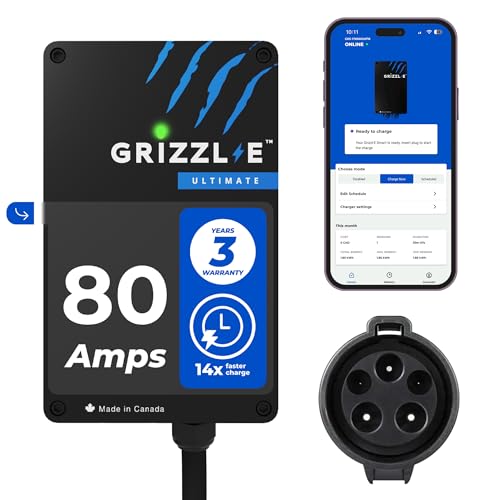
The Grizzl-E Ultimate stands out for its metal Type 4 enclosure and ability to charge with or without an online connection. It is a hardwired 80A, 19.2 kW unit with Wi-Fi monitoring, scheduling, energy statistics, diagnostics, and an external antenna. The product features cite protections for overcurrent, overvoltage, undervoltage, ground faults, missing diode, and overtemperature. This combination suits buyers prioritizing a robust enclosure and connected monitoring. Its limitation is that app features rely on network access, even though charging itself can work offline.
Bottom line: Choose this for a metal enclosure and charging that can continue offline.
PRIMECOM 80A Smart Charger

The PRIMECOM option distinguishes itself with an 18.5-foot cable and multiple selectable current settings, from 24A through 80A. Its app supports scheduling and energy monitoring, which may suit drivers who want to adjust charging output or track sessions by phone. The product name also identifies a 220V Level 2 station, but its power figures conflict, so the maximum output in kilowatts is not a dependable basis for comparison. Confirm the connector supplied for your vehicle and the installation requirements before choosing it.
Bottom line: Pick this if the 18.5-foot cable and selectable current settings fit your setup.
How to choose an 80 amp EV charger
Start with your home circuit and the vehicle’s onboard charging limit: an 80A charger only helps if both can support its output. EV charging is a continuous load, so an 80A load generally calls for a 100A branch circuit under the 125% sizing rule. Have a qualified electrician confirm panel capacity, wire size, breaker, and local requirements before installation. At 240V, 80A corresponds to 19.2 kW, but the vehicle may accept less. If the onboard charger is rated below 19.2 kW, the car—not the station—sets the maximum charging rate. Choose adjustable amperage when you need to limit load to fit the available circuit.
Connector fit and cable reach
Match the charger connector to the vehicle inlet before comparing app features. J1772 is a common AC charging connector for many North American EVs, while some vehicles use a different inlet or an adapter; confirm compatibility for the specific vehicle and charging situation. Cable length determines whether the connector can reach the parked vehicle without stretching or routing across a walkway. Measure from the planned charger location to the inlet with the vehicle parked in its usual position, then allow practical slack. Keep the cable away from vehicle tires, doors, and pedestrian paths. A longer cable can help with variable parking positions, but orderly routing matters for safe everyday use.
80 amp charging power and real charging speed
An 80A charger can supply up to 19.2 kW on a 240V connection, but that figure is a ceiling rather than a guarantee of vehicle charging speed. The car’s onboard charger, battery state, temperature, and charging settings can all reduce the rate. Range added per hour also varies with vehicle efficiency, so advertised mileage estimates are not directly comparable across cars. For a useful comparison, check the onboard AC charging limit in the vehicle manual and compare it with charger output in kilowatts. If the car accepts 11.5 kW AC, for example, a 19.2 kW station will not make it charge at 19.2 kW.
Electrical installation and safe operation
Plan an 80A EV charger installation as a major electrical load, not a plug-in appliance. A typical 80A continuous charging load requires a 100A branch circuit; existing panel space alone does not establish that the service has enough capacity. An electrician should verify the service, conductors, breaker, grounding, and local permit requirements before work begins. Hardwired stations avoid a plug connection at the charger, but they still require installation to the applicable electrical code. For an outdoor location, use equipment rated for the exposure and protect the cable from standing water, impact, and vehicle traffic. Stop using a charger if its cable or enclosure is visibly damaged.
Frequently Asked Questions
What size breaker does an 80 amp EV charger need?
An 80A continuous charging load generally needs a 100A branch circuit because continuous loads are sized at 125%. An electrician must verify conductor size, panel and service capacity, and local code requirements.
Can every EV charge at 80 amps?
No; the vehicle’s onboard AC charger caps the power it can accept. Check the vehicle manual for its maximum AC charging rate in kilowatts before paying for an 80A installation.
How much power does an 80 amp EV charger use?
At 240V, 80A corresponds to 19.2 kW. The actual draw can be lower if the vehicle, charger setting, or electrical supply limits current.
Does a J1772 charger work with every electric vehicle?
No; connector compatibility depends on the vehicle inlet and charging method. Check the vehicle manual and confirm whether a compatible adapter is required for the specific vehicle.
How long should an EV charger cable be?
Choose a cable that reaches the vehicle inlet from the planned mounting point without crossing a walkway or sitting under a tire. Measure the usual parked position and allow enough slack to connect without tension.