
Best Counterfeit Bill Detector: 4 Models Compared

PONNOR AL-135T suits most cash-handling setups because it combines pass/fail checking with denomination and total-value modes and supports USD, EUR, CAD and MXN. Choose another detector if you need a compact, lightweight unit or a cordless rechargeable design; those priorities point to different features.
We earn a commission if you buy through links on this page. As an Amazon Associate I earn from qualifying purchases. Products are compared on manufacturer specifications, not hands-on testing.
- Best overall: PONNOR AL-135T – Offers pass/fail and total-value modes and supports four currencies.
- Best for cordless use: PONNOR AL-135 – Has a built-in 500 mAh rechargeable battery.
- Best for a compact counter: Cassida InstaCheck – Measures 5.1 by 2.75 inches and weighs 0.85 pounds.
| Product | Best for | Currency support | Detection checks | Power or size | Shop |
|---|---|---|---|---|---|
| PONNOR AL-135T | Multi-currency checks | USD, EUR, CAD, MXN | Up to 10 checks | 3-inch screen | Check Price on Amazon |
| PONNOR AL-135 | Cordless checking | USD | UV, MG, IR, size, double-note | 500 mAh battery | Check Price on Amazon |
| Cassida InstaCheck | Small workspaces | — | Infrared, magnetic, ultraviolet | 5.1 × 2.75 in; 0.85 lb | Check Price on Amazon |
| Kolibri KCD-1000 | Any-way bill feeding | — | UV, MG, IR, size, double-note | 6.3 × 5.1 in | Check Price on Amazon |
Counterfeit Bill Detectors Compared
Compare currency coverage, verification features and practical setup needs before choosing a detector.
PONNOR AL-135T

For businesses that need more than a binary check, this detector adds denomination identification and total-value calculation alongside a pass/fail mode. It supports USD, EUR, CAD and MXN, and accepts bills in four orientations. The 3-inch digital screen makes it the clearest fit here for staff who need to see amounts as well as authenticity results. The maker claims up to 10 authentication checks; that claim is not a guarantee that every counterfeit will be caught. Its large size may be a drawback where counter space is tight.
Bottom line: Pick this if you handle multiple supported currencies and want denomination totals.
PONNOR AL-135

Unlike the other detectors here, this model specifies a rechargeable battery, so it can be used without a cord while charged. It checks U.S. currency in under 2 seconds according to the maker and combines UV, magnetic, infrared, size and double-note sensing. The four-way feed and adjustable output chute offer flexibility for different counter layouts. This is a practical match for mobile counters or spaces without a convenient outlet. It is limited to U.S. currency in the feature set, so businesses checking other currencies should choose a multi-currency model instead.
Bottom line: Choose it for cordless U.S.-bill verification and adjustable bill output.
Cassida InstaCheck

The Cassida InstaCheck stands out for its small footprint and low weight: it measures 5.1 by 2.75 inches and weighs 0.85 pounds. Its automatic scan checks infrared, magnetic and ultraviolet markings and returns a pass/fail result in less than a second, according to the maker. That combination suits a checkout station where space is limited and staff need a quick binary result. Unlike a detector that calculates denomination totals, this is a pass/fail unit, so it will not serve buyers who want cash totals calculated during verification.
Bottom line: Pick it when a small, lightweight pass/fail detector matters most.
Kolibri KCD-1000
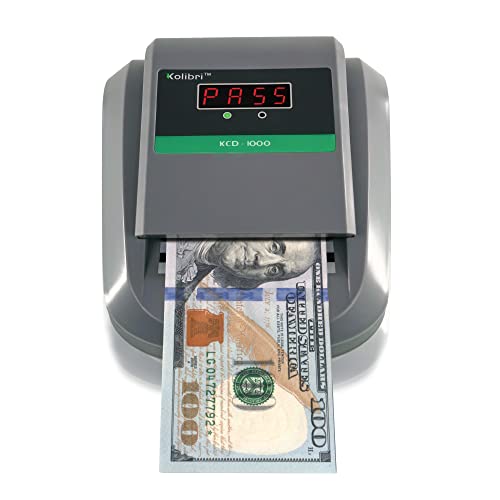
The KCD-1000 is distinguished by its all-way bill orientation and broad sensing mix: UV, magnetic, infrared, size and double-note sensors. Its pass/fail indicator simplifies the result for a cashier who does not need denomination totals. Kolibri says field testing reached 99% accuracy, with results varying by currency and condition; treat that as a maker claim rather than a guarantee. The 6.3-by-5.1-inch footprint is larger than the compact Cassida unit, so it is less suited to a very crowded counter.
Bottom line: Choose it for all-way feeding and several sensor types in a pass/fail unit.
How to Choose a Counterfeit Bill Detector
Choose by the decision you need at the counter: a pass/fail result, an amount total, or a visual check of security features. Automatic detectors commonly combine ultraviolet (UV), magnetic (MG) and infrared (IR) sensing; some also check bill dimensions or detect two notes fed together. UV can reveal fluorescent features, while magnetic and infrared sensors check other printed or embedded characteristics. No single sensor is a universal guarantee, so use a detector as one part of a cash-handling routine. If staff need a denomination total, choose a model with value-add mode; if the counter needs only quick sorting, a simple pass/fail unit may be enough. For work across four currencies, select a model that explicitly supports each one you handle.
Detector makers may advertise accuracy, but counterfeit quality and currency condition affect results. Keep a second verification method available for suspicious bills rather than treating a pass indicator as proof.
What Detector Features Mean
UV, magnetic and infrared checks examine different bill features; a multi-sensor device uses more than one signal instead of relying on a pen mark or a single UV lamp. Size sensing compares dimensions, and double-note sensing can alert staff when two notes travel together. These functions do not replace examining a bill’s security features or following your organization’s cash procedures. A pass/fail detector reports a result, while a value-counting mode additionally identifies denominations and calculates a total. Those are separate capabilities, so confirm which output staff need before selecting a machine.
Orientation is another workflow distinction: a four-way feed accepts a bill from any of four directions, reducing the need to turn notes first. A chute that changes output direction can help adapt the device to a specific counter arrangement.
Fit a Detector to Your Counter
Measure the available counter depth and width before choosing a machine; a footprint around 5 by 3 inches is notably more compact than one around 6 by 5 inches. Leave working room for inserting bills and collecting output, not just the unit’s base. If the detector will move between stations or be used away from an outlet, a rechargeable battery is a useful deciding feature. Check whether the intended currencies are explicitly supported; currency coverage is not interchangeable between models.
For a simple choice, match the need to the function below. A device with more sensors can still be the wrong fit if it lacks the currency or result mode your staff need.
| Need | Feature to prioritize |
|---|---|
| Calculate denomination totals | Value-add mode and a digital screen |
| Use away from a cord | Rechargeable battery |
| Reduce bill turning | Four-way orientation feed |
| Inspect features by eye | UV light and watermark illumination |
Use and Maintain a Bill Detector
Keep the feed path and sensor area free of dust and paper residue, because debris can obstruct bill movement or interfere with a scan. A jammed or visibly damaged note should be removed carefully according to the device’s operating instructions, with power disconnected if the manual calls for it. Never force a bill through a detector; forcing notes can damage rollers or sensors. For routine use, keep bills flat and feed one at a time unless the device’s design explicitly supports another method.
Use the detector’s result as a screening step, not a substitute for a trained visual check when a bill remains suspicious. Confirm the unit’s supported currencies and use mode when procedures change, particularly if a business begins accepting another currency.
Frequently Asked Questions
Can a counterfeit bill detector catch every fake?
No detector should be treated as a guarantee against every counterfeit. Currency condition and the quality of a fake can affect sensor results, so a suspicious bill still merits a separate check.
What does four-way orientation mean on a detector?
Four-way orientation means the machine accepts a bill in any of four feeding directions. That reduces the need to turn each note before checking it.
Why does a bill detector use infrared and magnetic sensors?
Infrared and magnetic sensors check different security characteristics from ultraviolet light. Combining sensor types gives an automatic detector multiple kinds of signals to assess.
How much counter space should I allow for a detector?
Measure the unit’s footprint and leave extra room for feeding bills and collecting output. A device around 5 by 3 inches is more compact than one around 6 by 5 inches.
Can I use one detector for several currencies?
Only if its supported currencies include each currency you handle. For example, a machine supporting USD, EUR, CAD and MXN covers those four, not automatically every world currency.