
Induction Tools for Rusted Bolts: 4 Models Compared

For most repairs, Solary 1,200W Induction Bolt Heater stands out by combining 1,200W power with eight coils, including two 600 mm flexible coils for awkward access. Choose another model if you need its specific power or coil configuration; an induction heater uses an electromagnetic field to heat conductive metal without an open flame.
These tools suit people loosening seized metal fasteners, but they are not a fit for nonconductive hardware or work where the heating coil cannot approach the fastener safely.
We earn a commission if you buy through links on this page. As an Amazon Associate I earn from qualifying purchases. Products are compared on manufacturer specifications, not hands-on testing.
- Best overall: Solary 1,200W Induction Bolt Heater – Eight coils include two 600 mm flexible coils, and the maker says heating can take 15 seconds.
- Best for higher power: 1,500W Induction Heater with 8 Coils – The 1,500W, 110V tool includes eight coils, seven preformed and one flexible.
- Best for a five-coil kit: 1,300W Red Induction Heater – The 1,300W model includes five coils plus a built-in LED light.
| Product | Best for | Power | Coils | Shop |
|---|---|---|---|---|
| Solary 1,200W Induction Bolt Heater | Flexible coil reach | 1,200W | 8 | Check Price on Amazon |
| 1,500W Induction Heater with 8 Coils | Mixed coil access | 1,500W | 8 | Check Price on Amazon |
| 1,500W Handheld Induction Heater | Eight-coil variety | 1,500W | 8 | Check Price on Amazon |
| 1,300W Red Induction Heater | Built-in work light | 1,300W | 5 | Check Price on Amazon |
Induction Tools for Rusted Bolts
Compare power and coil configurations to match the heater to the fastener and available access.
Solary 1,200W Induction Bolt Heater

Two 600 mm flexible coils distinguish this 1,200W heater from the other kits, which may help when a rigid coil cannot readily reach around a fastener. The kit also has six rigid coils in 25 mm, 30 mm and 45 mm sizes. The maker says it heats in 15 seconds and includes a cooling fan and overheat protection. The flexible coils add reach, but buyers who need a higher-power option should compare the 1,500W models. Match a coil to the fastener while leaving room to position it without contacting nearby parts.
Bottom line: Choose this kit when flexible coil reach matters more than maximum listed wattage.
1,500W Induction Heater with 8 Coils

Seven preformed coils plus one flexible coil give this 1,500W heater a mix of fixed and adaptable access. The maker says the tool targets heat at fasteners and can heat them in 25 seconds; those are performance claims, not a guarantee for every bolt, coil position or repair. Its 110V supply is shared with the other compared tools, while its specific coil mix may suit a shop with varied fastener locations. The flexible coil count is one, so buyers who want multiple flexible coils should consider Solary 1,200W Induction Bolt Heater.
Bottom line: Pick this model for 1,500W power with both preformed and flexible coils.
1,500W Handheld Induction Heater

This 1,500W handheld heater is presented with an eight-coil kit and is a close match for buyers who want the higher of the two listed power levels. The maker claims 25-second heating and says the tool works without open flames or sparks; surrounding materials can still be affected by heat from the fastener, so do not treat induction as risk-free. Its maker describes uses from exhaust fasteners to bearings, but does not identify coil sizes. Buyers who need a known coil-size range may prefer a kit that gives those measurements.
Bottom line: Choose this option for 1,500W power and an eight-coil kit.
1,300W Red Induction Heater
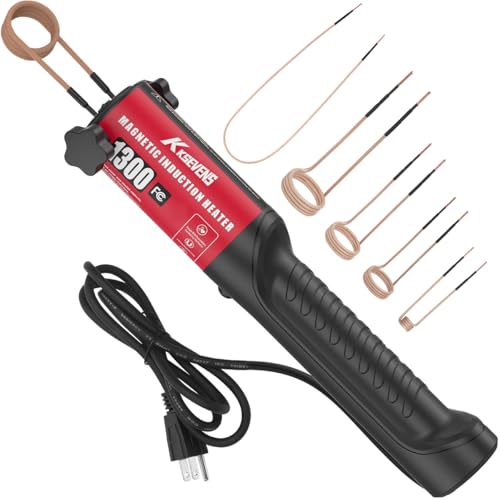
A built-in LED light and threaded non-slip handle set this 1,300W heater apart from the other options. Its five-coil kit is smaller than the eight-coil kits, so it may be less adaptable when fastener access calls for more coil choices. The maker says the tool heats in 25 seconds and describes the handle as comfortable for extended use; actual results depend on the fastener and coil placement. Buyers who prioritize coil variety should compare the eight-coil kits, while this model may suit repairs where a work light is useful.
Bottom line: Pick this model when a built-in LED and five-coil kit suit the job.
How induction heating loosens rusted bolts
An induction heater creates a changing magnetic field that induces electrical currents in conductive metal, generating heat in the fastener. The coil should be positioned close to the target metal; it does not need to touch the bolt. Heating expands the fastener and can help break the corrosion bond, but the needed time varies with bolt size, coil shape, starting temperature and how well the coil fits. A smaller coil held close can concentrate energy more effectively than a loose fit. Heat can travel into surrounding metal, so protect paint, rubber, wiring and fuel-related components and stop if nearby materials begin to soften or smoke. The fastener remains hot after the tool is switched off.
Choose power and coil access
Choose a coil configuration that can approach the fastener without touching adjacent parts; coil shape and clearance can matter as much as wattage. These four tools are all 110V, while their power ranges from 1,200W to 1,500W. The maker claims faster heating for higher-output models, but the real heating time also depends on fastener mass and coil positioning. A flexible coil is useful where a rigid preformed loop cannot be aligned, while multiple rigid sizes suit different bolt diameters. Use this decision table to narrow the choice by job condition.
| Job condition | What to prioritize |
|---|---|
| Limited approach around the bolt | Flexible coil |
| Known, open access | Rigid coil sized close to the fastener |
| Frequent work across different fasteners | More coil sizes |
Use an induction heater safely
Induction avoids an open flame, but it does not make the work area or heated fastener safe to touch. Remove flammable materials from the work zone, keep hands clear of the coil and heated metal, and use suitable eye and hand protection. Treat the fastener as hot until it has cooled; red-hot metal can cause severe burns and ignite nearby materials. Nearby conductive parts may also heat if they fall within the magnetic field, while heat can spread through the fastener into adjacent components. Keep the coil centered on the target and stop if the coil or tool is damaged, overheats, or behaves unexpectedly. Do not rely on a no-sparks claim as a substitute for fire precautions.
Prepare seized fasteners before heating
Remove dirt and loose corrosion around the fastener so the coil can sit close and stay aligned. A penetrating oil may help after heating and cooling, but keep flammable liquids away from hot metal and let the assembly cool fully before applying them. Avoid forcing a bolt while it is hot: softened surrounding materials or a weakened fastener can complicate removal. Use the smallest suitable coil that provides clearance, and stop if the coil touches the bolt or nearby hardware. If the fastener sits beside plastic, rubber or wiring that cannot be moved or shielded, verify the available clearance and protect those parts before heating.
Frequently Asked Questions
Does an induction heater need to touch the bolt?
No, the coil creates a magnetic field that heats conductive metal without contact. Keep the coil close and centered, with clearance from the bolt and neighboring parts.
How long does induction heating take on a seized bolt?
There is no fixed time because bolt mass, coil fit and starting temperature change the result. The makers of these models claim heating times of 15 or 25 seconds, but those figures are not guaranteed for every fastener.
Can an induction heater damage nearby wiring or plastic?
Yes, heat can conduct from the fastener into nearby parts, and conductive metal near the coil can also warm. Shield or move sensitive materials and stop if they soften, smoke or overheat.
Is an induction bolt heater safe around fuel lines?
An induction tool has no open flame, but a heated fastener can still ignite fuel vapors or damage nearby components. Keep the work area free of fuel leaks and flammable materials, and do not treat flame-free operation as a guarantee of safety.
What size induction coil should I use?
Use a coil that fits close around the fastener while clearing adjacent hardware; a loose, oversized coil is less targeted. Flexible coils can help where a rigid loop cannot be positioned around the bolt.