
Best Hand Held Tungsten Sharpener: 4 Options Compared

YESWELDER Cordless Tungsten Sharpener suits most people who want a cordless hand held tungsten sharpener, with six angle settings and four electrode sizes. Choose Sharpie DXCL Cordless Tungsten Sharpener instead for a grinder with a 15°–45° adjustment and a tip-flat option; choose a manual holder if you want a non-powered sharpening fixture.
We earn a commission if you buy through links on this page. As an Amazon Associate I earn from qualifying purchases. Products are compared on manufacturer specifications, not hands-on testing.
- Best overall: YESWELDER Cordless Tungsten Sharpener – Cordless operation, six angles, four electrode sizes, and an LED display make it the most adjustable option.
- Best for taper control: Sharpie DXCL Cordless Tungsten Sharpener – Its adjustable 15°–45° taper and tip-flat option address specific grinding preferences.
- Best for long electrodes: Extended Manual Tungsten Holder – The extended holder provides up to 134 mm of clamping depth for electrodes from 1.0 to 4.0 mm.
| Product | Best for | Electrode sizes | Angle range or settings | Power type | Shop |
|---|---|---|---|---|---|
| YESWELDER Cordless Tungsten Sharpener | Adjustable cordless grinding | 1.6, 2.0, 2.4, 3.2 mm | 15°, 20°, 30°, 40°, 45°, 50° | Cordless electric | Check Price on Amazon |
| Sharpie DXCL Cordless Tungsten Sharpener | Adjustable taper grinding | 1.0, 1.6, 2.4, 3.2 mm | 15°–45° adjustable | Cordless electric | Check Price on Amazon |
| Extended Manual Tungsten Holder | Deep electrode clamping | 1.0–4.0 mm | — | Manual holder | Check Price on Amazon |
| Handheld Manual Tungsten Holder | Manual holding | — | — | Manual holder | Check Price on Amazon |
Hand held tungsten sharpeners
Compare powered grinders with manual holders by electrode fit, angle control, and how you plan to sharpen.
YESWELDER Cordless Tungsten Sharpener

Six selectable angles and a cordless electric design distinguish this sharpener from the other options. The head accommodates four electrode diameters: 1.6, 2.0, 2.4, and 3.2 mm. Its LED display and 0–32 speed settings provide controls for users who want to adjust operation rather than rely on a fixed manual fixture. The maker says the rechargeable battery supports up to 4.5 hours of continuous use per charge. Its size range is narrower than the manual holders, so check your electrode diameter before choosing it if you use sizes outside those four.
Bottom line: Pick this if you want a cordless grinder with several preset angles and your electrodes fit its four supported sizes.
Sharpie DXCL Cordless Tungsten Sharpener

The adjustable 15°–45° taper range and tip-flat option set this grinder apart. It accommodates 1.0, 1.6, 2.4, and 3.2 mm electrodes, and its double-sided diamond wheel is specified for grinding. The integrated cut-off and scoring option is useful when a job calls for removing part of an electrode without bending or breaking it. Choose this model if those functions matter more than a broader set of preset angles. Its size range tops out at 3.2 mm, so it is not the match for larger electrodes.
Bottom line: Choose this for adjustable taper angles, a tip-flat feature, and the integrated scoring option.
Extended Manual Tungsten Holder
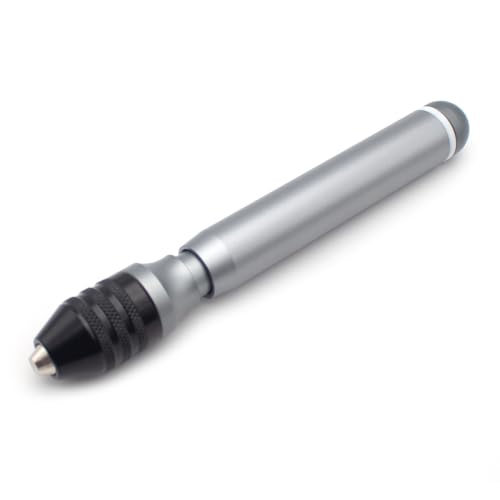
Unlike the powered grinders, this is a manual clamping holder rather than a self-contained electric sharpener. Its adjustable rotary chuck accepts 1.0–4.0 mm electrodes, and the extended version provides up to 134 mm of clamping depth. The alloy construction and slim handle make it a portable fixture for someone who already has a compatible grinding method and wants to hold the electrode securely during sharpening. It does not provide its own motor or stated angle controls, so buyers seeking an all-in-one powered grinder should choose one of the electric models.
Bottom line: Pick this if you need a deep-clamping manual fixture and already have a way to grind the electrode.
Handheld Manual Tungsten Holder

This option is a manual holder, not an electric sharpener, so it serves a different role from the cordless grinders. The product name identifies an adjustable rotary chuck and quick electrode loading, which may suit a buyer who wants a hand-held fixture for a separate sharpening setup. The size information identifies a 7.25-inch tool, but does not establish the electrode diameter range; confirm that fit before ordering if you need a specific size. Choose a powered grinder instead if you want the sharpening mechanism included in the tool.
Bottom line: Choose this only if a manual holder fits your sharpening setup and electrode size.
How to choose a hand held tungsten sharpener
Start with electrode diameter, then decide whether angle adjustment or portability matters more. The powered options here cover different ranges: Sharpie DXCL Cordless Tungsten Sharpener and YESWELDER Cordless Tungsten Sharpener both accept electrodes up to 1/8 inch, while Extended Manual Tungsten Holder clamps electrodes up to 4.0 mm. If you use multiple diameters, verify that each falls within the tool’s supported sizes rather than assuming a chuck is universal. A hand-held tool can mean either a powered grinder or a holder used with a separate grinding method, so identify which job you need it to do. For repeatable tapers, a tool with selectable or adjustable angles gives more control than a holder without stated angle settings.
For a quick fit decision, use the supported ranges rather than the tool’s overall length:
| Need | Option to consider | Fit detail |
|---|---|---|
| Cordless powered grinding | YESWELDER Cordless Tungsten Sharpener | Four sizes through 1/8 in |
| Adjustable taper and tip flat | Sharpie DXCL Cordless Tungsten Sharpener | Four sizes through 1/8 in |
| Manual deep clamping | Extended Manual Tungsten Holder | 1.0–4.0 mm; up to 134 mm clamping depth |
Tungsten electrode size and angle fit
Electrode diameter is the first fit check: a grinder’s guide or chuck must match the diameter you use, and these tools do not all cover the same sizes. A taper angle also affects the shape of the electrode tip; a longer, sharper taper is commonly used for lower-current work, while a blunter taper suits higher current. Consider whether your work needs one repeatable angle or a range of choices: Sharpie DXCL Cordless Tungsten Sharpener adjusts from 15° to 45°, while YESWELDER Cordless Tungsten Sharpener offers six settings from 15° to 50°. Neither angle preference alone determines the correct setup; electrode type, current, and welding process also matter. Avoid forcing an electrode into a guide that does not fit.
Manual holders and powered tungsten grinders
A manual holder clamps the electrode, while a powered sharpener supplies the grinding action. That difference matters more than the shared hand-held format: Extended Manual Tungsten Holder and Handheld Manual Tungsten Holder are holders, whereas Sharpie DXCL Cordless Tungsten Sharpener and YESWELDER Cordless Tungsten Sharpener are cordless electric grinders. A holder can suit a shop that already has a dedicated grinding arrangement, but it is not a self-contained grinder. Powered units add functions such as angle adjustment, speed control, or cut-off features, depending on the model. For TIG work, grind the taper lengthwise rather than around the electrode; circumferential grinding marks can encourage an unstable arc. Keep a dedicated tungsten grinding surface to avoid contaminating the electrode with other metals.
Safe tungsten grinding practices
Grinding tungsten creates fine dust, so use local dust extraction and eye protection, and avoid breathing the dust. Some tungsten electrodes contain thorium, a radioactive material, so check the electrode type and follow applicable workplace handling and disposal rules. Keep the grinding wheel and work area dedicated to tungsten; grinding other metals on the same surface can contaminate the electrode and affect weld quality. A flat on the tip can reduce the risk of a sharp point breaking off into a weld pool, but the appropriate tip shape depends on the welding procedure. Secure the electrode before grinding and keep fingers away from the wheel.
Frequently Asked Questions
What tungsten electrode sizes should a sharpener fit?
Choose a tool that explicitly accommodates your electrode diameter. The powered models here support sizes through 1/8 inch, while the extended manual holder accepts 1.0–4.0 mm electrodes.
Why grind tungsten lengthwise for TIG welding?
Lengthwise grinding aligns the grind marks with the electrode axis, helping maintain a stable arc. Circumferential marks can make the arc wander.
Is a manual tungsten holder the same as a grinder?
No. A holder clamps the electrode but does not supply the grinding action; a powered grinder combines a motor and grinding mechanism. Choose a holder only if you already have a compatible way to grind.
How do I reduce tungsten grinding dust exposure?
Use local extraction and eye protection, and do not breathe the fine dust. Check whether the electrode contains thorium and follow workplace rules for handling and disposal.
What does a flat tip do on a tungsten electrode?
A small flat can reduce the chance of a sharp point breaking off into the weld pool. The right tip shape still depends on the welding procedure and electrode type.