
Coarse Sand for Plants: 5 Options by Size and Use

For a plant-focused 1–2 mm grit, NUPICK 1–2 mm Horticultural Sand is the most targeted choice because it gives a particle size and a mixing ratio.
We earn a commission if you buy through links on this page. As an Amazon Associate I earn from qualifying purchases. Products are compared on manufacturer specifications, not hands-on testing.
- Best overall: NUPICK 1–2 mm Horticultural Sand – Its 1–2 mm grain size and stated 1:3 soil-mixing ratio make the intended use clear.
- Best for larger 1–2 mm bag: Rahato 1–2 mm Coarse Sand, 6 lb – It supplies 6 pounds of sand in a 1–2 mm size.
- Best for larger grains: SHIZWU 2–4 mm Natural Pebbles, 5 lb – Its 2–4 mm natural pebbles are coarser than the 1–2 mm options.
| Product | Best for | Particle size | Bag weight | Primary use | Shop |
|---|---|---|---|---|---|
| NUPICK 1–2 mm Horticultural Sand | Measured soil mixing | 1–2 mm | 3 lb | Mixing and top dressing | Check Price on Amazon |
| Rahato 1–2 mm Coarse Sand, 6 lb | Larger grit quantity | 1–2 mm | 6 lb | Mixing and surface use | Check Price on Amazon |
| SHIZWU 2–4 mm Natural Pebbles, 5 lb | Coarser surface dressing | 2–4 mm | 5 lb | Plant dressing and decor | Check Price on Amazon |
Coarse Sand for Plants
Compare grain size and intended use first, then choose the bag quantity that suits your potting or decorative project.
NUPICK 1–2 mm Horticultural Sand

For a plant-focused mix with a proportion, this sand has 1–2 mm grains and a suggested 1:3 sand-to-potting-soil ratio. The maker says the natural silica sand has no dyes or artificial additives and can be washed for reuse. Its beige color also suits surface dressing. The 3-pound bag is smaller than the 6-pound option, so it may not suit someone preparing several large containers. Treat the ratio as the maker’s guidance, not a universal recipe: the right texture depends on the existing potting medium and the plant’s water needs.
Bottom line: Choose this when you want 1–2 mm grit and a mixing proportion.
Rahato 1–2 mm Coarse Sand, 6 lb
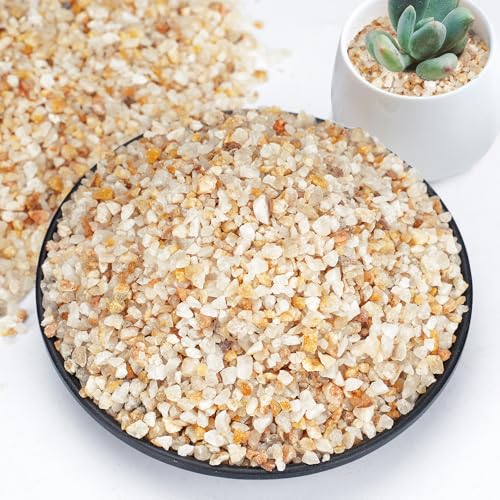
The 6-pound bag makes this the larger-quantity pick among the two 1–2 mm choices. The sand has naturally varied shapes and an off-white color; the maker describes it for use on top of or at the bottom of plants, as well as for vases, terrariums and aquariums. That breadth suits gardeners who want one material for plant and decorative projects. The specifications do not give a soil-mixing proportion, so gardeners planning to blend it into a potting mix should decide the ratio based on the mix’s texture rather than assume the proportion suggested for another sand.
Bottom line: Pick this when 1–2 mm grains and a 6-pound quantity matter most.
SHIZWU 2–4 mm Natural Pebbles, 5 lb

Unlike the 1–2 mm sands, this 5-pound bag contains polished natural pebbles sized 2–4 mm, making it the coarser plant-dressing option. The maker says the gravel is unwaxed and intended for succulent and potted-plant paving, as well as aquarium and vase decoration. It can suit a visible top layer where larger grains are desired. Its pebble form and polish make it less directly comparable to a finer sand intended for blending through potting soil; choose it for the surface appearance and grain size rather than relying on it as a complete drainage fix.
Bottom line: Choose this for a coarser, polished surface layer around potted plants.
How to Choose Coarse Sand for Plants
Start with the grain size and whether the sand will be mixed into the potting medium or used as a surface layer. The 1–2 mm options here are finer than grains measuring 2–4 mm or about 3.0–5.1 mm; that distinction matters more for texture than the word “coarse” alone. Sand does not replace a free-draining potting mix or drainage holes. For a succulent or cactus container, choose a mix formulated for those plants and use an amendment only when it improves the mix’s structure. A practical decision rule is to select a product with a particle size when you intend to blend it into soil; choose by appearance when the goal is a decorative top dressing.
Sand Grain Size and Potting Mix Texture
Particle size affects how a mineral material behaves among potting-medium particles. Fine sand can fill larger air spaces and leave a dense mix, so a visible grain size is more useful than a product name when choosing an amendment. A typical coarse horticultural grit is around 1–3 mm, while the 1–2 mm sands here sit toward the finer end of that range. Do not assume that adding sand automatically improves drainage: the overall mix, container depth and drainage opening also determine how water moves. Use a gritty, free-draining medium for plants that need it, and avoid making a heavy potting mix denser by adding an excessive amount of fine material.
Mixing Sand Versus Using a Top Dressing
Mixing sand through potting soil changes the medium’s texture, while a surface layer mainly covers the soil and affects appearance. The 1–2 mm products are presented for mixing as well as decorative use; polished pebbles and larger grains are more clearly suited to a visible layer. Keep decorative material from blocking the pot’s drainage opening, and don’t put a layer of rocks at the bottom as a drainage shortcut. Water can collect above a coarse layer instead of draining freely from the root zone. A simple choice guide is below.
| Need | Choose by |
|---|---|
| Blend into a plant mix | Measured 1–2 mm grit |
| Cover soil decoratively | Color and visible grain size |
| Prepare several projects | Bag weight and intended coverage |
Watering and Drainage Mistakes to Avoid
Use pots with drainage holes for plants that cannot tolerate standing water, and empty any saucer after excess water drains. A coarse surface dressing does not correct a potting mix that stays wet for too long, and watering schedules should respond to how quickly the root zone dries. Check moisture below the surface rather than judging only by a dry-looking top layer. When repotting, keep the original root ball at a similar depth and avoid compressing the mix tightly around roots. For indoor plants, a saucer or cachepot should not leave the nursery pot sitting in water; decorative sand and gravel do not make that setup safe from waterlogging.
Frequently Asked Questions
What grain size is coarse sand for plants?
A practical coarse horticultural grit range is roughly 1–3 mm, though product labels vary. Choose a particle size when you plan to mix it through potting soil.
Can I mix sand into potting soil for succulents?
Yes, but use a gritty, free-draining mix and avoid adding fine sand that can fill air spaces and make the medium denser. A pot with drainage holes remains important for succulents.
Does sand at the bottom of a pot improve drainage?
No; a coarse layer below finer potting mix can leave water perched above the layer rather than improve drainage from the root zone. Use a draining pot and a suitable mix instead.
Should sand cover the top of plant soil?
A surface layer can cover soil for decorative purposes, but keep the pot’s drainage opening clear. Check moisture below the layer because a dry-looking top does not show whether the root zone needs water.
How much sand should I add to potting soil?
There is no universal proportion because potting mixes and plants differ; one supplied product suggests 1 part sand to 3 parts potting soil. Treat that as the maker’s guidance and avoid using the ratio automatically with a different sand or mix.