
Kitchen Rail With Hooks: 4 Wall Rails Compared

For a kitchen rail with hooks, Dseap 15.75-Inch Rail, 8 Hooks suits most kitchens that need a compact 15.75-inch rail with eight hooks. Choose a longer rail if you have more wall space or larger cookware, or a mug-focused rack if cups are the main items to hang.
A kitchen rail is a wall-mounted bar that holds hanging items on individual hooks; the products here differ in length, material, and hook count.
We earn a commission if you buy through links on this page. As an Amazon Associate I earn from qualifying purchases. Products are compared on manufacturer specifications, not hands-on testing.
- Best overall: Dseap 15.75-Inch Rail, 8 Hooks – Its 15.75-inch rail comes with eight hooks and is made of 6063 aluminum.
- Best for a 22-inch span: YIGUANXIN 22-Inch Rail, 5 Hooks – The 22-inch stainless-steel rail includes five detachable hooks.
- Best for more hooks: NEWRAIN 21-Inch Rail, 10 Hooks – It pairs a 21-inch stainless-steel rail with 10 adjustable S-hooks.
- Best for a long wall run: ROTHLEY 39.4-Inch Pot Rack, 8 Hooks – The 39.4-inch stainless-steel rail has eight adjustable S-hooks.
| Product | Best for | Rail length | Hook count | Material | Shop |
|---|---|---|---|---|---|
| Dseap 15.75-Inch Rail, 8 Hooks | Compact utensil storage | 15.75 in | 8 | 6063 aluminum | Check Price on Amazon |
| YIGUANXIN 22-Inch Rail, 5 Hooks | Stainless steel option | 22 in | 5 detachable | Stainless steel | Check Price on Amazon |
| NEWRAIN 21-Inch Rail, 10 Hooks | Maximum hook count | 21 in | 10 adjustable | Stainless steel | Check Price on Amazon |
| ROTHLEY 39.4-Inch Pot Rack, 8 Hooks | Long wall sections | 39.4 in | 8 adjustable | Stainless steel | Check Price on Amazon |
Kitchen rails with hooks
Compare rail length, hook count, and construction to match the bar to your wall space and hanging items.
Dseap 15.75-Inch Rail, 8 Hooks

At 15.75 inches long, this rail is the compact option for a short stretch of wall, while its eight S-hooks provide separate hanging points for utensils or mugs. The rail is made from 6063 aluminum and comes in antique copper. The maker says it can hold up to 22 pounds. Its shorter length suits smaller spaces; choose a longer bar if you need more room between several large pans or handles. Mounting hardware is included.
Bottom line: Choose this for a short wall section and a higher hook count in a compact rail.
YIGUANXIN 22-Inch Rail, 5 Hooks

This 22-inch rail offers a brushed-gold stainless-steel option with five detachable hooks, distinguishing it from the shorter aluminum rail and the longer cookware bars. The maker says the steel is rust resistant and suitable for hanging cookware, towels, clothing, or bags. It can also serve as a towel or pot-lid rack, so it fits a kitchen where the hanging items may change. Five hooks give less separation capacity than rails with eight or 10; count the items you plan to hang before choosing it.
Bottom line: Pick this when a 22-inch stainless-steel bar and detachable hooks fit your hanging needs.
NEWRAIN 21-Inch Rail, 10 Hooks

With 10 adjustable S-hooks on a 21-inch stainless-steel rail, this option provides the most hanging points among the compact bars here. The maker says the steel is rust- and corrosion-resistant and describes the frame as suitable for heavy cast-iron pots. Sliding hooks let you change their spacing to suit different items. That flexibility is useful when a rail holds a mix of cookware and utensils, but closely spaced hooks can still crowd bulky handles; check the clearance each item needs before mounting.
Bottom line: Choose this if you want 10 movable hooks on a 21-inch stainless-steel rail.
ROTHLEY 39.4-Inch Pot Rack, 8 Hooks
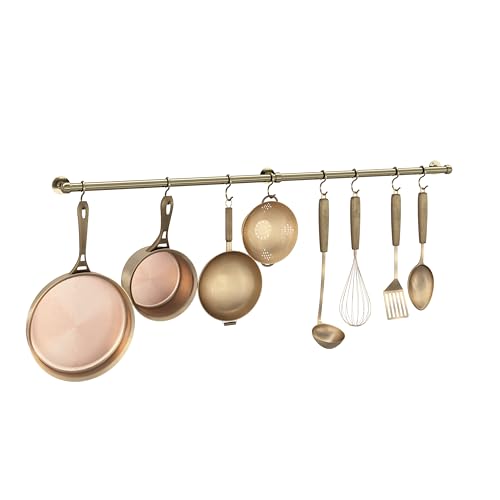
At 39.4 inches, this is the longest rail in the group and is aimed at a longer wall run for pots, pans, spatulas, and bakeware. The stainless-steel tube uses two wall brackets and a connecting bracket, and the eight S-hooks slide for adjustable spacing. That length can spread cookware across more wall space, but it needs a clear mounting area wide enough for the full rail. Its larger bracket arrangement also makes locating suitable mounting points important before installation.
Bottom line: Pick this for a long, clear wall section and cookware that benefits from adjustable hook spacing.
How to choose a kitchen rail with hooks
Choose a rail by measuring the usable wall span, counting hanging items, and allowing room for handles to clear one another. Lengths in this group range from 15.75 to 39.4 inches, while hook counts range from five to 10. A rail with more hooks does not necessarily provide more room per item: bulky pans need wider gaps than slim utensils. For a 22-inch or shorter wall space, the 15.75-, 21-, and 22-inch options fit the length; reserve the 39.4-inch rail for a longer run. Also account for nearby cabinet doors, appliance controls, and the swing of hanging cookware before settling on a mounting location.
Mounting a wall rail safely
Mount a loaded rail into wall studs when possible; if studs do not align with the brackets, use wall anchors rated for the combined load and wall material. Drywall anchors and masonry anchors are not interchangeable, and a rail’s capacity does not make an unsuitable anchor safe. Add up the weight of the rail and everything you plan to hang, then keep the total within the maker’s capacity. Only one product here gives a capacity figure, so confirm the supported load before hanging heavy cookware on another rail. Keep the rail away from hot burners and leave enough clearance that hanging handles cannot contact a flame or hot surface.
Plan hook spacing for cookware and utensils
Hook spacing should reflect what hangs from the rail: long-handled tools can sit closer together than wide pans. Measure the widest pan or handle, then use that width as a minimum spacing guide; add clearance if handles overlap or items need to be lifted off independently. Sliding or detachable hooks make rearranging easier, but fixed positions can still work for a consistent utensil set. A 10-hook rail is not automatically the best choice if the wall span is short and the cookware is bulky. Before drilling, mark the planned hook positions on the wall and check that the items can hang without touching counters or one another.
Compare rail lengths and hook layouts
Rail length gives a quick first screen, while hook count indicates how many separate hanging points come with the bar. Use this guide to narrow options, then match the hook spacing to the shapes and sizes of the items.
| Need | Rail to consider | Reason |
|---|---|---|
| Short wall span | 15.75-inch rail | Shortest rail; eight hooks |
| More hanging points | 21-inch rail | Ten adjustable hooks |
| Long wall run | 39.4-inch rail | Longest rail; eight adjustable hooks |
Frequently Asked Questions
How much weight can a kitchen rail with hooks hold?
Capacity depends on the rail, brackets, anchors, and wall material. One rail here has a maker-stated maximum of 22 pounds; verify the capacity and mounting requirements for the rail you choose before hanging heavy pans.
Should I mount a kitchen rail into a wall stud?
Yes, mounting into studs is a sound choice when bracket positions allow it. Otherwise, use anchors rated for the combined load and the specific wall material; drywall and masonry require different anchors.
How far apart should hooks be on a pot rail?
Space hooks at least as far apart as the widest pan or handle they will hold, then add clearance so adjacent cookware can be lifted separately. Large pans need wider gaps than narrow utensils.
Can kitchen rails hold cast-iron pans?
A rail can hold cast iron only if its rated capacity and mounting system support the combined load. Add the weight of every pan and the rail, and confirm the wall anchors are rated for that load before hanging them.
Where should I place a kitchen utensil rail?
Place it where hanging items stay clear of burners, hot surfaces, and cabinet doors. Measure the rail’s full length and the hanging items’ drop before drilling, and avoid locations where cookware could contact a flame.